Soundbreak Gypsum Board vs Alternatives: Which Acoustic Wall Wins?
Compare soundbreak gypsum board against MLV, resilient channels, and double stud walls. Find the best STC-rated acoustic drywall for your project.

The Physics of Damping: How Soundbreak Gypsum Board Works
Acoustic separation in modern construction relies on three fundamental principles: mass, decoupling, and damping. While traditional methods focus heavily on adding mass or creating physical air gaps, soundbreak gypsum board introduces constrained layer damping directly into the wall assembly. Products like National Gypsum SoundBreak XP and CertainTeed SilentFX QuickCut utilize a viscoelastic polymer core sandwiched between two layers of high-density gypsum.
When sound waves strike the wall, the shear forces generated within the polymer layer convert acoustic energy into negligible amounts of thermal energy. This damping effect specifically targets the low-to-mid frequency coincidence dip—a notorious weak point in standard rigid drywall where sound transmission spikes. By integrating the damping mechanism directly into the panel, soundbreak gypsum board achieves Sound Transmission Class (STC) ratings of 50 to 54 on a standard single wood-stud wall, compared to an STC of 33 to 35 for standard 5/8-inch drywall.
Head-to-Head Matrix: Soundbreak vs. Acoustic Alternatives
Choosing the right acoustic assembly requires balancing STC performance, spatial footprint, material costs, and labor intensity. The following matrix compares soundbreak gypsum board against the three most common acoustic alternatives used in residential and commercial framing.
| Assembly Type | Expected STC | Added Thickness | Material Cost (per sq ft) | Labor Factor | Best Application |
|---|---|---|---|---|---|
| Soundbreak Gypsum (5/8") | 50 - 54 | 0.625" | $0.85 - $1.15 | Standard (1x) | Retrofits, space-constrained multi-family, hotel corridors |
| Standard Drywall + MLV (1 lb) | 45 - 48 | 0.75" | $1.20 - $1.60 | High (1.5x) | Home theaters, recording studios requiring mass |
| Standard Drywall + RC-1 Channel | 42 - 46 | 1.125" | $0.55 - $0.70 | High (1.4x) | Budget commercial builds, basement ceiling decoupling |
| Decoupled Double Stud Wall | 55 - 63 | 1.5" - 3.0" | $0.70 - $0.90 | Very High (2.5x) | New construction, luxury condos, critical isolation |
Evaluating the Alternatives (And Their Hidden Flaws)
Mass Loaded Vinyl (MLV)
MLV is a limp-mass barrier that blocks sound through sheer density. While effective at stopping high-frequency airborne noise, MLV requires meticulous installation. It must be hung loosely to remain 'limp'; if it is stretched tight or pinned rigidly to the studs, it loses up to 40% of its acoustic efficacy. Furthermore, MLV adds significant weight to the assembly and requires a secondary layer of standard drywall over it to provide a paintable surface, driving up both material and labor costs well beyond that of a single layer of soundbreak gypsum board.
Resilient Channels (RC-1)
Resilient channels attempt to decouple the drywall from the framing. In laboratory settings, RC-1 channels perform brilliantly. In the field, they are notorious for failure. The most common error is the 'short-circuit'—a drywall screw driven slightly too deep, penetrating the channel and biting into the wood or metal stud behind it. A single short-circuited screw can drop the assembly's STC rating by 10 to 15 points, effectively rendering the acoustic treatment useless. Soundbreak gypsum board eliminates this risk entirely because it does not rely on decoupling to achieve its primary damping performance.
Decoupled Double Stud Walls
Building two independent stud walls with an air gap is the gold standard for low-frequency isolation (Impact Insulation Class and low-Hz STC). However, this method consumes 4 to 6 inches of valuable floor space per partition. In high-density urban multi-family projects or commercial retrofits where square footage directly correlates to revenue, sacrificing floor space for acoustics is often financially unviable. Additionally, the framing labor for double stud walls is more than double that of a single stud wall.
The 2026 Cost-Benefit Decision Framework
Choose Soundbreak Gypsum Board if:
- You are retrofitting an existing space and cannot afford to lose floor area.
- Labor rates in your market exceed $85/hour, making complex decoupling assemblies cost-prohibitive.
- You need a reliable STC 50+ rating without risking resilient channel short-circuits.
Choose Double Stud / Decoupled Assemblies if:
- You are framing a dedicated home theater or recording studio requiring STC 60+ and IIC isolation.
- Low-frequency bass transmission (subwoofers, HVAC rumble) is the primary acoustic threat.
- Floor space constraints are non-existent (new construction).
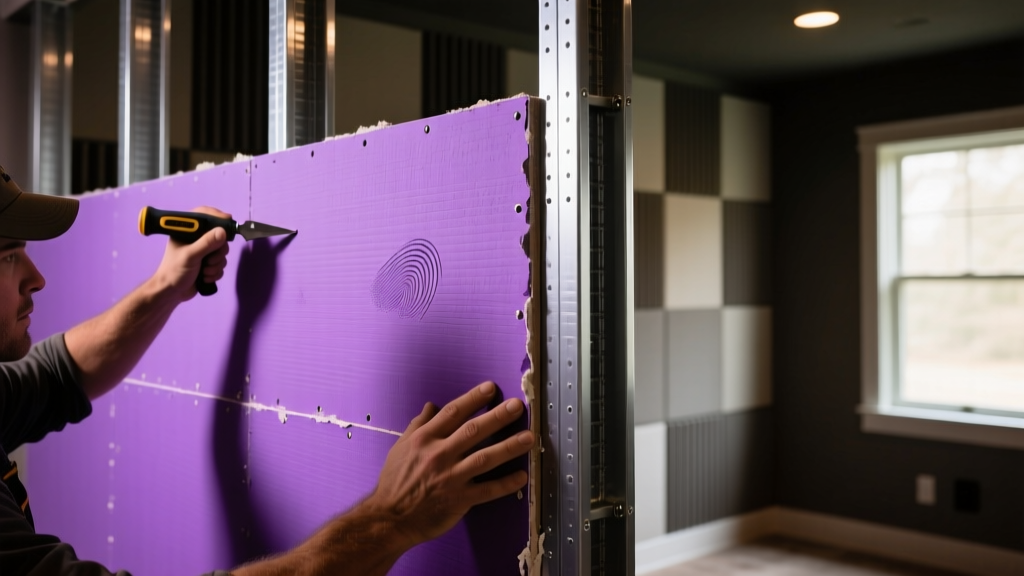
Critical Installation Failures That Void Your STC Rating
Acoustic separation is a binary system: it only works if the envelope is completely sealed. Upgrading to premium soundbreak gypsum board will not yield the expected STC 50+ performance if the following installation details are ignored.
- Unsealed Electrical Boxes: Standard plastic electrical boxes act as acoustic megaphones. If back-to-back boxes are installed on a shared soundbreak wall, the STC rating will plummet. You must use acoustic putty pads (like STI SpecSeal) or stagger the boxes by at least 24 inches on separate studs.
- Perimeter Flanking: The drywall must not touch the floor or the ceiling deck rigidly. Leave a 1/4-inch gap at all perimeters and fill it with a non-hardening acoustical sealant (e.g., Tremco Acoustical Sealant). Hardening joint compound will crack and transmit vibration.
- Rigid HVAC Penetrations: If a rigid sheet metal duct passes through the soundbreak partition, it creates a direct structural bridge. Use flexible duct connectors or wrap the penetration in acoustic lagging to maintain the wall's integrity.
- Improper Screw Patterns: While soundbreak board doesn't rely on decoupling, over-driving screws breaks the paper face and compromises the polymer core's shear strength. Use specialized acoustic drywall screws with self-dimpling heads to ensure the screw sits perfectly flush without tearing the face paper.
Ultimately, soundbreak gypsum board represents a shift from labor-intensive acoustic assemblies to material-science solutions. By paying a premium of roughly $0.50 to $0.70 per square foot over standard drywall, contractors eliminate the spatial penalties of double stud walls and the catastrophic failure risks of resilient channels, delivering predictable, high-performance acoustic separation in modern building envelopes.
Written by
Sarah WhitfieldSarah Whitfield is a chartered quantity surveyor (MRICS) and construction cost analyst with 15 years of experience in material pricing, procurement strategy, and project budgeting. She earned her degree in Construction Management from the University of Reading (UK) and has worked on projects ranging from $2M custom homes to $180M mixed-use developments across North America and Europe. Sarah currently leads cost estimating for BuildMat Insight, maintaining a proprietary database of 4,000+ material price points updated quarterly. She is a frequent contributor to RSMeans cost data panels and has presented at the International Cost Engineering Council (ICEC) congress. Based in Denver, CO, Sarah is an avid trail runner and volunteer mentor for Women in Construction.
More from Sarah Whitfield
View all
Wood & Lumber
What Are the Different Types of Wood? A Builder's Guide
Compare structural softwoods, finish hardwoods, and engineered lumber. Analyze Janka ratings, MOE values, and 2026 pricing for construction.
Aug 4, 2026

Walls & Panels
Steel Framing vs Wood Framing: Corrosion and Moisture Defense
Compare steel framing vs wood framing for moisture resistance. Learn about galvanized coatings, condensation risks, and corrosion protection strategies.
Jul 21, 2026

Stone & Masonry
How to Cut Stone Veneer: Wet Saw vs Grinder Comparison
Compare the best tools for cutting stone veneer. We review wet saws, angle grinders, and chop saws to help you achieve clean, chip-free cuts.
Jul 21, 2026