SoundBreak XP Gypsum Board Cost Analysis and Pricing Guide 2026
Detailed 2026 cost analysis of SoundBreak XP gypsum board. Compare material prices, labor premiums, STC ratings, and ROI against standard drywall alternatives.

The True Cost of SoundBreak XP in 2026
Specifying acoustic drywall for multi-family residential, boutique hospitality, or high-end home theater projects requires balancing decibel reduction against strict budget constraints. National Gypsum's SoundBreak XP gypsum board remains a dominant player in this space, utilizing a constrained-layer damping (CLD) polymer core sandwiched between two high-density gypsum layers. But how does the premium material cost translate to total installed assembly costs?
Unlike standard 5/8-inch Type X drywall, SoundBreak XP requires specialized handling, specific fastening patterns, and complementary acoustic sealants to achieve its published Sound Transmission Class (STC) ratings. According to National Gypsum's SoundBreak XP specifications, the board is engineered to reduce sound transmission by up to 90% compared to standard drywall assemblies, but achieving those metrics in the field dictates the true project cost.
2026 Baseline Material Pricing
The prices below reflect Q1 2026 national averages for commercial distributors. Regional fluctuations of 8-12% should be expected based on local freight surcharges and supply chain variables.
| Material Component | Specification | Unit Cost (2026) | Cost per Sq. Ft. |
|---|---|---|---|
| SoundBreak XP | 5/8 in. Fire-Shield (4x8) | $38.00 - $46.00 / sheet | $1.18 - $1.43 |
| SoundBreak XP | 5/8 in. Fire-Shield (4x12) | $58.00 - $68.00 / sheet | $1.20 - $1.41 |
| Acoustical Sealant | 28 oz. cartridge (non-hardening) | $7.50 - $10.00 / tube | $0.08 - $0.12 (linear) |
| Electrical Putty Pads | Single-gang acoustic barrier | $3.50 - $5.00 / pad | N/A |
| Resilient Channel | 25-gauge RC-1 | $4.50 - $6.00 / 12ft piece | $0.15 - $0.20 |
Material vs. Assembly: Where Your Budget Actually Goes
The most common budgeting error in acoustic design is isolating the cost of the drywall panel while ignoring the assembly. A $42 sheet of SoundBreak XP will not yield an STC 50+ rating if installed on standard 16-inch on-center (O.C.) wood studs with rigid perimeter connections. The Gypsum Association emphasizes that acoustic performance is a system-level metric, not a material-level metric.
If you omit non-hardening acoustical sealant at the top and bottom plates, or if HVAC ductwork bridges the partition cavity, your STC rating will drop by 10 to 15 points. The $0.10 per linear foot cost of acoustic sealant is non-negotiable. A $4,000 investment in premium acoustic board is entirely negated by a $50 savings on standard painter's caulk.
Hidden Cost Drivers in Acoustic Framing
- Staggered Stud Framing: Upgrading from standard 2x4 studs to staggered 2x6 plate framing increases lumber costs by $1.10 to $1.40 per square foot of wall area, but is required to reach STC 55+ with single-layer SoundBreak XP.
- Electrical Box Staggering: Back-to-back electrical outlets create a direct acoustic flanking path. Code-compliant acoustic designs require boxes to be staggered by at least 24 inches horizontally, or wrapped in $4.00 acoustic putty pads. For a 200-unit hotel, putty pads and shifted framing add $2,500 to $4,000 in labor and materials.
- Insulation Density: Standard R-13 fiberglass batts are insufficient. Acoustic assemblies require mineral wool (e.g., Rockwool Safe'n'Sound), which costs approximately $0.65 to $0.85 per square foot, compared to $0.35 for standard fiberglass.
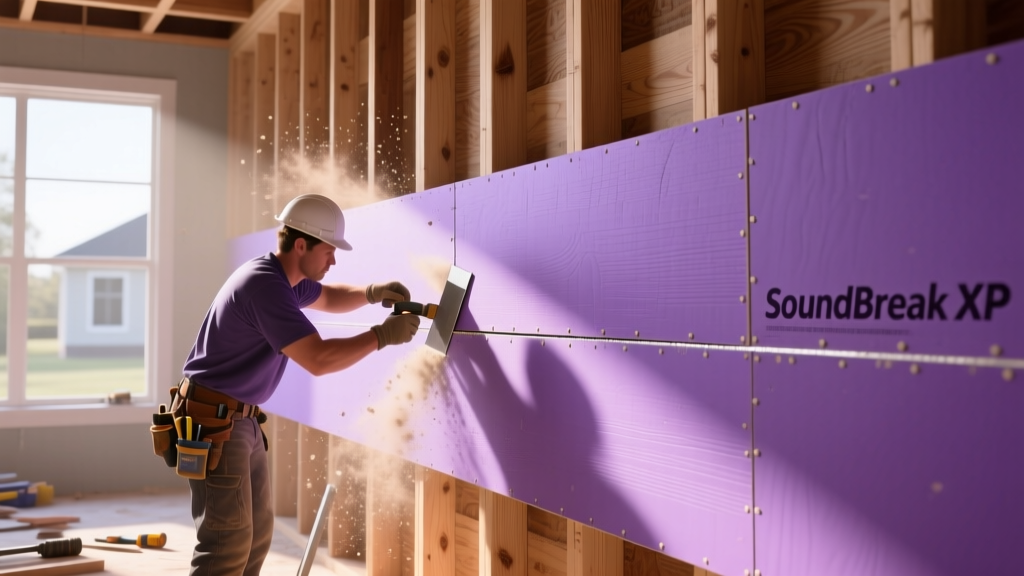
SoundBreak XP vs. Competitors: A Cost-to-STC Matrix
When evaluating the cost-effectiveness of SoundBreak XP, it must be benchmarked against the two primary market alternatives: standard Type X drywall paired with viscoelastic damping compounds (Green Glue), and pre-damped competitor panels like QuietRock.
| Product System | Material Cost / Sq. Ft. | Assembly Weight | STC Rating (Wood Stud + R-13) | Fire Rating |
|---|---|---|---|---|
| SoundBreak XP 5/8" (1-Layer) | $1.30 | 2.4 lbs/sq ft | 50 - 52 | 1-Hour (Type X) |
| QuietRock 510 ES 5/8" (1-Layer) | $1.55 - $1.75 | 2.6 lbs/sq ft | 50 - 53 | 1-Hour (Type X) |
| Standard 5/8" Type X + Green Glue | $1.15 (Board + Compound) | 3.8 lbs/sq ft (2 layers) | 52 - 55 | 1-Hour (Type X) |
| Standard 5/8" Type X (Baseline) | $0.50 - $0.60 | 2.2 lbs/sq ft | 35 - 38 | 1-Hour (Type X) |
Analysis: SoundBreak XP occupies the 'value-performance' sweet spot. It is roughly 15-20% cheaper per square foot than equivalent pre-damped competitor boards. While the Standard Type X + Green Glue system is slightly cheaper on raw materials and yields a marginally higher STC due to the mass of two gypsum layers, it requires hanging, screwing, and finishing two full layers of drywall. The labor savings of hanging a single layer of SoundBreak XP almost always offsets its higher per-sheet material cost in commercial applications.
Labor Premiums and Installation Timelines
Acoustic drywall is not installed identically to standard board. The Acoustical Society of America frequently notes that improper field installation is the leading cause of acoustic failure in multi-family construction. Contractors must account for specific labor premiums when bidding SoundBreak XP projects.
Cutting and Handling Realities
The viscoelastic polymer core inside SoundBreak XP does not snap cleanly like standard gypsum. When a contractor scores the face paper and snaps the board, the polymer layer remains intact and must be cut through with a heavy-duty utility knife or a specialized drywall saw.
Standard drywall blades will gum up and dull rapidly against the polymer core. Mandate the use of carbide-tipped scoring tools and budget for a 30% increase in blade consumption. Furthermore, the 5/8-inch SoundBreak XP panel weighs approximately 76 pounds per 4x8 sheet. While manageable, it requires two-person handling or a mechanical drywall lift, slowing the hanging phase by roughly 10-15% compared to lightweight standard boards.
Labor Cost Adjustments
Expect drywall hanging labor to increase from the national average of $1.60 per square foot to $2.10 - $2.40 per square foot. This premium covers the slower cutting process, the application of acoustic sealant at all perimeters and penetrations, and the strict screw-pattern adherence required to maintain the fire and acoustic ratings. Taping and finishing costs remain largely unchanged, as the tapered edges behave identically to standard gypsum board.
ROI Analysis: When is the Premium Justified?
Specifying SoundBreak XP is an exercise in risk mitigation and asset valuation. The decision framework below outlines when the 2026 material premiums yield a positive return on investment.
- Multi-Family Residential (Class A & B): Highly Justified. Acoustic complaints are the number one driver of tenant turnover in multi-family housing. Spending an additional $1.20 per square foot on demising walls to achieve STC 50+ reduces turnover costs and justifies premium rental rates.
- Boutique Hotels & Extended Stay: Highly Justified. Guest satisfaction scores are directly correlated to room-to-room noise isolation. The single-layer installation speed of SoundBreak XP keeps construction timelines on track while meeting strict brand acoustic standards.
- Home Theaters & Recording Studios: Moderately Justified. While SoundBreak XP is an excellent base layer, critical listening environments usually require decoupled room-within-a-room assemblies. Here, standard heavy drywall with Green Glue might offer better low-frequency damping for the budget.
- Standard Commercial Office Partitions: Low Justification. Unless separating executive boardrooms or HR offices from open-plan bullpens, standard 5/8-inch Type X with ceiling baffling provides adequate privacy at a fraction of the cost.
Ultimately, the cost of SoundBreak XP gypsum board in 2026 is best viewed not as a line-item material expense, but as an insurance policy against acoustic callbacks, tenant disputes, and code-compliance failures. By pairing the board with proper mineral wool insulation, resilient framing, and rigorous perimeter sealing, developers secure long-term asset value that far exceeds the initial upfront premium.
Written by
Marcus ChenMarcus Chen is a licensed structural engineer (PE) and building materials analyst with over 12 years of experience across residential, commercial, and industrial construction. He holds a Master of Science in Civil Engineering from UC Berkeley and spent six years at Thornton Tomasetti before transitioning to independent consulting and technical writing. Marcus specializes in material selection for seismic-prone regions, concrete reinforcement strategies, and lifecycle cost analysis. His work has been cited by the American Concrete Institute (ACI) and the Structural Engineers Association of California (SEAOC). When he is not on a job site or at his desk, you will find him hiking the Sierra Nevada or restoring a 1920s craftsman bungalow in Oakland, CA.
More from Marcus Chen
View all
Construction Cost
How Much Did the Eiffel Tower Cost to Build?
How much did the Eiffel Tower cost to build in 1889? We adjust for inflation and compare its budget to modern skyscraper construction.
Aug 4, 2026

Fire Resistance
What Is a Fire Resistant Material? Testing & Certification Guide
Discover what is a fire resistant material through ASTM and UL testing. Learn how fire ratings, certifications, and assemblies work in construction.
Aug 4, 2026

Construction Cost
How Much Did the Burj Khalifa Cost to Build?
How much did the Burj Khalifa cost to build? We break down the $1.5B project and extract 5 money-saving strategies for your next build.
Jul 30, 2026