Type X Gypsum Board vs Fire-Rated Alternatives Compared
Compare Type X gypsum board against Type C, cement board, and calcium silicate. Find the best fire-rated wall assembly for your 2026 project.

The Core Anatomy of Type X Gypsum Board
To understand why type x gypsum board remains the baseline for commercial and multi-family residential fire separations, you must look at its chemical composition. Standard gypsum (calcium sulfate dihydrate) contains approximately 21% chemically combined water. When exposed to fire, this water undergoes calcination—converting to steam and absorbing massive amounts of thermal energy. This phase change keeps the unexposed side of the board near 212°F (100°C) until all free water is driven off.
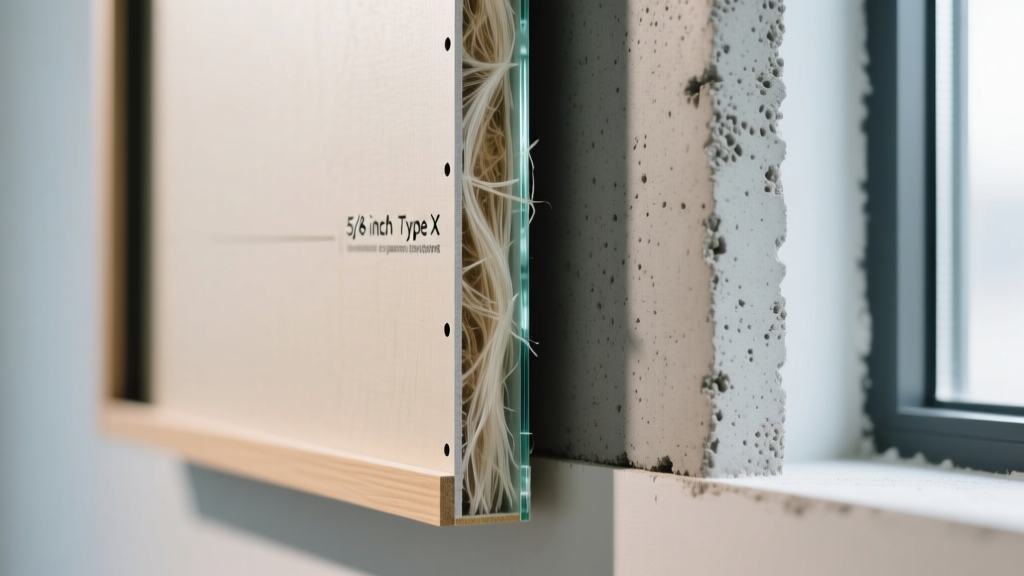
The critical differentiator for Type X (typically 5/8-inch thick) is the inclusion of glass fibers and other additives within the core. In standard 1/2-inch drywall, the calcined gypsum core shrinks and cracks once the water is depleted, causing the board to collapse off the framing and exposing the cavity to flames. The glass fibers in Type X act as a structural mesh, holding the calcined core intact for a minimum of one hour under the rigorous ASTM E119 time-temperature curve.
Head-to-Head Matrix: Type X vs. Fire-Rated Alternatives
Selecting a fire barrier requires balancing hourly rating requirements, spatial constraints, and material costs. The table below compares Type X against its primary market alternatives for 2026 construction projects.
| Material | Thickness for 1-Hour Rating | Core Composition | Approx. Cost per 4x8 Sheet (2026) | Primary Application |
|---|---|---|---|---|
| Type X Gypsum | 5/8" (Single layer per side) | Gypsum + Glass Fibers | $19.00 - $24.00 | Shaft walls, corridor partitions, garage ceilings |
| Type C Gypsum | 1/2" (Enhanced) or 5/8" | Gypsum + Glass Fibers + Vermiculite | $26.00 - $34.00 | Space-constrained 2-hour assemblies, area separation walls |
| Cement Board | N/A (Fails ASTM E119 alone) | Portland Cement + Fiberglass Mesh | $14.00 - $18.00 | Wet areas, exterior cladding substrate (not primary fire block) |
| Calcium Silicate | 1" to 2" (Varies by temp) | Calcium Silicate Hydrate | $85.00 - $120.00+ | Industrial high-heat, commercial kitchen hood enclosures |
Deep Dive: When to Choose Type C Over Type X
While type x gypsum board handles standard 1-hour and 2-hour assemblies (like UL Design U305 or U419) efficiently, it has a physical limitation: core shrinkage at extreme temperatures. Type C gypsum board (such as USG Sheetrock Brand Firecode Core or CertainTeed Firestop) solves this by incorporating unexpanded vermiculite.
When exposed to intense heat, the vermiculite expands, compensating for the shrinkage of the calcined gypsum core. This allows Type C to achieve the same 1-hour fire rating at a thinner 1/2-inch profile, or to achieve 2-hour and 3-hour ratings with fewer total layers than Type X. If your architectural plans mandate a 2-hour area separation wall between townhomes but the floor plan leaves only 4 inches for the wall cavity, switching from a multi-layer Type X assembly to a Type C assembly is the most cost-effective spatial solution.
The "Non-Combustible" Trap: Cement Board Misconceptions
A frequent and costly error in commercial construction is assuming that because cement board (like Durock or HardieBacker) is non-combustible, it provides a fire rating. Non-combustible simply means the material will not add fuel to a fire. It does not mean the material insulates against heat transfer.
During an ASTM E119 test, a wall assembly must prevent the unexposed surface from rising more than 250°F above ambient temperature. Cement board has virtually no insulating value at high temperatures. Heat transfers directly through the cement matrix, igniting the wood or steel studs behind it long before the 60-minute mark. Cement board should only be used in fire-rated assemblies when explicitly called out as a protective membrane over combustible framing in highly specific, tested designs, or as a tile backing in wet areas that happen to be within a fire-rated partition.
Calcium Silicate for Extreme Heat Environments
For environments where temperatures exceed the structural limits of gypsum (which completely calcines and loses all structural integrity around 1200°F), calcium silicate boards (such as Promat or Skamol) are required. These boards can withstand continuous exposure to temperatures exceeding 1800°F (1000°C).
You will rarely use calcium silicate in standard commercial partitions due to its high cost (often 5x the price of type x gypsum board) and its brittle, heavy nature, which requires specialized carbide tooling to cut. Its primary domain is enclosing commercial kitchen exhaust ducts, industrial furnace surrounds, and passive fire protection for structural steel beams where intumescent paint is not viable.
Fastening and Assembly Realities
The fire rating of type x gypsum board is entirely dependent on the fastening schedule. A 1-hour rated wood-framed wall typically requires the following strict adherence to the Gypsum Association Fire Design Manual:
- Screw Type: Type W (coarse thread) for wood studs; Type S (fine thread) for steel studs (minimum 20-gauge).
- Screw Length: Minimum 1-5/8" for 5/8" board to ensure adequate penetration into the framing.
- Spacing: Maximum 7 inches on center (o.c.) on walls, and 8 inches o.c. on ceilings. Perimeter fastening must not exceed 8 inches o.c.
- Joint Treatment: All joints must be taped and finished with at least two coats of joint compound. Untaped joints allow superheated gases to penetrate the cavity, destroying the assembly's integrity in minutes.
Decision Framework: Selecting the Right Fire Barrier
Use this practical framework to specify the correct material for your 2026 project:
- Is the requirement a standard 1-hour partition or ceiling? Specify 5/8" Type X. It is the most economical, widely available, and easily finished material for standard commercial corridors and garage separations.
- Is the requirement a 2-hour or 3-hour assembly with strict cavity depth limitations? Specify Type C. The vermiculite core allows for fewer layers, saving framing space and reducing labor costs associated with screwing and taping multiple layers of Type X.
- Is the environment subject to continuous high heat (above 125°F) or direct industrial flame impingement? Abandon gypsum entirely and specify Calcium Silicate or specialized fire-brick assemblies.
- Are you enclosing a wet area (shower/tub) within a fire-rated shaft? Use a specialized glass-mat gypsum panel (like DensGlass or Fiberock Aqua-Tough) that is both moisture-resistant and fire-rated, rather than layering cement board over standard drywall.
Understanding the exact thermal mechanics and code limitations of these materials prevents catastrophic inspection failures and ensures life-safety compliance under the NFPA 101 Life Safety Code.
Written by
Elena RodriguezElena Rodriguez is a civil engineer and technical writer specializing in concrete technology, masonry systems, and ASTM/ACI compliance. She earned her B.S. in Civil Engineering from Texas A&M University and spent a decade at a materials testing laboratory, performing over 2,000 concrete compressive strength tests and masonry prism evaluations. Elena is an ACI-certified Field Testing Technician (Grade I) and a member of ASTM Committee C12 on Natural Building Stone. She currently consults on forensic engineering cases involving concrete failures and moisture intrusion. Based in San Antonio, TX, Elena is a proud member of the Society of Women Engineers (SWE) and coaches her daughter's FIRST Robotics team.
More from Elena Rodriguez
View all
Walls & Panels
Cost Analysis: Light Gauge Steel Framing Advantages and Disadvantages
Evaluate light gauge steel framing advantages and disadvantages through a strict cost analysis lens, comparing material, labor, and lifecycle expenses.
Aug 4, 2026

Walls & Panels
Gypsum Board Types: Exact Specifications, Thickness & Dimensions
Compare standard, Type X, and moisture-resistant gypsum board types. Get exact specifications, thicknesses, dimensions, and ASTM standards for your project.
Aug 4, 2026

Fire Resistance
Best Fire-Resistant Outdoor Decking Materials: 2026 Buyer Guide
Discover the best fire-resistant outdoor decking materials for 2026. Compare Class A PVC, aluminum, and hardwood options for WUI compliance and safety.
Aug 4, 2026