Is Steel Framing Cheaper Than Wood? A Grade-by-Grade Cost Analysis
Discover if steel framing is cheaper than wood. We compare cold-formed steel grades, gauges, labor, and hidden costs to give you a definitive answer.

The Short Answer: Upfront Material Costs vs. Lifetime Value
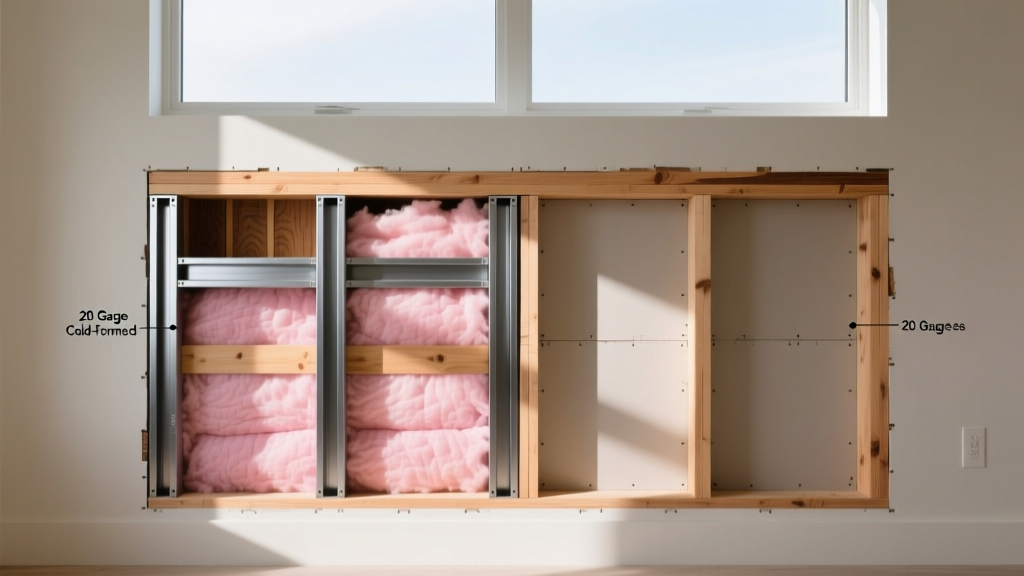
When evaluating whether cold-formed steel (CFS) framing is cheaper than traditional dimensional lumber, the answer depends entirely on the specific steel grade, gauge thickness, and the scale of your project. For non-load-bearing interior walls, light-gauge steel (20-ga to 25-ga) is currently 5% to 12% cheaper per linear foot than standard Spruce-Pine-Fir (SPF) wood studs. However, for load-bearing exterior walls requiring heavy-gauge steel (16-ga to 12-ga), the raw material cost for steel exceeds that of wood by 15% to 25%.
Yet, material price per linear foot is only one variable in the framing equation. To accurately determine if steel framing is cheaper than wood, builders must calculate the total installed cost, factoring in labor efficiency, fastener premiums, waste disposal, and long-term insurance classifications. According to the Steel Framing Industry Association (SFIA), when waste reduction and panelization are applied, steel frequently undercuts wood in total project costs for commercial and multi-family residential builds.
- Non-Load-Bearing (20-ga CFS vs. 2x4 SPF): Steel wins on material cost by ~$0.40 per linear foot.
- Load-Bearing (16-ga CFS vs. 2x6 Douglas Fir): Wood wins on material cost by ~$1.10 per linear foot.
- Total Installed Cost (Multi-Family): Steel wins by 8-14% due to pre-panelization and lower insurance premiums.
How Steel Grades and Gauges Dictate Framing Prices
Unlike wood, which is graded by visual defects and species (e.g., SPF #2 or Douglas Fir-Larch Select Structural), steel framing is engineered to precise metallurgical standards. The governing standard for CFS framing members is ASTM A1003. The cost of your steel studs is directly tied to the yield strength (grade) and the thickness (gauge).
Grade 33 vs. Grade 50 Yield Strengths
Cold-formed steel is primarily manufactured in two yield strength grades:
- Grade 33 (33 ksi minimum yield strength): Used predominantly for non-load-bearing applications, such as interior partition walls, soffits, and curtain walls. Because it requires less intensive galvanization and processing, Grade 33 is the most cost-competitive against standard wood studs.
- Grade 50 (50 ksi minimum yield strength): Required for load-bearing walls, roof trusses, and floor joists. The higher yield strength allows engineers to specify thinner gauges of steel to carry the same structural loads, optimizing material weight and cost. However, the base price per ton for Grade 50 coil stock is inherently higher.
Understanding this distinction is critical. If a builder attempts to use cheaper Grade 33 steel in a load-bearing application to beat wood prices, the framing will fail structural engineering inspections and require costly tear-outs.
Material Cost Matrix: Steel Gauges vs. Wood Species
The following table breaks down the average 2026 material costs per linear foot (LF) for the most common framing members. Prices reflect bulk contractor pricing and exclude taxes or delivery surcharges.
| Material Type | Grade / Species | Dimensions | Avg Cost per LF | Primary Application |
|---|---|---|---|---|
| 25-ga CFS Stud | ASTM A1003 Gr. 33 | 1-5/8" x 10' | $1.90 - $2.30 | Non-load-bearing partitions |
| 20-ga CFS Stud | ASTM A1003 Gr. 33 | 2-1/2" x 10' | $2.80 - $3.40 | Interior walls, exterior curtain walls |
| 16-ga CFS Stud | ASTM A1003 Gr. 50 | 3-5/8" x 10' | $5.20 - $6.50 | Load-bearing exterior walls |
| 12-ga CFS Stud | ASTM A1003 Gr. 50 | 6" x 10' | $8.50 - $10.20 | Multi-story load-bearing, shear walls |
| 2x4 Wood Stud | SPF #2 or Better | 1.5" x 3.5" x 10' | $3.40 - $4.20 | Standard interior/exterior walls |
| 2x6 Wood Stud | Douglas Fir-Larch #2 | 1.5" x 5.5" x 10' | $5.50 - $7.10 | Load-bearing exterior, high snow loads |
Hidden Cost Variables: Labor, Fasteners, and Waste
Relying solely on the lumber yard or steel service center invoice provides a distorted view of framing economics. The National Association of Home Builders (NAHB) consistently highlights that labor and site logistics account for over 60% of total framing costs.
The Fastener and Hardware Premium
Wood framing relies on pneumatic nails, which are exceptionally cheap. A 50-lb box of 10d common nails (3-inch) costs roughly $60 and contains approximately 1,400 nails, equating to $0.04 per fastener. Steel framing, however, requires self-drilling tek screws or specialized pneumatic pin tools. A standard #8 x 1-5/8-inch wafer-head self-drilling screw costs between $0.04 and $0.06 in bulk. While the per-unit cost is similar, steel framing often requires more fasteners per connection point, and the labor time to drive screws is marginally slower than firing pneumatic nails, increasing the hardware budget by roughly 8% to 12% compared to wood.
Waste Factor and Scrap Value Recovery
This is where steel framing aggressively reclaims the cost advantage. The American Wood Council (AWC) notes that traditional stick-framing generates 10% to 15% material waste in the form of offcuts, warped boards, and damaged lumber. This waste must be hauled away, incurring dumpster rental and landfill tipping fees (often $50 to $110 per ton in metropolitan areas).
Cold-formed steel, conversely, generates less than 2% waste. Steel studs are cut to exact lengths using aviation snips or chop saws with metal-cutting blades, and the resulting offcuts are 100% recyclable. Scrap metal recyclers typically pay $0.08 to $0.15 per pound for light iron/stud scrap. On a 5,000-square-foot commercial build, the scrap buyback from steel framing can yield $800 to $1,200 in direct revenue, effectively subsidizing the initial material purchase.
Long-Term Financial Implications: Insurance and Maintenance
For developers and commercial builders, the question of whether steel is cheaper than wood extends beyond the construction phase into the operational lifecycle. Building codes classify construction types based on combustibility. Wood framing falls under Type III or Type V (combustible), while steel framing qualifies for Type II (non-combustible) when paired with appropriate fire-rated gypsum board assemblies.
This classification triggers significant financial benefits:
- Builder’s Risk Insurance: During construction, non-combustible steel frames carry a significantly lower risk of catastrophic site fires. Insurers typically discount builder's risk premiums by 15% to 25% for steel-framed projects compared to wood.
- Property Insurance: Upon completion, multi-family and commercial properties framed in steel enjoy lower long-term property insurance rates.
- Maintenance and Durability: Steel does not warp, split, or rot. It is immune to termite damage and moisture-induced mold. This eliminates the costly drywall callbacks associated with wood stud shrinkage and nail pops, which typically occur 6 to 12 months after a wood-framed building is enclosed and climate-controlled.
Decision Framework: When to Choose Cold-Formed Steel Over Wood
To maximize your budget, apply this practical decision matrix when selecting your framing material:
- Choose 20-ga / 25-ga CFS (Grade 33) when: You are framing interior commercial partitions, multi-family residential demising walls, or soffits. The material is cheaper than wood, perfectly straight, and eliminates drywall callbacks for nail pops.
- Choose 16-ga / 12-ga CFS (Grade 50) when: You are building mid-rise multi-family (3 to 5 stories), hotels, or commercial retail spaces where non-combustible Type II construction is required by code or heavily incentivized by insurance underwriters.
- Choose Dimensional Lumber (SPF / Douglas Fir) when: You are building single-family residential homes or low-rise townhomes (Type V construction). The localized availability of lumber, the speed of pneumatic nail framing for complex roof geometries, and the lower skill threshold for residential carpenters make wood the undisputed cost-leader for custom, small-scale residential builds.
Sourcing Strategies and Panelization
If your project economics point toward steel, do not buy sticks and build on-site. The true cost parity between steel and wood is unlocked through pre-panelization. Modern CFS framing is detailed using BIM (Building Information Modeling) software. The digital models are sent directly to roll-forming machines that punch, cut, and label every stud, track, and brace to exact millimeter tolerances.
These components are shipped to the site as flat-packed panels. A crew of four can typically erect pre-panelized steel walls 30% to 40% faster than they can stick-frame wood, drastically reducing labor hours and crane time. When negotiating with CFS suppliers, request quotes that include roll-forming, BIM detailing, and panelization. While this adds a 5% to 8% premium to the raw material invoice, it routinely shaves 20% off the total installed labor budget, cementing steel as the cheaper, more predictable option for scaled construction.
Written by
Elena RodriguezElena Rodriguez is a civil engineer and technical writer specializing in concrete technology, masonry systems, and ASTM/ACI compliance. She earned her B.S. in Civil Engineering from Texas A&M University and spent a decade at a materials testing laboratory, performing over 2,000 concrete compressive strength tests and masonry prism evaluations. Elena is an ACI-certified Field Testing Technician (Grade I) and a member of ASTM Committee C12 on Natural Building Stone. She currently consults on forensic engineering cases involving concrete failures and moisture intrusion. Based in San Antonio, TX, Elena is a proud member of the Society of Women Engineers (SWE) and coaches her daughter's FIRST Robotics team.
More from Elena Rodriguez
View all
Walls & Panels
Cost Analysis: Light Gauge Steel Framing Advantages and Disadvantages
Evaluate light gauge steel framing advantages and disadvantages through a strict cost analysis lens, comparing material, labor, and lifecycle expenses.
Aug 4, 2026

Walls & Panels
Gypsum Board Types: Exact Specifications, Thickness & Dimensions
Compare standard, Type X, and moisture-resistant gypsum board types. Get exact specifications, thicknesses, dimensions, and ASTM standards for your project.
Aug 4, 2026

Fire Resistance
Best Fire-Resistant Outdoor Decking Materials: 2026 Buyer Guide
Discover the best fire-resistant outdoor decking materials for 2026. Compare Class A PVC, aluminum, and hardwood options for WUI compliance and safety.
Aug 4, 2026