Corrosion Guide: Evaluating Light Gauge Steel Framing Manufacturers
Learn how to evaluate light gauge steel framing manufacturers based on galvanization coatings, ZAM technology, and corrosion protection for lasting durability.

The Hidden Cost of Inadequate Corrosion Protection
Specifying light gauge steel framing (LGSF) for commercial or multi-family residential projects requires rigorous attention to corrosion protection. When structural studs degrade due to environmental moisture, the resulting loss of cross-sectional area compromises the axial load capacity of the entire wall assembly. While the base material is identical across the industry, the protective metallurgical coatings applied by different light gauge steel framing manufacturers vary drastically in quality, thickness, and chemical composition.
In 2026, the shift toward advanced ternary alloy coatings has disrupted the traditional galvanized market. Selecting a manufacturer based solely on the lowest linear-foot price often results in field failures, expensive remediation, and premature structural degradation. This guide provides the technical framework required to evaluate manufacturer coating specifications, decode industry standards, and match the correct corrosion protection to your specific environmental exposure category.
Decoding Coating Standards: G60 vs. G90 vs. ZAM
The baseline standard for galvanized steel sheet used in framing is ASTM A653/A653M. Manufacturers purchase steel coil with specific coating designations before roll-forming it into C-studs and U-tracks. The designation refers to the total weight of the zinc coating on both sides of the steel sheet per square foot.
| Coating Designation | Zinc Weight (oz/ft²) | Approx. Thickness (mils) | Cut-Edge Protection | 2026 Cost Premium (vs G60) |
|---|---|---|---|---|
| G60 (Standard) | 0.60 | 0.50 | Poor (Requires field treatment) | Baseline |
| G90 (Heavy) | 0.90 | 0.75 | Fair (Sacrificial depletion is slower) | +$0.12 - $0.18 / linear ft |
| ZAM (Ternary Alloy) | 0.60 - 0.90 | 0.50 - 0.75 | Excellent (Self-healing properties) | +$0.35 - $0.50 / linear ft |
While G60 is sufficient for interior, climate-controlled partition walls (ISO Category C1/C2), it is entirely inadequate for exterior sheathing backing, parapets, or high-humidity zones. G90 provides 50% more zinc mass, extending the time to red rust. However, neither traditional G60 nor G90 solves the fundamental vulnerability of LGSF: the cut edge.
The Cut-Edge Vulnerability and ZAM Technology
When a framer cuts a galvanized stud with a chop saw or aviation snips, the raw, uncoated steel core is exposed. In traditional zinc coatings (G60/G90), the surrounding zinc provides "galvanic sacrificial protection," corroding preferentially to protect the exposed steel. However, in high-moisture environments, this sacrificial layer depletes rapidly, leading to edge-creep rust that undermines the adjacent coating.
Leading light gauge steel framing manufacturers are now adopting ZAM (Zinc-Aluminum-Magnesium) coatings, such as PosMAC or SuperDyma. ZAM introduces approximately 2-3% aluminum and 2-3% magnesium into the zinc bath.
When a ZAM-coated stud is cut, the magnesium in the alloy reacts with moisture and chlorides to form a dense, highly stable layer of zinc hydroxychloride over the exposed edge. Unlike the porous white rust formed by pure zinc, this hydroxychloride layer acts as a physical barrier that halts further oxidation. Field tests demonstrate that ZAM cut-edges can resist red rust in salt-spray environments (ASTM B117) up to 10 times longer than standard G90 galvanized edges.
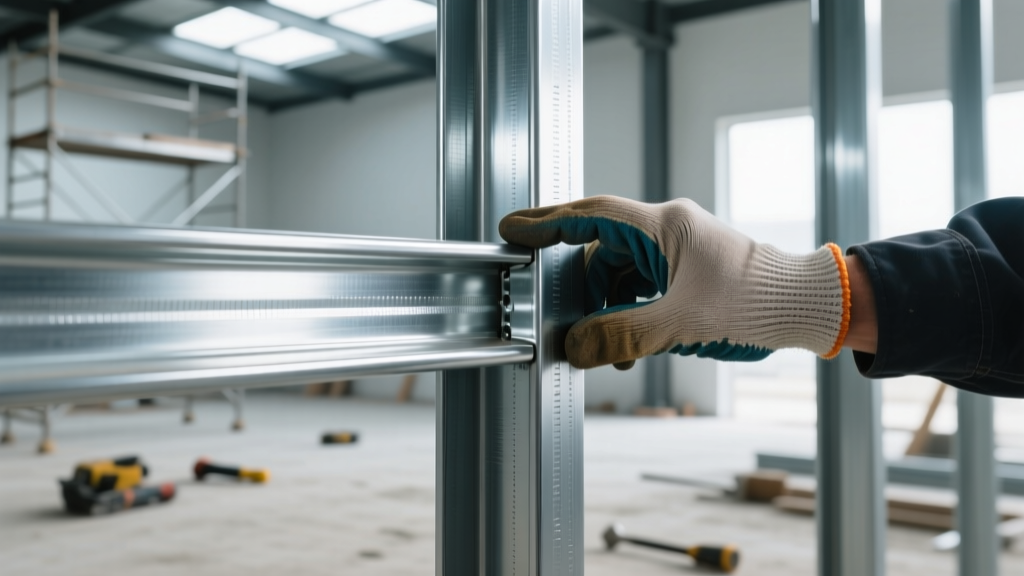
Critical Questions to Ask Light Gauge Steel Framing Manufacturers
When issuing Requests for Proposals (RFPs) for exterior or high-moisture framing packages, do not accept generic "galvanized" descriptions. Require manufacturers to explicitly answer the following technical criteria:
- What is the exact ASTM A653 coating designation? Require mill certificates for the coil stock used for your specific production run, verifying the G90 or ZAM weight.
- Do you apply a post-roll-forming passivation treatment? Passivation (often a chrome-free nanotechnology sealant) prevents "wet storage stain" (white rust) during transit and outdoor staging. Unpassivated G90 steel can develop severe white rust within 72 hours if exposed to condensation under tarpaulins.
- How are punched knockouts and service holes protected? The roll-forming process creates sheer edges at electrical and plumbing knockouts. Ask if the manufacturer uses inline ZAM coil or applies a secondary zinc-rich powder coating to the die-cut edges.
- What is the yield strength of the base metal? Corrosion protection is useless if the steel yields. Ensure the manufacturer uses Grade 50 (50 ksi) or Grade 33 (33 ksi) steel as specified by the structural engineer, conforming to Steel Framing Industry Association (SFIA) guidelines.
Environmental Exposure Mapping: Selecting the Right Spec
Match the manufacturer's coating capabilities to the ISO 12944 environmental corrosivity categories of your project site. Over-specifying wastes budget; under-specifying risks structural failure.
- C1 (Heated buildings, clean atmospheres): Interior demising walls. Specification: G60 minimum. No edge treatment required.
- C2 (Unheated buildings, rural areas): Unconditioned warehouses. Specification: G60 with chromate passivation to prevent storage staining.
- C3 (Urban/industrial, moderate SO2): Exterior backup framing in standard climates. Specification: G90 minimum. Field-applied cold galvanizing compound (zinc dust paint) mandatory on all field cuts.
- C4 (Industrial, coastal moderate): Coastal projects within 1 mile of the surf zone. Specification: ZAM coating (minimum AZ150 / 0.90 oz/ft² equivalent). Eliminates the need for field-applied edge treatments, saving significant labor costs.
- C5 (Offshore, severe industrial): Direct marine splash zones. Specification: LGSF is generally not recommended without secondary encapsulation. If used, require ZAM plus a full liquid-applied elastomeric encapsulation membrane.
Never allow aluminum flashing or copper pipes to rest directly against galvanized or ZAM steel studs. In the presence of an electrolyte (moisture), a galvanic cell is created where the steel or zinc acts as the anode and corrodes rapidly. Manufacturers must supply or specify dielectric separation tapes (e.g., closed-cell polyethylene foam) for all dissimilar metal intersections.
Quality Assurance and Delivery Inspection
Even the best light gauge steel framing manufacturers can suffer supply chain or transit failures. Implement a strict receiving protocol at the job site to verify corrosion protection integrity before the materials are enclosed in the building envelope.
The 5-Point Receiving Checklist
- Visual Spangle Check: Inspect the surface pattern. A uniform, tight spangle indicates proper cooling during the galvanizing process. Large, irregular spangles can indicate uneven coating thickness.
- White Rust Inspection: Look for powdery white deposits between nested studs. This is wet storage stain. While superficial white rust does not immediately compromise structural integrity, it indicates a failure in the manufacturer's passivation process and will complicate drywall adhesion and fire-taping.
- Edge Creep Verification: Examine the cut ends of the bundle. If you see red rust creeping more than 1/16th of an inch from the cut edge on G90 material, the coil may have been exposed to saltwater during overseas shipping.
- Thickness Spot-Check: Use a magnetic or ultrasonic coating thickness gauge on a random sample of 5 studs. Verify the mil thickness matches the manufacturer's claimed G90 (approx. 0.75 mils total) or ZAM specification.
- Bundle Wrapping Integrity: Ensure the manufacturer used VCI (Volatile Corrosion Inhibitor) paper or heavy-duty UV-resistant shrink wrap, rather than standard polyethylene, which traps condensation and accelerates white rust formation during outdoor staging.
By shifting the evaluation criteria from simple linear-foot pricing to a comprehensive analysis of metallurgical coatings, passivation chemistry, and cut-edge protection, project teams can secure framing systems that guarantee long-term structural resilience. Demanding transparency regarding ASTM standards and ZAM capabilities separates elite manufacturers from commodity roll-formers, ultimately protecting the building envelope from concealed degradation.
Written by
David NakamuraDavid Nakamura is a licensed architect (AIA) and construction technology writer focused on sustainable building methods, mass timber engineering, and high-performance building envelopes. He holds a Master of Architecture from the University of Washington and is a certified Passive House Consultant (CPHC). David spent eight years at the Seattle firm Mithun, where he led the design of three LEED Platinum projects, before founding his own practice specializing in net-zero residential design. He serves on the editorial advisory board of GreenBuilder Magazine and has authored peer-reviewed papers on cross-laminated timber (CLT) connections for the Journal of Structural Engineering. In his spare time, David teaches woodworking at Pratt Fine Arts Center and kayaks the Puget Sound.
More from David Nakamura
View all
Construction Cost
Labor Cost to Build a Deck Per Sq Ft: 2026 Installation Guide
Discover the exact labor cost to build a deck per sq ft in 2026. This installation guide breaks down contractor rates, complexity factors, and hidden fees.
Aug 4, 2026

Construction Cost
How Much Does It Cost to Build a 3 Bedroom House? Financing Guide
Learn exactly how much it costs to build a 3 bedroom house and explore 2026 financing options, construction loan types, and budget frameworks for your build.
Aug 4, 2026

Construction Cost
Cost to Build a Tennis Court: 2026 Guide
How much does it cost to build a tennis court in 2026? Breakdowns for asphalt, concrete, and synthetic surfaces plus fencing and lighting.
Jul 30, 2026