Framing Steel Grades Explained: Choosing the Right ASTM Standard
Discover the essential framing steel grades and ASTM standards for construction. Learn how to choose the right structural steel for your building project.

Hot-Rolled Structural Framing Steel: ASTM A992, A500, and A572
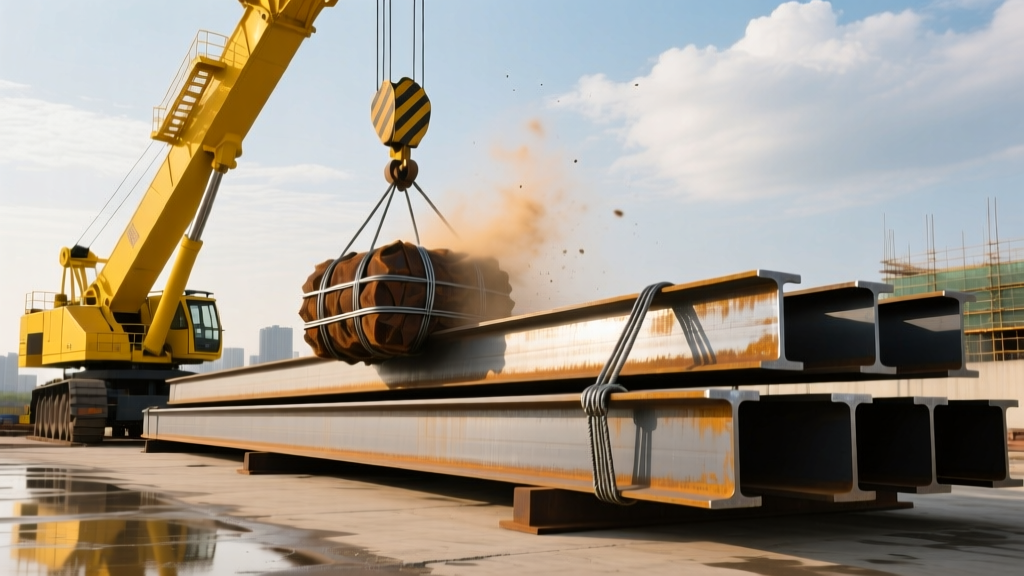
Hot-rolled framing steel forms the primary skeleton of mid-to-high-rise commercial buildings, industrial facilities, and large-span structures. The manufacturing process involves heating steel billets above their recrystallization temperature (typically over 1,700°F) and passing them through rollers to form I-beams, channels, and hollow structural sections (HSS). The American Society for Testing and Materials (ASTM) dictates the chemical and mechanical properties of these shapes.
For modern structural framing, specifying the correct ASTM grade is non-negotiable for ensuring ductility, weldability, and load-bearing capacity. According to the American Institute of Steel Construction (AISC), the industry has largely standardized around three primary grades for hot-rolled framing members.
| ASTM Grade | Min. Yield (Fy) | Min. Tensile (Fu) | Primary Application | 2026 Avg. Price (Fabricated) |
|---|---|---|---|---|
| A992 | 50 ksi | 65 ksi | W-Shapes (Beams/Columns) | $1,150 - $1,350 / ton |
| A500 Gr. B/C | 42-46 ksi | 58-63 ksi | HSS (Tubes/Pipes) | $1,300 - $1,500 / ton |
| A572 Gr. 50 | 50 ksi | 65 ksi | Plates, Angles, Channels | $1,200 - $1,400 / ton |
| A36 | 36 ksi | 58-80 ksi | Legacy/Light Bracing | $1,050 - $1,250 / ton |
The Engineering Shift: Why ASTM A992 Replaced A36 for W-Shapes
A common mistake in legacy specifications or DIY commercial builds is calling out ASTM A36 for wide-flange (W-shape) beams. While A36 was the default framing steel for decades, the industry transitioned to ASTM A992 in the late 1990s, and it remains the absolute standard today. The reason lies in the yield-to-tensile ratio (Fy/Fu).
ASTM A36 has a minimum yield strength of 36 ksi, but its tensile strength can range wildly from 58 ksi to 80 ksi. This unpredictability creates a risk in seismic or high-wind events: if the actual tensile strength of the beam flange is much higher than expected, the beam might not yield in bending as designed. Instead, the connection (bolts or welds) or the column web could fail in shear before the beam achieves its plastic moment capacity. ASTM A992 guarantees a tighter Fy/Fu ratio (maximum 0.85), ensuring that the beam will yield and dissipate energy predictably before the connections rupture.
Cold-Formed Framing Steel: Gauges, Coatings, and ASTM A653
Cold-formed steel (CFS) framing dominates light commercial, mid-rise multi-family, and interior partition walls. Unlike hot-rolled steel, CFS is formed at room temperature from sheet steel bent into C-sections (studs) and U-sections (tracks). The governing standard for the base material is typically ASTM A653 (galvanized sheet) or ASTM A1003 (structural sheet), as detailed by the American Iron and Steel Institute (AISI).
When procuring CFS framing steel, you must specify both the gauge (thickness) and the galvanization coating. The structural capacity of a cold-formed stud drops exponentially as the thickness decreases, making precise gauge selection critical.
- 14 Gauge (0.068 inches): Used for load-bearing exterior walls in mid-rise construction and heavy floor joists. Yields high axial capacity but requires heavier self-drilling screws (e.g., #12 or 1/4-inch hex washer head).
- 16 Gauge (0.054 inches): The workhorse for standard load-bearing interior partitions and low-rise exterior walls. Balances structural capacity with ease of cutting and fastening.
- 18 Gauge (0.043 inches): Strictly for non-load-bearing partitions, curtain wall backing, and soffits. Do not use for axial load-bearing applications.
- 20 Gauge (0.033 inches): Used exclusively for light non-structural framing, such as drop ceiling grids or temporary enclosures.
Decision Matrix: Selecting Framing Steel by Project Type
Choosing between hot-rolled and cold-formed framing steel requires evaluating the building's height, fire rating requirements, and erection timeline. Use this framework to align your material choice with the project parameters.
| Project Parameter | Hot-Rolled Steel (W-Shapes/HSS) | Cold-Formed Steel (Studs/Joists) |
|---|---|---|
| Building Height | High-rise, heavy industrial, long spans (>40 ft) | Low-to-mid-rise (up to 10 stories with engineered CFS), interior fit-outs |
| Fireproofing | Requires spray-applied fire-resistive material (SFRM) or intumescent paint to achieve 1-2 hour ratings | Achieves 1-2 hour ratings inherently through Type X gypsum board layering on the studs |
| Erection Speed | Slower; requires heavy cranes, certified welders, and bolt-up crews | Rapid; light enough for manual handling, fastened with self-drilling screws or pneumatic pins |
| MEP Integration | Requires routing around massive beams or cutting web penetrations (with engineering approval) | Pre-punched knockouts in stud webs allow seamless routing of plumbing and electrical |
Common Failure Modes and Edge Cases in Steel Framing
Even with the correct ASTM grade specified, structural failures often occur due to misunderstood edge cases during fabrication and erection. Recognizing these failure modes prevents costly rework and structural compromises.
1. Lamellar Tearing in Thick Hot-Rolled Plates
When welding heavy W-shapes (e.g., W14x370) or thick base plates, the through-thickness tensile stress induced by weld shrinkage can cause lamellar tearing. This is a step-like cracking internal to the steel plate, parallel to the surface. To prevent this, specify ASTM A709 or A572 with supplemental 'Z-direction' reduction of area testing for heavily restrained, thick-plate moment connections.
2. Local Buckling in Thin-Walled HSS
Hollow Structural Sections (HSS) are highly efficient in compression and torsion. However, specifying an HSS with a high width-to-thickness ratio (e.g., HSS8x8x1/8) for a primary compression column can lead to local buckling of the tube walls before the member reaches its global Euler buckling capacity. Always check the 'slender element' classifications in the AISC Steel Construction Manual when utilizing thin-walled HSS for axial loads.
3. Galvanic Corrosion in Mixed-Material Assemblies
When cold-formed galvanized steel studs are anchored directly to untreated carbon steel embed plates or aluminum window mullions without a dielectric separator, galvanic corrosion accelerates rapidly in the presence of moisture. Always specify neoprene or EPDM gaskets, or apply a heavy-bituminous coating to the interface between dissimilar metals in exterior wall framing assemblies.
2026 Procurement Realities and Supply Chain Dynamics
The structural steel market in 2026 is heavily influenced by the dominance of Electric Arc Furnace (EAF) 'mini-mills' (such as Nucor and Steel Dynamics), which now produce over 70% of domestic structural framing steel. This shift has stabilized prices compared to the volatile integrated-mill era, but it has altered lead times.
Standard W-shapes (A992) and HSS (A500) typically carry a mill lead time of 4 to 6 weeks. However, specialized shapes, heavy jumbo sections (W14x426 and larger), or specific CFS gauges with G90 coatings can push lead times to 10 to 14 weeks. To mitigate schedule risks, structural engineers and procurement managers should lock in mill orders during the schematic design phase rather than waiting for the final construction documents to issue the purchase order.
For comprehensive data on material properties, connection design, and grade-specific limitations, refer to the Steel Construction Institute's guide on steel grades and maintain a current digital copy of the AISC Shapes Database for precise dimensional and weight calculations.
Written by
Marcus ChenMarcus Chen is a licensed structural engineer (PE) and building materials analyst with over 12 years of experience across residential, commercial, and industrial construction. He holds a Master of Science in Civil Engineering from UC Berkeley and spent six years at Thornton Tomasetti before transitioning to independent consulting and technical writing. Marcus specializes in material selection for seismic-prone regions, concrete reinforcement strategies, and lifecycle cost analysis. His work has been cited by the American Concrete Institute (ACI) and the Structural Engineers Association of California (SEAOC). When he is not on a job site or at his desk, you will find him hiking the Sierra Nevada or restoring a 1920s craftsman bungalow in Oakland, CA.
More from Marcus Chen
View all
Construction Cost
How Much Did the Eiffel Tower Cost to Build?
How much did the Eiffel Tower cost to build in 1889? We adjust for inflation and compare its budget to modern skyscraper construction.
Aug 4, 2026

Fire Resistance
What Is a Fire Resistant Material? Testing & Certification Guide
Discover what is a fire resistant material through ASTM and UL testing. Learn how fire ratings, certifications, and assemblies work in construction.
Aug 4, 2026

Construction Cost
How Much Did the Burj Khalifa Cost to Build?
How much did the Burj Khalifa cost to build? We break down the $1.5B project and extract 5 money-saving strategies for your next build.
Jul 30, 2026