Why Steel is a Top Environmentally Friendly House Building Material
Discover why steel is a top environmentally friendly house building material. Explore LCA data, EAF recycling, LEED credits, and 2026 framing costs.

The Embodied Carbon Reality: EAF vs. BOF Production
When evaluating environmentally friendly house building materials, structural and light-gauge steel often faces initial scrutiny due to the high energy required to mine iron ore. However, this perspective ignores the modern metallurgical reality of steel production. The environmental impact of steel depends entirely on the manufacturing method: the Basic Oxygen Furnace (BOF) or the Electric Arc Furnace (EAF).
BOF production relies primarily on virgin iron ore and coal, generating approximately 2.0 to 2.2 kg of CO2 equivalent per kilogram of steel. In contrast, EAF production melts recycled scrap steel using high-voltage electric arcs. According to the World Steel Association, EAF steel contains an average of 90% to 95% recycled content and generates roughly 0.6 kg of CO2 equivalent per kilogram—a 70% reduction in embodied carbon. For residential framing, sourcing light-gauge steel (LGS) from EAF mills is the critical first step in minimizing your project's carbon footprint.
Steel is the most recycled material on the planet, with an overall recycling rate exceeding 85%. Unlike wood, which degrades in quality when recycled, steel can be melted and reformed infinitely without any loss of structural integrity or tensile strength.
Site Waste, Precision, and the Circular Economy
One of the most compelling arguments for steel as an environmentally friendly house building material is its manufacturing precision. Traditional wood framing generates an estimated 15% to 20% site waste, much of which ends up in landfills or is burned, releasing stored carbon. Light-gauge steel framing, particularly when utilizing panelized or prefabricated systems, operates with near-zero site waste.
Steel studs are roll-formed to exact lengths based on BIM (Building Information Modeling) specifications. Any off-cuts generated at the factory are immediately swept up, melted, and reintroduced into the production cycle. Furthermore, steel framing is assembled using screws rather than adhesives or chemical treatments. This mechanical fastening means that at the end of the building's 80-to-100-year lifespan, the frame can be unbolted and sold as high-value scrap, embodying the true principles of the circular economy and "design for deconstruction."
Environmental Comparison Matrix: Steel vs. Wood vs. Concrete
To understand where steel fits among environmentally friendly house building materials, we must compare it against traditional alternatives across key lifecycle metrics.
| Metric | Light-Gauge Steel (EAF) | Dimensional Lumber (FSC) | Poured Concrete |
|---|---|---|---|
| Recycled Content | 90% - 95% | 0% (Virgin Biomass) | 5% - 15% (Fly ash/Slag) |
| End-of-Life Recyclability | 100% Infinite | Low (Downcycled/Burned) | Moderate (Crushed for aggregate) |
| Site Waste Generation | < 2% | 15% - 20% | 5% - 10% |
| Chemical Treatments | None (Galvanized Zinc) | High (Borate/Copper preservatives) | Admixtures/Release agents |
| Resilience (Rot/Termite) | Immune | Vulnerable | Immune |
Overcoming the Thermal Bridging Challenge
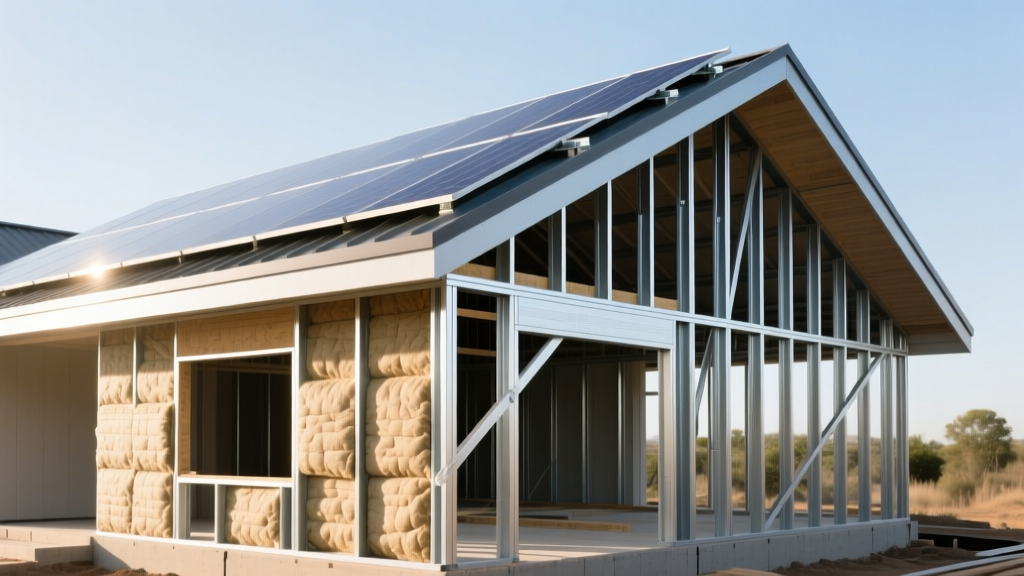
No discussion of steel as a green building material is complete without addressing thermal bridging. Steel is highly conductive (approximately 50 W/m·K), meaning a steel stud that extends from the interior drywall to the exterior sheathing will rapidly transfer heat, severely compromising the building envelope's energy efficiency and potentially causing interior condensation and mold.
To ensure steel framing performs as an environmentally friendly house building material in practice, builders must mitigate thermal bridging through specific detailing:
- Continuous Insulation (ci): Install a minimum of 2 inches of exterior rigid polyisocyanurate (polyiso) foam over the steel studs to break the thermal bridge.
- Thermally Broken Studs: Specify slotted-web steel studs or studs with factory-applied thermal break strips that reduce the cross-sectional area of the steel path.
- Advanced Framing Spacing: Space LGS studs at 24 inches on-center rather than 16 inches, reducing the total volume of conductive metal in the wall cavity by 33%.
Navigating LEED v4.1 and EPD Requirements
For builders targeting LEED certification, steel offers distinct advantages under the Materials and Resources (MR) category. The U.S. Green Building Council awards credits for utilizing products with verified Environmental Product Declarations (EPDs). An EPD is a standardized document (compliant with ISO 14025) that transparently reports a product's lifecycle environmental impact.
Because the steel industry is highly consolidated and heavily regulated, obtaining Type III, third-party verified EPDs for structural and light-gauge steel is significantly easier than for fragmented, regional lumber mills. When specifying steel, require your supplier to provide an industry-wide or facility-specific EPD to secure LEED MR Credit: Building Product Disclosure and Optimization.
2026 Cost Analysis: Green Premiums vs. Lifecycle Savings
While steel is an environmentally friendly house building material from a lifecycle perspective, builders must account for upfront costs. As of early 2026, material costs for light-gauge steel framing range from $12.50 to $17.00 per square foot of floor area, compared to $9.00 to $14.00 for advanced wood framing. This represents an upfront "green premium" of roughly 15% to 25%.
However, this premium is frequently offset by secondary savings:
- Insurance Reductions: Steel's non-combustible nature (ASTM E136) often qualifies projects for builder's risk and long-term property insurance discounts of 10% to 15%.
- Warranty Callbacks: Steel does not warp, shrink, or split. Builders report a 60% reduction in drywall nail-pop callbacks and door-frame sticking issues in the first two years compared to wood framing.
- Scrap Value: Unlike paying landfill tipping fees for wood waste, steel off-cuts can be sold to local scrap yards, recovering a small portion of the material cost.
Builder’s Sourcing Checklist for Low-Carbon Steel
To ensure the steel you purchase aligns with your sustainability goals, use this procurement checklist when vetting suppliers and mills:
- Demand EAF Production: Explicitly specify that the steel must be melted in an Electric Arc Furnace, not a Basic Oxygen Furnace.
- Request the EPD: Ask for a current, ISO-compliant Environmental Product Declaration detailing the Global Warming Potential (GWP) per kilogram.
- Verify Recycled Content: Require a mill certificate stating the exact percentage of post-consumer and post-industrial recycled scrap used in the heat batch.
- Check Galvanization Standards: Specify G60 or G90 zinc coating (ASTM A653) to ensure corrosion resistance without relying on toxic secondary chemical sprays.
- Confirm Regional Sourcing: To minimize transportation-related emissions, prioritize mills and roll-formers located within a 500-mile radius of your job site, aligning with LEED regional materials credits.
According to the American Institute of Steel Construction (AISC), the domestic steel industry has reduced its greenhouse gas emissions by 36% over the last three decades. When detailing steel for residential envelopes, always pair the frame with high-performance mineral wool insulation to achieve both acoustic dampening and fire-resistance ratings that exceed code minimums.
By understanding the nuances of EAF production, meticulously detailing thermal breaks, and leveraging EPDs for certification, builders can confidently position steel as a premier, high-performance choice among environmentally friendly house building materials.
Written by
Elena RodriguezElena Rodriguez is a civil engineer and technical writer specializing in concrete technology, masonry systems, and ASTM/ACI compliance. She earned her B.S. in Civil Engineering from Texas A&M University and spent a decade at a materials testing laboratory, performing over 2,000 concrete compressive strength tests and masonry prism evaluations. Elena is an ACI-certified Field Testing Technician (Grade I) and a member of ASTM Committee C12 on Natural Building Stone. She currently consults on forensic engineering cases involving concrete failures and moisture intrusion. Based in San Antonio, TX, Elena is a proud member of the Society of Women Engineers (SWE) and coaches her daughter's FIRST Robotics team.
More from Elena Rodriguez
View all
Walls & Panels
Cost Analysis: Light Gauge Steel Framing Advantages and Disadvantages
Evaluate light gauge steel framing advantages and disadvantages through a strict cost analysis lens, comparing material, labor, and lifecycle expenses.
Aug 4, 2026

Walls & Panels
Gypsum Board Types: Exact Specifications, Thickness & Dimensions
Compare standard, Type X, and moisture-resistant gypsum board types. Get exact specifications, thicknesses, dimensions, and ASTM standards for your project.
Aug 4, 2026

Fire Resistance
Best Fire-Resistant Outdoor Decking Materials: 2026 Buyer Guide
Discover the best fire-resistant outdoor decking materials for 2026. Compare Class A PVC, aluminum, and hardwood options for WUI compliance and safety.
Aug 4, 2026