Steel Wall Framing Price vs Wood & Concrete: 2026 Cost Guide
Compare the 2026 steel wall framing price against wood and concrete. Discover material costs, labor rates, hidden expenses, and long-term ROI metrics.

The 2026 Baseline: Steel Wall Framing Price vs. Alternatives
When estimating the steel wall framing price for commercial or multi-family residential projects in 2026, general contractors must look beyond the raw cost of the studs. Cold-formed steel (CFS) framing currently averages $5.50 to $9.00 per square foot of wall area installed. This positions it firmly between traditional wood framing and cast-in-place or masonry concrete. However, the upfront material cost is only one variable in a complex equation involving labor efficiency, energy code compliance, and lifecycle durability. Understanding the granular differences between steel, wood, and concrete is critical for accurate budgeting and value engineering.
2026 Pricing Matrix: Steel vs. Wood vs. Concrete
The following table breaks down the average installed costs per square foot of wall area for standard commercial and multi-family applications. Costs include materials, labor, and standard fasteners, but exclude finishes like drywall or exterior cladding.
| Material Type | Material Cost (per sq ft) | Installed Cost (per sq ft) | Primary Cost Driver |
|---|---|---|---|
| Cold-Formed Steel (20ga, Non-Load) | $2.00 - $3.20 | $5.50 - $7.50 | Specialized labor & fasteners |
| Cold-Formed Steel (16ga, Load-Bearing) | $3.50 - $5.00 | $7.50 - $9.50 | Heavier gauge steel & welding |
| Wood Framing (2x4 SPF, Interior) | $1.20 - $2.00 | $4.00 - $6.00 | Lumber market volatility |
| Wood Framing (2x6 SPF, Exterior) | $1.80 - $2.80 | $5.50 - $7.50 | Sheathing & moisture barriers |
| Concrete (8-inch CMU Block) | $3.00 - $4.50 | $9.00 - $13.00 | Masonry labor & mortar |
| Concrete (ICF - Insulated Forms) | $4.50 - $6.50 | $11.00 - $16.00 | Formwork & concrete pumping |
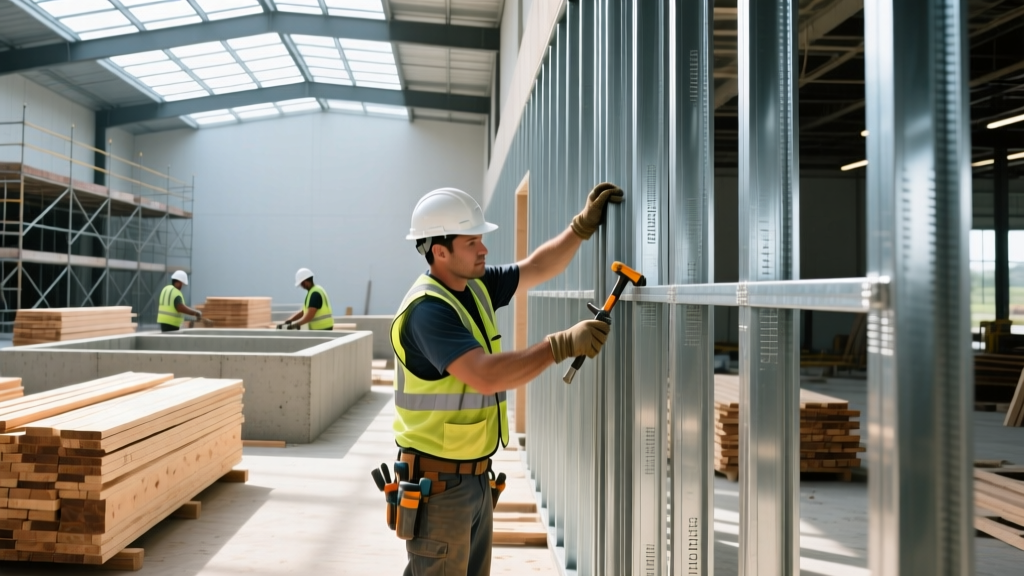
Deconstructing the Steel Wall Framing Price
To accurately bid a project, you must separate the steel wall framing price into its core components: the metal itself, the connection hardware, and the labor required to assemble it.
Material Specifications and Costs
For non-load-bearing interior partitions, standard 3-5/8-inch wide, 20-gauge (33 mil) galvanized studs are the industry standard, costing between $1.60 and $2.20 per linear foot. Top and bottom tracks run slightly cheaper. For exterior load-bearing walls, engineers typically specify 16-gauge (54 mil) or 14-gauge (68 mil) studs, which jump to $3.00 to $4.50 per linear foot. All structural steel framing must comply with the American Iron and Steel Institute (AISI) S100 design standards to ensure adequate yield strength and ductility.
Fasteners and Connection Hardware
Unlike wood framing, which relies on inexpensive pneumatic nails, steel framing requires self-drilling screws. A standard #8 x 1/2-inch hex washer head self-drilling screw costs roughly $0.04 to $0.06 each. A typical 100-square-foot wall partition requires approximately 120 to 150 screws, adding $6.00 to $9.00 in fastener costs alone. Additionally, securing the bottom track to a concrete slab requires powder-actuated fasteners (such as Hilti or Ramset pins) or wedge anchors, adding another $0.50 to $0.80 per linear foot of track.
Labor Efficiency and Rates
Steel framing labor rates are generally 15% to 20% higher than wood framing due to the specialized tools required (aviation snips, screw guns, and welders for heavy tracks). However, steel studs are pre-punched for electrical and plumbing, eliminating the need for on-site drilling and reducing MEP (Mechanical, Electrical, Plumbing) rough-in labor by up to 10%.
Hidden Costs That Skew the Budget
The base steel wall framing price rarely tells the whole story. Two major hidden costs frequently catch estimators off guard when comparing steel to wood or concrete.
Never attach bare or standard galvanized steel bottom tracks directly to ACQ or copper-based pressure-treated wood sill plates. The chemical reaction causes rapid galvanic corrosion, compromising the structural integrity of the track within 3 to 5 years. Always use a minimum 30-mil polyethylene slip sheet or specify heavily galvanized (G90 or Z275) tracks when interfacing with treated lumber.
The Thermal Bridging Tax
Steel is a highly conductive material, transferring heat approximately 300 times faster than wood. According to the Building America Solution Center, a standard 3-5/8-inch steel stud wall with R-13 cavity insulation suffers from severe thermal bridging, reducing the effective whole-wall R-value to roughly R-6 or R-8. To meet IECC 2024 and 2026 energy codes, exterior steel-framed walls mandate continuous insulation (ci), such as 2-inch polyisocyanurate rigid foam boards. This adds $1.50 to $2.50 per square foot to the exterior wall assembly cost, an expense that wood framing (which naturally resists thermal bridging) often avoids.
Acoustic Decoupling
Steel studs transmit sound vibrations efficiently. For multi-family residential or commercial office partitions requiring high STC (Sound Transmission Class) ratings, framers must install resilient channels or sound isolation clips before hanging drywall. This acoustic decoupling adds $0.80 to $1.20 per square foot to the steel wall framing price.
Lifecycle ROI: Where Steel Recoups the Premium
While the initial steel wall framing price may exceed wood, the long-term return on investment (ROI) often favors steel in commercial and multi-family applications.
- Insurance Premiums: Because cold-formed steel is non-combustible and meets ASTM E119 fire-resistance standards without requiring chemical treatments, builders and property owners frequently secure 10% to 15% discounts on builder's risk and commercial property insurance.
- Scrap Value and Waste Disposal: Wood and concrete offcuts require expensive dumpster disposal (averaging $400 to $600 per 20-yard bin). Steel offcuts, however, possess high scrap value. Framing crews can sell steel scrap to local recycling yards for $0.08 to $0.12 per pound, effectively turning a disposal cost into a minor revenue stream. The Steel Framing Industry Association (SFIA) notes that CFS contains a minimum of 25% recycled content and is 100% recyclable at end-of-life.
- Moisture and Biological Resistance: Unlike wood, steel will not rot, warp, or harbor termites. In high-humidity climates or below-grade applications where concrete might suffer from efflorescence or spalling, galvanized steel maintains its dimensional stability indefinitely, eliminating costly warranty callbacks for drywall cracking caused by lumber shrinkage.
Decision Framework: Which Material Fits Your Build?
Use this practical matrix to determine when the steel wall framing price is justified over wood or concrete alternatives:
- Choose Cold-Formed Steel When: You are building multi-family residential (3+ stories), commercial offices, or healthcare facilities. The non-combustible nature, dimensional stability, and pre-punched utility holes make it the undisputed king of mid-rise interior and exterior partitions.
- Choose Wood Framing When: You are constructing single-family homes, low-rise custom residential, or temporary structures. The lower upfront material cost, ease of on-site modification, and natural thermal resistance make wood the most economical choice for small-scale builds.
- Choose Concrete (CMU or ICF) When: You are building below-grade foundation walls, retaining walls, or structures in extreme hurricane/tornado zones requiring high impact resistance and massive thermal mass. Concrete's compressive strength and acoustic mass are unmatched, though labor costs remain the highest of the three.
Frequently Asked Questions
Does the steel wall framing price fluctuate like lumber?
No. While steel prices are tied to global iron ore and scrap metal markets, they are significantly more stable than the extreme volatility seen in SPF (Spruce-Pine-Fir) lumber markets. Lumber prices can swing 30% to 50% in a single quarter due to weather, mill strikes, or supply chain disruptions, whereas steel pricing typically shifts in predictable 5% to 10% increments over longer periods.
How does concrete block (CMU) compare to steel studs for interior partitions?
CMU is rarely used for non-load-bearing interior partitions in modern commercial construction. An 8-inch CMU wall weighs roughly 30 pounds per square foot, requiring heavier structural floor slabs to support the dead load. A steel stud wall with 5/8-inch drywall weighs less than 10 pounds per square foot, drastically reducing the structural steel or concrete requirements for the building's primary frame.
Can steel framing be used in coastal, high-salt environments?
Yes, but the galvanization coating must be upgraded. Standard G60 galvanized coatings will corrode rapidly in salt-air environments. For coastal projects, specify G90 or AZ55 (aluminum-zinc alloy) coated steel studs and tracks, and ensure all cut edges are treated with a zinc-rich cold galvanizing compound to prevent localized rust.
Written by
Sarah WhitfieldSarah Whitfield is a chartered quantity surveyor (MRICS) and construction cost analyst with 15 years of experience in material pricing, procurement strategy, and project budgeting. She earned her degree in Construction Management from the University of Reading (UK) and has worked on projects ranging from $2M custom homes to $180M mixed-use developments across North America and Europe. Sarah currently leads cost estimating for BuildMat Insight, maintaining a proprietary database of 4,000+ material price points updated quarterly. She is a frequent contributor to RSMeans cost data panels and has presented at the International Cost Engineering Council (ICEC) congress. Based in Denver, CO, Sarah is an avid trail runner and volunteer mentor for Women in Construction.
More from Sarah Whitfield
View all
Wood & Lumber
What Are the Different Types of Wood? A Builder's Guide
Compare structural softwoods, finish hardwoods, and engineered lumber. Analyze Janka ratings, MOE values, and 2026 pricing for construction.
Aug 4, 2026

Walls & Panels
Steel Framing vs Wood Framing: Corrosion and Moisture Defense
Compare steel framing vs wood framing for moisture resistance. Learn about galvanized coatings, condensation risks, and corrosion protection strategies.
Jul 21, 2026

Stone & Masonry
How to Cut Stone Veneer: Wet Saw vs Grinder Comparison
Compare the best tools for cutting stone veneer. We review wet saws, angle grinders, and chop saws to help you achieve clean, chip-free cuts.
Jul 21, 2026