Preserving Exotic Types of Wood From Africa: A Treatment Guide
Master the treatment and preservation of exotic types of wood from Africa. Learn specific sealing, oiling, and maintenance protocols for Iroko, Sapele, and Wenge.

The Cellular Challenge: Why African Hardwoods Defy Standard Finishes
When specifying types of wood from Africa for high-end architectural millwork, exterior decking, or heavy-duty flooring, contractors are drawn to their exceptional Janka hardness ratings and striking grain patterns. However, the very biological defenses that make species like Iroko, Wenge, and Afrormosia resistant to rot and insects also make them notoriously difficult to treat and preserve. Standard polyurethanes and water-based acrylics frequently suffer from adhesion failure, peeling, and improper curing when applied to these timbers.
The core issue lies in the cellular chemistry. Many African hardwoods are saturated with natural lipids, resins, and tannins. Furthermore, species like Iroko (Milicia excelsa) contain high concentrations of silica deposits within the wood fibers. According to the USDA Forest Products Laboratory Wood Handbook, these extractives can act as natural antioxidants, actively inhibiting the oxidative cross-linking process required for oil-based varnishes and alkyd resins to cure. If you attempt to treat African hardwoods using the same protocols as domestic oak or maple, the finish will almost certainly fail within 12 to 18 months.
African Species Matrix: Preservation Profiles
Not all African imports share the same chemical makeup. Selecting the correct preservative requires matching the finish chemistry to the specific extractive profile of the timber. Below is a decision matrix for the most commonly imported structural and finish-grade African species.
| Species | Janka Hardness | Extractive Profile | Primary Vulnerability | Recommended Preservative |
|---|---|---|---|---|
| Iroko (Milicia excelsa) | 1,260 lbf | High Silica / Med Oil | Film finish adhesion failure | Penetrating alkyd or modified tung oil |
| Sapele (Entandrophragma cylindricum) | 1,410 lbf | Low Oil / High Tannin | Tannin bleed, UV graying | Film-forming UV-blocking spar varnish |
| Wenge (Millettia laurentii) | 1,930 lbf | Med Oil / Extreme Density | Solvent trapping, splintering | Hardwax oil (e.g., Osmo Polyx-Oil) |
| Padauk (Pterocarpus soyauxii) | 1,725 lbf | Low Oil / High Dye | Rapid color oxidation (orange to brown) | UV-inhibiting clear penetrating oil |
| Afrormosia (Pericopsis elata) | 1,570 lbf | High Oil / Med Silica | Glue joint failure, finish curing delay | Solvent-wiped penetrating decking oil |
Pre-Treatment Protocols: Surface Preparation
The success of any preservation system on types of wood from Africa relies entirely on the first 15 minutes of surface preparation. Because natural oils migrate to the surface immediately after the cellular structure is cut or sanded, timing is critical.
1. Mechanical Abrasion Limits
Do not over-sand. For exterior decking (Iroko, Afrormosia), stop sanding at 80 to 100 grit. The larger pore structure allows deep penetration of alkyd-based preservatives. For interior flooring and millwork (Wenge, Sapele), stop at 120 to 150 grit if using a hardwax oil, or 180 grit for a film-forming finish. Sanding African hardwoods past 220 grit burnishes the dense fibers, effectively sealing the pores and preventing oil penetration.
2. The Solvent Wipe (Crucial Step)
Within 15 minutes of your final sanding pass, wipe the entire surface with a clean, lint-free rag heavily saturated with acetone or denatured alcohol. This flash-wipe dissolves and removes the surface lipids that inhibit finish adhesion. Allow the solvent to flash off completely (usually 10 to 20 minutes depending on ambient temperature) before applying any preservative. Skipping this step is the leading cause of polyurethane peeling on African timbers.
Selecting the Right Preservative Chemistry
Matching the finish to the environment and the wood species is non-negotiable. The International Tropical Timber Organization (ITTO) emphasizes that maximizing the service life of tropical hardwoods requires finishes that accommodate their natural dimensional movement without cracking.
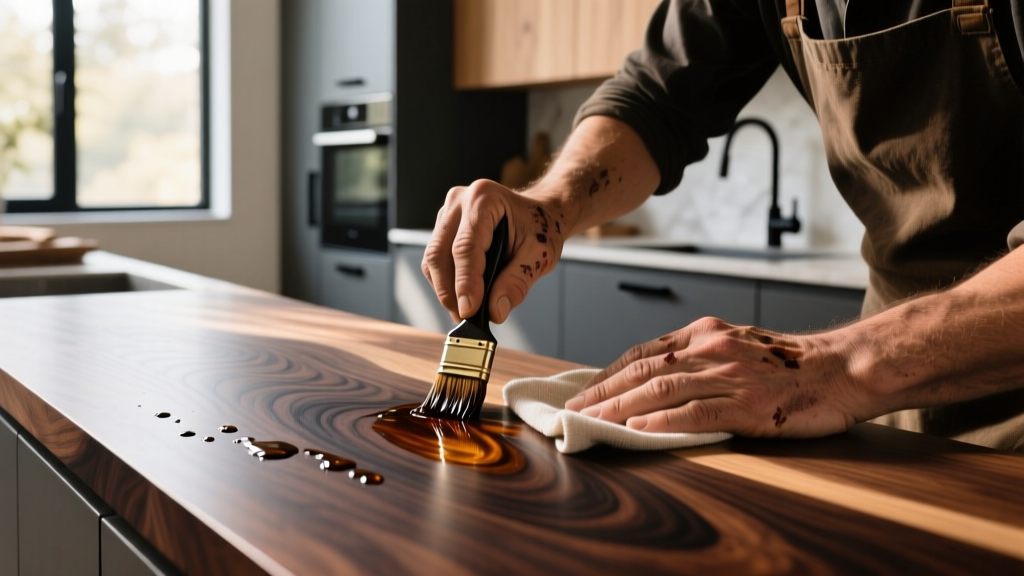
- Penetrating Alkyd/Oil Blends (Exterior): Products like Messmers UV Plus for Hardwoods or Penofin Architectural are ideal for Iroko and Afrormosia decking. They do not form a surface film, meaning they cannot peel or blister. They simply fade over time and can be reapplied without sanding.
- Hardwax Oils (Interior Floors & Countertops): For Wenge and Sapele interior applications, hardwax oils (such as Osmo Polyx-Oil 3043 or Rubio Monocoat Oil Plus 2C) bond molecularly with the free hydroxyl groups in the wood cellulose. They provide a matte, natural feel while offering high resistance to liquid spills.
- Marine-Grade Spar Varnish (High-Exposure Exterior): If Sapele is used for exterior doors or marine brightwork, a high-build, UV-stabilized spar varnish (like Epifanes High Gloss) is required. It must be applied in minimum 6 to 8 coats to build a flexible film that can handle the wood's seasonal expansion.
Step-by-Step Application for High-Oil Species
When treating high-oil species like Afrormosia or Iroko for exterior use, follow this precise application sequence to ensure maximum preservative uptake and UV protection.
- Mill and Prep: Cut to final dimensions. Sand to 80 grit for rough-sawn decking profiles.
- De-dust and Degrease: Vacuum thoroughly. Wipe with acetone to extract surface oils.
- Saturation Coat: Apply the penetrating oil (e.g., Messmers UV Plus) using a high-nap roller or pump sprayer. Flood the surface heavily. African hardwoods are incredibly dense and will absorb significantly less oil per square foot than pine or cedar, but the initial coat must remain wet for 15 minutes to allow capillary action into the end-grain.
- Back-Wiping: After 15 minutes, aggressively back-wipe the surface with clean cotton rags. Never leave puddles of oil on the surface. Excess oil will oxidize into a sticky, tacky film that attracts dirt and pollen.
- Curing: Allow 48 to 72 hours of dry time before light foot traffic. Full cross-linking of the alkyd resins may take up to 14 days depending on humidity.
Troubleshooting Common Preservation Failures
Failure: Padauk Color Shift (Orange to Dark Brown)
The Cause: Padauk contains water-soluble dyes and photo-reactive extractives. Upon exposure to UV light and oxygen, the vibrant coral-orange heartwood rapidly oxidizes to a deep mahogany brown. This is a chemical inevitability, not a finish failure.
The Fix: You cannot stop the color shift entirely, but you can slow it by 3 to 5 years using finishes loaded with Hindered Amine Light Stabilizers (HALS) and UV absorbers. For interior pieces, keep Padauk out of direct sunlight. If the orange color is the primary design intent, consider using a dye-stabilizing chemical treatment prior to clear-coating, though this is rarely practical for large architectural installations.
Failure: Black Tannin Staining on Sapele Millwork
The Cause: Sapele is rich in tannic acid. When moisture penetrates the wood and reacts with iron or zinc from standard galvanized nails, screws, or adjacent metal flashing, it creates a black iron-tannate stain that bleeds through most finishes.
The Fix: Never use galvanized or electroplated hardware with Sapele, Iroko, or Afrormosia. Always specify Type 316 marine-grade stainless steel fasteners and hidden fastening systems. If staining has already occurred, wash the affected area with a 5% solution of oxalic acid to chemically neutralize the tannin reaction, rinse thoroughly, and reapply the preservative.
Failure: Peeling Polyurethane on Iroko Flooring
The Cause: Standard oil-based polyurethane relies on oxygen to cure. The natural antioxidants in Iroko prevent the finish from cross-linking at the wood-finish interface, resulting in a finish that chips off in large sheets.
The Fix: Strip the failed finish using a chemical methylene chloride stripper or a heavy floor buffer with 40-grit sanding screens. Perform the acetone solvent wipe detailed above. Switch to a moisture-cured urethane or a two-component water-based commercial finish (like Bona Traffic HD), which relies on a chemical catalyst rather than oxidative curing, completely bypassing the wood's natural antioxidant interference.
Properly treating types of wood from Africa requires respecting their unique biological architecture. By abandoning generic domestic finishing schedules and adopting solvent-wiping, species-specific chemistry matching, and rigorous hardware isolation, contractors can ensure these premium timbers perform flawlessly for decades in both interior and exterior environments.
Written by
Marcus ChenMarcus Chen is a licensed structural engineer (PE) and building materials analyst with over 12 years of experience across residential, commercial, and industrial construction. He holds a Master of Science in Civil Engineering from UC Berkeley and spent six years at Thornton Tomasetti before transitioning to independent consulting and technical writing. Marcus specializes in material selection for seismic-prone regions, concrete reinforcement strategies, and lifecycle cost analysis. His work has been cited by the American Concrete Institute (ACI) and the Structural Engineers Association of California (SEAOC). When he is not on a job site or at his desk, you will find him hiking the Sierra Nevada or restoring a 1920s craftsman bungalow in Oakland, CA.
More from Marcus Chen
View all
Construction Cost
How Much Did the Eiffel Tower Cost to Build?
How much did the Eiffel Tower cost to build in 1889? We adjust for inflation and compare its budget to modern skyscraper construction.
Aug 4, 2026

Fire Resistance
What Is a Fire Resistant Material? Testing & Certification Guide
Discover what is a fire resistant material through ASTM and UL testing. Learn how fire ratings, certifications, and assemblies work in construction.
Aug 4, 2026

Construction Cost
How Much Did the Burj Khalifa Cost to Build?
How much did the Burj Khalifa cost to build? We break down the $1.5B project and extract 5 money-saving strategies for your next build.
Jul 30, 2026