Best Type of Wood Bat: Species, Grain, and Grip Installation Guide
Find the best type of wood bat for your swing. Compare maple, ash, and birch, plus learn expert grip installation and finishing techniques.

The Core Three: Selecting the Best Type of Wood Bat
Determining the best type of wood bat requires analyzing the cellular structure of the timber, its specific gravity, and how it responds to high-velocity impact. In professional and high-level amateur baseball, three North American hardwood species dominate the market: Sugar Maple, White Ash, and Yellow Birch. Each species possesses distinct mechanical properties that dictate its performance, durability, and required preparation.
Sugar Maple (Acer saccharum)
Maple is the most widely used wood in the major leagues today. It features a closed-pore, diffuse-porous structure that makes it incredibly dense and hard. According to the USDA Forest Products Laboratory Wood Handbook, Sugar Maple boasts a specific gravity of 0.71 and a Janka hardness rating of 1,450 lbf. This density prevents the wood from compressing upon impact, resulting in maximum energy transfer to the ball. However, its rigidity means it lacks the 'whip' of ash, and when it fails, it tends to snap cleanly rather than flake.
White Ash (Fraxinus americana)
White Ash is a ring-porous wood with an open grain structure. It is lighter and more flexible than maple, offering a 'trampoline effect' upon contact. Ash has a Janka hardness of 1,320 lbf. The primary drawback of ash is its tendency to flake and splinter as the open grain cells separate over time, especially when hitting off the end-grain or in cold weather.
Yellow Birch (Betula alleghaniensis)
Birch serves as a hybrid between maple and ash. It offers the hardness of maple with the flex of ash. Because it is a diffuse-porous wood with a tighter grain than ash but softer than maple, birch requires a mandatory break-in period to compress the surface fibers before it reaches peak performance.
| Species | Janka Hardness | Grain Structure | Flex/Whip | Break-In Required |
|---|---|---|---|---|
| Sugar Maple | 1,450 lbf | Closed / Diffuse | Low (Stiff) | No |
| White Ash | 1,320 lbf | Open / Ring | High | No |
| Yellow Birch | 1,260 lbf | Semi-Closed | Medium | Yes (100+ swings) |
Grain Orientation and the 'Ink Dot' Mandate
Identifying the best type of wood bat goes beyond species; it requires strict adherence to grain orientation. Following a series of dangerous bat-shattering incidents in 2008, MLB implemented strict grading rules for maple and birch billets. The most critical metric is the Slope of Grain (SoG). The grain lines must run parallel to the length of the bat with a deviation of no more than 3 degrees.
To verify this, manufacturers apply an 'ink dot' to the face grain (the flat-sawn side) of the handle. The ink bleeds along the wood's medullary rays, allowing inspectors to measure the exact angle of the grain. Hitting on the edge grain (quartersawn side, 90 degrees from the ink dot) provides maximum stiffness and prevents the bat from splintering into jagged shards. If you are purchasing a maple or birch bat, always ensure the manufacturer logo and ink dot are facing up or down relative to your swing, forcing contact on the edge grain.
Installation Best Practices: Finishing and Grip Tape
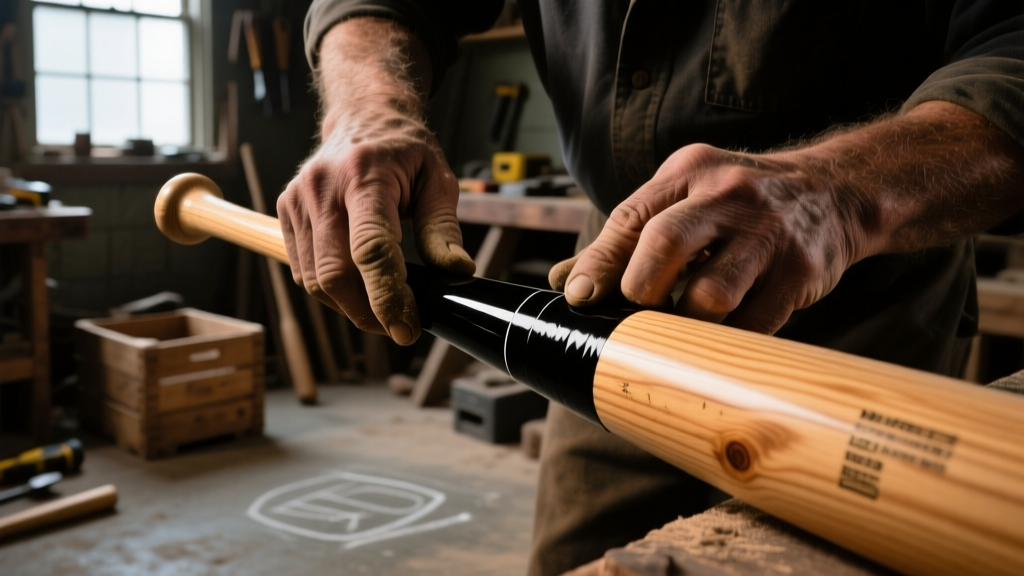
Once the correct wood species and billet are selected, the 'installation' phase begins. This involves applying protective finishes and installing the grip tape to optimize tactile feedback and moisture resistance. Proper installation prevents premature wood degradation and ensures consistent swing mechanics.
Step 1: Surface Burnishing and Sealing
Historically, players used a femur bone to 'bone rub' the barrel, compressing the wood cells to increase surface hardness. In 2026, this is largely replaced by synthetic burnishing tools or factory-applied polyurethane sealants. If you are finishing a raw bat:
- Burnish: Rub a hardened steel rod or synthetic burnisher firmly along the barrel to close the wood pores.
- Seal: Apply two thin coats of water-based polyurethane. Avoid oil-based finishes on the barrel, as they add unnecessary weight and remain tacky.
- Cure: Allow the bat to cure in a low-humidity environment (below 45% RH) for 48 hours before installing the grip.
Step 2: Grip Tape Installation
Installing grip tape correctly is vital for bat control and vibration dampening. The most common materials are 1.1mm and 1.75mm polyurethane synthetic tapes (such as Lizard Skins or similar polyurethane wraps).
- Prep the Handle: Wipe the bare wood handle with 90% isopropyl alcohol to remove factory oils and dust.
- The Anchor Cut: Cut the starting end of the grip tape at a 45-degree angle. Anchor it flush against the bottom of the knob.
- Application Tension: Wrap the tape upward with a 50% overlap. Apply moderate tension—stretching the tape too tightly will cause it to snap back and bunch up during swings, while wrapping it too loosely will cause it to slide.
- The Taper Finish: Stop wrapping 1 to 1.5 inches below the start of the barrel taper. Cut the tape at a steep 60-degree angle and secure the end with a 3-inch strip of black electrical tape or the manufacturer's provided finishing strip.
If you install pine tar or grip enhancers over your tape, be aware of MLB Rule 3.02(c). The substance cannot extend more than 18 inches from the bottom of the knob. Applying pine tar beyond this 18-inch mark can result in the bat being declared illegal and the batter being called out. Use a measuring tape during application to mark the 18-inch boundary with a piece of masking tape before applying the rosin.
Barrel Cupping and Swing Weight Calibration
The final manufacturing 'installation' step that affects the bat's performance is barrel cupping. Cupping involves hollowing out the end of the barrel to remove 0.5 to 1.0 ounces of wood. This shifts the balance point closer to the hands, reducing the swing weight (moment of inertia) without sacrificing the overall mass of the bat.
When ordering a custom bat, specify your cupping preference. A deep cup (removing ~1 oz) is ideal for contact hitters who prioritize bat speed and barrel control. A shallow or no-cup barrel retains the weight at the end of the bat, favored by power hitters who rely on mass and momentum to drive the ball through the infield.
Hygroscopic Storage: Protecting the Billet
Wood is a hygroscopic material, meaning it continuously absorbs and releases moisture from the surrounding environment. The best type of wood bat will quickly degrade if stored improperly. A bat's ideal moisture content is between 8% and 12%.
- Avoid Damp Environments: Never leave bats in a car trunk overnight or in a damp dugout bag. High humidity causes the wood cells to swell, making the bat heavier and 'dead' upon impact.
- Avoid Extreme Dryness: Conversely, storing a bat near a radiator or in a heavily air-conditioned room will draw moisture out of the wood, making it brittle and highly susceptible to shattering on inside pitches.
- Vertical Storage: Store bats vertically in a climate-controlled room (65°F to 75°F) to prevent warping along the longitudinal axis.
By meticulously selecting the appropriate wood species based on your swing mechanics, verifying the ink dot grain orientation, and executing a precise grip installation, you ensure the timber performs at its absolute mechanical peak.
Written by
Sarah WhitfieldSarah Whitfield is a chartered quantity surveyor (MRICS) and construction cost analyst with 15 years of experience in material pricing, procurement strategy, and project budgeting. She earned her degree in Construction Management from the University of Reading (UK) and has worked on projects ranging from $2M custom homes to $180M mixed-use developments across North America and Europe. Sarah currently leads cost estimating for BuildMat Insight, maintaining a proprietary database of 4,000+ material price points updated quarterly. She is a frequent contributor to RSMeans cost data panels and has presented at the International Cost Engineering Council (ICEC) congress. Based in Denver, CO, Sarah is an avid trail runner and volunteer mentor for Women in Construction.
More from Sarah Whitfield
View all
Wood & Lumber
What Are the Different Types of Wood? A Builder's Guide
Compare structural softwoods, finish hardwoods, and engineered lumber. Analyze Janka ratings, MOE values, and 2026 pricing for construction.
Aug 4, 2026

Walls & Panels
Steel Framing vs Wood Framing: Corrosion and Moisture Defense
Compare steel framing vs wood framing for moisture resistance. Learn about galvanized coatings, condensation risks, and corrosion protection strategies.
Jul 21, 2026

Stone & Masonry
How to Cut Stone Veneer: Wet Saw vs Grinder Comparison
Compare the best tools for cutting stone veneer. We review wet saws, angle grinders, and chop saws to help you achieve clean, chip-free cuts.
Jul 21, 2026