Treating Types of Wood Bats: Preservation Guide for Maple, Ash & Birch
Learn how to treat and preserve different types of wood bats. Expert tips on oiling, bone rubbing, and moisture control for maple, ash, and birch.

The Science of Wood Bat Preservation
Wood baseball bats are precision-engineered tools that require meticulous care to maintain their structural integrity and performance. Unlike composite or aluminum alternatives, wood is a hygroscopic material, meaning it continuously absorbs and releases moisture from its environment. According to the USDA Forest Products Laboratory, the Equilibrium Moisture Content (EMC) of wood dictates its dimensional stability and mechanical strength. For a wood bat to perform optimally and resist catastrophic failure, its internal moisture content (MC) must be strictly maintained between 6% and 10%, with 8% being the ideal target for amateur and professional play.
Preserving the various types of wood bats requires an understanding of their unique cellular structures. A treatment that extends the life of an open-grain ash bat might be entirely unnecessary—or even detrimental—for a closed-grain maple bat. This guide details the exact preservation protocols, grain compression techniques, and moisture management strategies required for the three primary species used in modern baseball.
Grain Structure and Treatment Needs by Species
The cellular anatomy of the wood dictates how it responds to impact, how it wears over time, and how it should be treated. Below is a comparative matrix of the three dominant wood species used in bat manufacturing.
| Wood Species | Grain Type | Janka Hardness | Primary Preservation Focus | Optimal Hitting Surface |
|---|---|---|---|---|
| Hard Maple | Closed / Tight | 1,450 lbf | Moisture retention to prevent brittle shattering | Edge Grain (90 degrees to face) |
| White Ash | Open / Porous | 1,320 lbf | Preventing grain flaking and drying out | Face Grain (parallel to growth rings) |
| Yellow Birch | Semi-Closed | 1,260 lbf | Grain compression and dent resistance | Edge Grain (90 degrees to face) |
The Ink Dot Test and Slope of Grain (SOG)
Before applying any physical treatments, it is critical to verify the Slope of Grain (SOG). In 2009, Major League Baseball mandated the 'ink dot test' for all maple and birch bats to ensure the grain runs straight enough to prevent dangerous, multi-piece shattering. When treating types of wood bats made from maple or birch, always look for the manufacturer's ink dot on the handle. If the grain lines deviate more than 3 degrees from the vertical axis of the bat, the wood is structurally compromised and should not be used, regardless of how well it is preserved. The Wood Bat Association strictly enforces these SOG limits to ensure player safety.
Step-by-Step Bone Rubbing and Grain Compression
Bone rubbing is a traditional, highly effective preservation technique used to compress the wood fibers on the barrel of the bat. This process, known as burnishing, closes the pores of the wood, increases surface hardness, and prevents the bat from denting upon impact with a dense baseball. While maple is naturally hard, birch and ash benefit immensely from this process.
Expert Insight: Never use a metal rod with sharp edges or a glass bottle for bone rubbing. These tools can micro-fracture the wood fibers. Always use a hardened porcelain bat bone or a purpose-built, polished steel burnishing rod.
The Bone Rubbing Procedure
- Secure the Bat: Place the bat on a padded surface or secure the handle in a vice with soft jaws to prevent movement.
- Apply Pressure: Grip the porcelain bone firmly. You should apply approximately 40 to 50 pounds of downward pressure. If you are not pressing hard enough, you are merely polishing the wood, not compressing it.
- Follow the Grain: Rub strictly parallel to the grain lines, moving from the handle toward the end cap. Never rub in circles or against the grain, as this will lift the fibers and create weak points.
- Coverage: Perform 3 to 5 complete passes over the entire barrel and taper. You will know the compression is successful when the wood takes on a slight, polished sheen and feels noticeably harder to the touch.
Oiling vs. Finishing: What to Apply and When
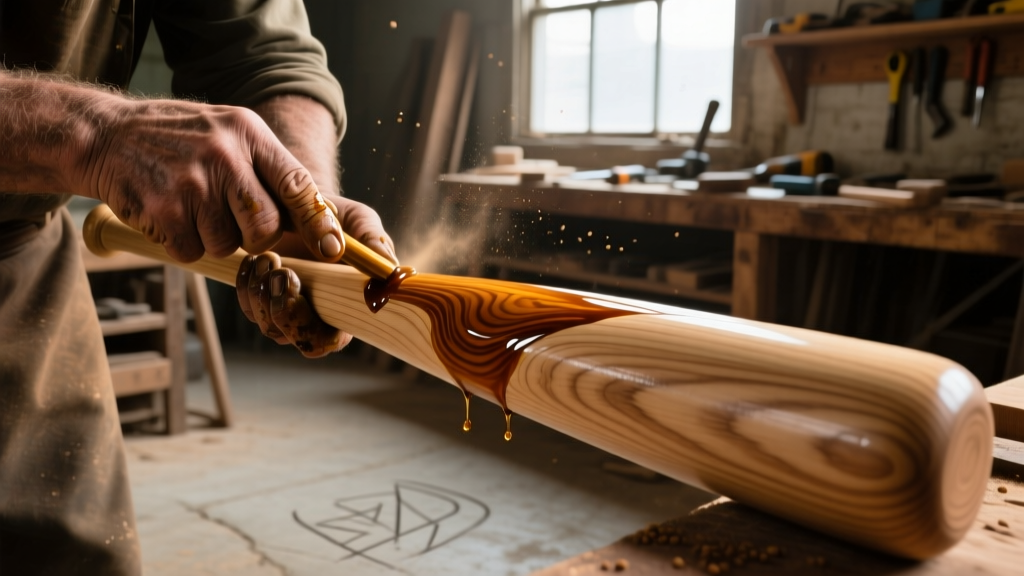
The most common mistake players make when preserving types of wood bats is applying the wrong type of oil or over-saturating the wood. The goal of oiling is to stabilize the moisture content, not to make the bat heavy or sticky.
Raw Linseed Oil (RLO) vs. Boiled Linseed Oil (BLO)
Always use Raw Linseed Oil for wood bat preservation. Boiled Linseed Oil contains metallic drying agents (like cobalt or manganese) that add unnecessary weight to the barrel and can alter the bat's flex profile. Furthermore, BLO cures into a hard, brittle film that can flake off upon impact.
Application Protocol
- Preparation: Ensure the bat is clean and free of dirt or pine tar residue. Use a damp cloth to wipe down the barrel, then let it dry completely.
- Dosing: Apply exactly 3 to 4 drops of RLO to a clean, lint-free cotton rag. Do not pour oil directly onto the wood.
- Rubbing: Rub the oil vigorously into the barrel, taper, and handle. The friction helps the oil penetrate the cellular structure.
- Curing: Stand the bat upright in a climate-controlled room (65°F to 75°F) for 24 hours. Wipe off any unabsorbed, tacky residue with a dry cloth before use.
Applying too much oil will clog the wood's pores, preventing it from breathing and adjusting to ambient humidity. An over-oiled bat will gain up to half an ounce in weight, ruining the manufacturer's carefully calibrated swing weight and balance point. Oil your bat no more than once every 3 to 4 weeks during the active season.
Climate Control and Storage Best Practices
Because wood seeks equilibrium with its environment, improper storage is the leading cause of premature bat death. The JustBats Wood Bat Care Guide emphasizes that extreme temperature and humidity fluctuations will destroy a wood bat faster than any pitcher.
The 'Car Trunk' Rule
Never store your wood bats in the trunk of a car, an outdoor shed, or a garage. In the summer, a closed car trunk can reach temperatures exceeding 140°F. This extreme heat bakes the moisture out of the wood, dropping the MC below 5%. When a maple bat drops below 6% MC, it loses its natural flexibility and becomes highly brittle, turning into a dangerous projectile that will shatter into sharp shards upon impact. In the winter, damp garages will cause the wood to absorb excess moisture, making the bat sluggish, heavy, and prone to deep denting.
Ideal Storage Parameters
- Temperature: 65°F to 75°F (18°C to 24°C)
- Relative Humidity: 40% to 55%
- Orientation: Store bats horizontally on a rack or vertically in a bat bag. Avoid leaning them against a wall at an angle, which can cause the wood to warp over time.
Troubleshooting Common Bat Failures
Even with meticulous treatment, wood bats will eventually fail. However, diagnosing how they fail can tell you if your preservation routine needs adjustment.
- Symptom: Ash bat is flaking and splintering on the barrel.
Cause: The wood has dried out, and the open pores are separating.
Fix: Apply a light coat of Raw Linseed Oil immediately and store in a 50% humidity environment. Bone rub the barrel to press the lifted fibers back down. - Symptom: Maple bat shatters into 3 or more jagged pieces.
Cause: Moisture content dropped below 6%, or the player is hitting on the face grain instead of the edge grain.
Fix: Discard the remaining pieces. For future bats, verify the ink dot test, ensure you are hitting with the label facing up or down (edge grain), and stop storing the bat in dry, heated areas. - Symptom: Birch bat is denting deeply on the sweet spot.
Cause: Inadequate grain compression prior to use.
Fix: Birch is naturally softer than maple and must be bone rubbed before its first use. Apply 50 lbs of pressure with a porcelain bone to harden the semi-closed grain structure. - Symptom: Bat feels noticeably heavier and sluggish.
Cause: Over-oiling or storage in a high-humidity environment (above 65% RH).
Fix: Move the bat to a climate-controlled room with a dehumidifier. Wipe the barrel with a dry cloth and allow it to stabilize for 48 hours.
Final Thoughts on Wood Bat Longevity
Treating and preserving types of wood bats is not a one-time event; it is an ongoing maintenance routine. By respecting the unique cellular properties of maple, ash, and birch, utilizing proper bone rubbing techniques, and strictly controlling moisture exposure, players can significantly extend the lifespan of their equipment while maintaining the premium feel and performance that only natural wood can provide.
Written by
Sarah WhitfieldSarah Whitfield is a chartered quantity surveyor (MRICS) and construction cost analyst with 15 years of experience in material pricing, procurement strategy, and project budgeting. She earned her degree in Construction Management from the University of Reading (UK) and has worked on projects ranging from $2M custom homes to $180M mixed-use developments across North America and Europe. Sarah currently leads cost estimating for BuildMat Insight, maintaining a proprietary database of 4,000+ material price points updated quarterly. She is a frequent contributor to RSMeans cost data panels and has presented at the International Cost Engineering Council (ICEC) congress. Based in Denver, CO, Sarah is an avid trail runner and volunteer mentor for Women in Construction.
More from Sarah Whitfield
View all
Wood & Lumber
What Are the Different Types of Wood? A Builder's Guide
Compare structural softwoods, finish hardwoods, and engineered lumber. Analyze Janka ratings, MOE values, and 2026 pricing for construction.
Aug 4, 2026

Walls & Panels
Steel Framing vs Wood Framing: Corrosion and Moisture Defense
Compare steel framing vs wood framing for moisture resistance. Learn about galvanized coatings, condensation risks, and corrosion protection strategies.
Jul 21, 2026

Stone & Masonry
How to Cut Stone Veneer: Wet Saw vs Grinder Comparison
Compare the best tools for cutting stone veneer. We review wet saws, angle grinders, and chop saws to help you achieve clean, chip-free cuts.
Jul 21, 2026