Selecting Lumber for Different Types of Wood Boats: A Framework
Discover the ultimate selection framework for choosing the right lumber species, grades, and marine treatments for building various types of wood boats.
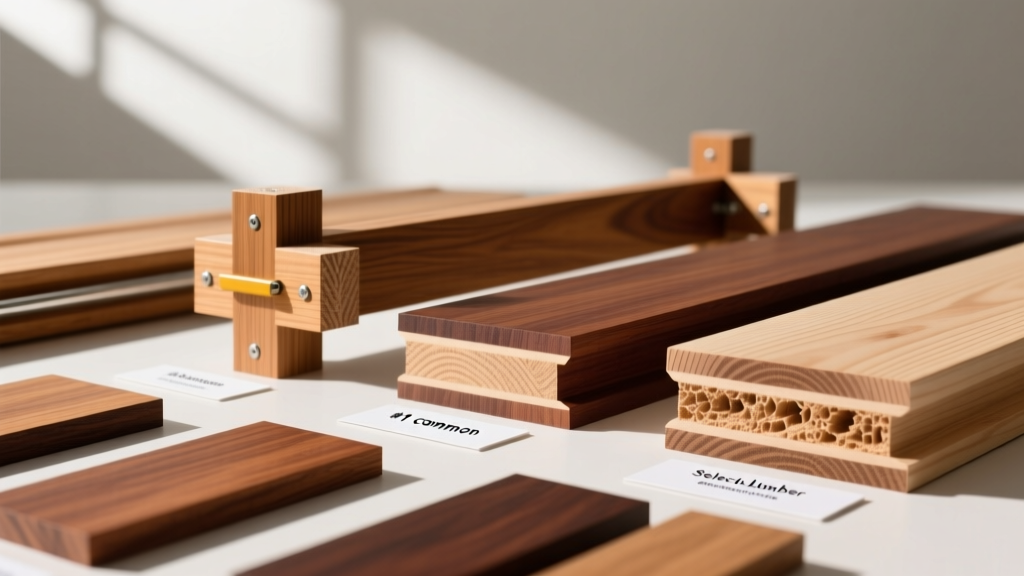
The Marine Wood Selection Matrix
Building a wooden vessel requires a rigorous understanding of cellular structure, decay resistance, and mechanical stress. The selection framework for marine lumber is not based on a single "best" wood, but rather on matching specific anatomical traits to the structural demands of distinct boat components. According to the USDA Forest Products Laboratory Wood Handbook, marine environments subject timber to cyclic wetting, high UV exposure, and aggressive biological decay agents like marine borers and fungi.
Use the following decision matrix to align your lumber selection with the primary structural zones of a wooden hull.
| Hull Component | Primary Species | Alternative Species | Critical Trait Required |
|---|---|---|---|
| Keel & Stem | White Oak (Quercus alba) | Ipe, Purpleheart | High density, extreme abrasion resistance |
| Framing (Ribs) | White Oak, Hackmatack | European Larch, Ash | Steam-bending capability, high impact strength |
| Planking (Hull Skin) | Western Red Cedar | Atlantic White Cedar, Cypress | Dimensional stability, low specific gravity |
| Decking & Brightwork | Teak (Tectona grandis) | African Mahogany, Iroko | Natural oils, silica content, UV resistance |
Decoding Wood Species by Hull Construction Method
The construction methodology dictates the acceptable moisture content, grain orientation, and adhesive compatibility of your lumber. Different types of wood boats demand entirely different material profiles.
Traditional Carvel and Clinker Planking
Carvel (smooth-skinned) and clinker (lapstrake) boats rely on the natural swelling of wood to create watertight seams. For these traditional methods, you must select air-dried or "green" lumber with a moisture content (MC) between 15% and 20%. Kiln-dried wood will absorb water, swell unevenly, and generate enough hoop stress to pop fasteners or fracture frames.
For the planking, Atlantic White Cedar and Longleaf Pine are premier choices due to their long, straight grain and high resin content. For the bent frames, White Oak is the undisputed standard. When steamed at 212°F (100°C), white oak's lignin softens, allowing it to bend to tight radii without cellular rupture, locking into shape as it cools and dries.
Cold-Molded and Strip-Planked Epoxy Hulls
Cold-molding involves layering thin diagonal wood veneers encapsulated in marine-grade epoxy, creating a composite monocoque structure. Because epoxy seals the wood entirely, the hull does not rely on swelling for waterproofing. Therefore, lumber must be kiln-dried to an MC of 8% to 12% before encapsulation. If the wood is too wet, trapped moisture will cause osmotic blistering or outgassing that compromises the epoxy bond.
Western Red Cedar (Thuja plicata) is the benchmark for strip-planking. With a Janka hardness of just 350 lbf and a specific gravity of 0.32, it yields an exceptionally high strength-to-weight ratio. For cold-molded veneers, Douglas Fir and Okoume are preferred for their high tensile strength and uniform grain, which prevents telegraphing through the final epoxy fairing compound. For comprehensive encapsulation protocols, builders frequently reference the West System Epoxy User Guides to ensure proper resin-to-hardener ratios and surface preparation.
Stitch-and-Glue Plywood Construction
For modern, multi-chine plywood boats, solid lumber is largely replaced by marine plywood. However, not all "marine" plywood is structural. You must specify BS1088 or BS6566 certified Okoume or Meranti plywood. The BS1088 British Standard guarantees zero core gaps, waterproof phenolic (WBP) glue lines, and strictly limited face veneer repairs. Standard exterior plywood contains voids in the inner plies that trap water and cause delamination under marine cyclic loading.
Fastener Compatibility and Galvanic Corrosion
A catastrophic failure mode in wooden boatbuilding is the chemical reaction between wood tannins, moisture, and metallic fasteners. Selecting the wrong fastener for a specific wood species will result in severe galvanic corrosion, wood necrosis, and structural failure. The following table outlines mandatory fastener pairings based on wood acidity and tannin profiles.
| Wood Species | Tannin / Acidity Profile | Mandatory Fastener Material | Materials to Strictly Avoid |
|---|---|---|---|
| White Oak | High Tannic Acid | Silicon Bronze (ASTM B99), Copper | Stainless Steel, Galvanized Steel |
| Western Red Cedar | Mild Acidity, Thujaplicins | 316L Stainless Steel, Silicon Bronze | Hot-dipped Galvanized, Aluminum |
| Douglas Fir | Neutral to Mildly Acidic | 304/316 Stainless, Silicon Bronze | Uncoated Carbon Steel |
| Teak | Neutral, High Silica/Oils | 316L Stainless Steel | Carbon Steel (causes black staining) |
Never use standard 304 stainless steel below the waterline. In oxygen-deprived environments (like inside a submerged wooden plank), 304 stainless suffers from crevice corrosion. Always upgrade to 316L (marine-grade) stainless steel or Silicon Bronze for any fastener exposed to bilge water or saltwater immersion.
Milling Specifications: Quarter-Sawn vs. Flat-Sawn
The orientation of the growth rings relative to the board face drastically alters how the wood moves when subjected to marine humidity swings. According to experts at WoodenBoat Magazine, understanding milling geometry is non-negotiable for high-end marine carpentry.
- Quarter-Sawn (Vertical Grain): The growth rings intersect the board face at a 60° to 90° angle. Quarter-sawn lumber shrinks and swells approximately half as much in width as flat-sawn lumber. It is mandatory for decking, transoms, and brightwork where dimensional stability is critical to prevent caulk seams from opening.
- Flat-Sawn (Tangential Grain): The growth rings run parallel to the board face. While cheaper and wider, flat-sawn boards are prone to cupping and severe tangential shrinkage. Use flat-sawn stock only for interior joinery, temporary molds, or non-structural bulkheads.
- Rift-Sawn: A compromise between quarter and flat, offering straight grain lines but with slightly more movement than true quarter-sawn. Often used for interior trim and cabinetry.
Frequently Asked Questions
Can I use pressure-treated landscape timbers for boat framing?
No. Modern pressure-treated lumber is infused with Alkaline Copper Quaternary (ACQ) or Copper Azole. These chemical preservatives are highly corrosive to aluminum and standard steel fasteners, and they do not penetrate deeply enough into dense hardwoods to provide uniform marine protection. Furthermore, the treatment process leaves the wood with a high moisture content that causes severe warping as it dries in a boatyard environment.
What is the ideal scarf joint ratio for marine timber splicing?
When splicing structural timber or plywood in boatbuilding, the industry standard scarf joint ratio is 8:1 for solid hardwoods and 12:1 for plywood and softwoods. This means for every 1 inch of wood thickness, the taper must extend 8 to 12 inches. This ensures the glued joint possesses greater tensile strength than the surrounding wood grain, preventing the joint from becoming a structural hinge under wave impact loads.
How do I test if my reclaimed wood is suitable for marine use?
Reclaimed wood (such as old-growth barn timber) can be excellent for boatbuilding, provided it passes three tests: a moisture meter reading below 14%, a visual inspection for metal detector hits (hidden nails destroy expensive marine planer blades), and a "pick test" using an awl to check for hidden internal rot or insect galleries along the end grain.
Written by
David NakamuraDavid Nakamura is a licensed architect (AIA) and construction technology writer focused on sustainable building methods, mass timber engineering, and high-performance building envelopes. He holds a Master of Architecture from the University of Washington and is a certified Passive House Consultant (CPHC). David spent eight years at the Seattle firm Mithun, where he led the design of three LEED Platinum projects, before founding his own practice specializing in net-zero residential design. He serves on the editorial advisory board of GreenBuilder Magazine and has authored peer-reviewed papers on cross-laminated timber (CLT) connections for the Journal of Structural Engineering. In his spare time, David teaches woodworking at Pratt Fine Arts Center and kayaks the Puget Sound.
More from David Nakamura
View all
Construction Cost
Labor Cost to Build a Deck Per Sq Ft: 2026 Installation Guide
Discover the exact labor cost to build a deck per sq ft in 2026. This installation guide breaks down contractor rates, complexity factors, and hidden fees.
Aug 4, 2026

Construction Cost
How Much Does It Cost to Build a 3 Bedroom House? Financing Guide
Learn exactly how much it costs to build a 3 bedroom house and explore 2026 financing options, construction loan types, and budget frameworks for your build.
Aug 4, 2026

Construction Cost
Cost to Build a Tennis Court: 2026 Guide
How much does it cost to build a tennis court in 2026? Breakdowns for asphalt, concrete, and synthetic surfaces plus fencing and lighting.
Jul 30, 2026