Types of Nails for Wood: Framing vs. Trim vs. Structural
Compare the best types of nails for wood construction. Learn framing, trim, and structural nail specs, shank geometries, and treated lumber codes.
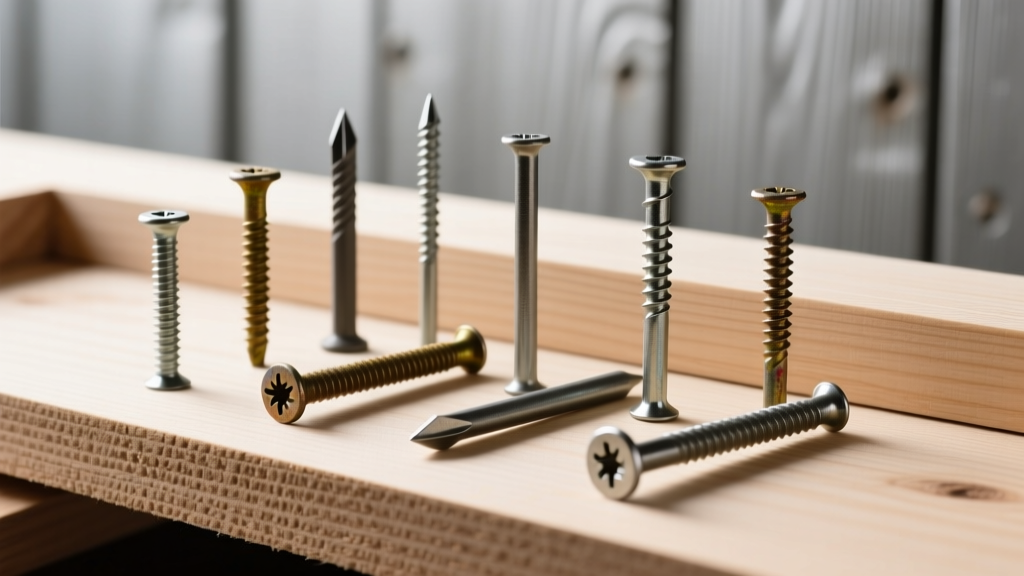
The Anatomy of Wood Fasteners: Beyond the Penny System
Selecting the correct types of nails for wood is not merely about matching lengths; it requires understanding shank geometry, metallurgical coatings, and head configurations. Using a smooth-shank common nail in engineered lumber or an electro-galvanized fastener in modern pressure-treated wood will result in catastrophic structural failures, backed-out fasteners, or severe corrosion within a single season.
The traditional "penny" system (denoted by the letter d) remains the baseline for hand-driven and pneumatic framing nails. However, modern building codes and engineered wood products demand precise dimensional tolerances that the penny system alone does not convey. For example, a 16d common nail measures 3.5 inches in length with a 0.162-inch diameter, while a 16d sinker nail measures 3.25 inches with a tapered 0.148-inch diameter. This 0.014-inch difference in diameter drastically alters the withdrawal resistance and the risk of splitting dense timber like Southern Yellow Pine or Douglas Fir.
- 6d: 2.0" length (Light framing, blocking)
- 8d: 2.5" length (Sheathing, subflooring, toe-nailing)
- 10d: 3.0" length (Heavy framing, joist hangers)
- 16d: 3.5" length (Primary structural framing, wall plates)
Head-to-Head: Structural Framing vs. Finish Nailing
The divergence between structural fasteners and finish carpentry nails lies in the trade-off between holding power and visual discretion. Below is a technical comparison matrix of the primary nail categories used in modern wood construction.
| Nail Category | Gauge / Diameter | Standard Lengths | Shank Options | Primary Application & Code Notes |
|---|---|---|---|---|
| Common Nail | 11.5 ga (0.162") | 2" to 6" | Smooth, Ring | Heavy framing, concrete formwork. Wide head provides high shear strength. |
| Sinker Nail | 11.5 ga (0.148" taper) | 2" to 5" | Ring, Spiral | Pneumatic framing. Tapered head allows countersinking without tearing wood fibers. |
| Box Nail | 12.5 ga (0.148") | 2" to 4" | Smooth | Light framing, cedar siding. Thinner shank reduces splitting in brittle woods. |
| Finish Nail (15/16ga) | 15ga (1.8mm) / 16ga (1.6mm) | 1" to 2.5" | Smooth | Crown molding, baseboards, door casings. Small barrel head leaves minimal putty void. |
| Brad Nail (18ga) | 18 ga (1.2mm) | 5/8" to 2" | Smooth | Shoe molding, delicate trim, temporary jig holding. Virtually invisible entry hole. |
Pneumatic Collation: Angles and Job-Site Realities
For production framing, the types of nails for wood are dictated by the collation format of the pneumatic nailer. The angle of the magazine determines the tool's ability to fit into tight corners, such as between joists or inside stair stringers.
- 21-Degree Plastic Strip: The standard for heavy framing. The plastic collation holds the nails rigidly, but it shatters upon firing, leaving small plastic debris on the subfloor. These nails typically feature full round heads, which are strictly required by the International Building Code (IBC) for shear wall nailing.
- 30 to 34-Degree Paper Tape: Preferred by finish and framing carpenters who demand a cleaner job site. The paper tape disintegrates cleanly. However, to achieve the tighter angle, these nails often feature clipped heads or offset full-round heads. Always verify local building codes, as some inspectors reject clipped-head nails for primary structural shear connections.
- 15-Degree Wire Coil: Used in coil nailers for high-volume sheathing and decking. The wire collation allows for massive magazine capacities (up to 300 nails), reducing reload time, but the tools are significantly heavier and cause operator fatigue during overhead work.

Shank Geometry and Withdrawal Resistance
The shank of the nail dictates how it interacts with the wood's cellular structure. Smooth shanks rely entirely on the friction and compression of displaced wood fibers. When wood undergoes seasonal moisture cycling (shrinking and swelling), smooth shanks lose their friction grip, leading to "nail pop" and squeaky subfloors.
Ring Shank (Annular Thread)
Ring shank nails feature concentric ridges that act like one-way barbs. Once driven, the wood fibers lock into the grooves. According to testing by the American Wood Council, ring shank nails can increase withdrawal resistance by 40% to over 100% compared to smooth shank nails of the identical diameter. They are mandatory for roof sheathing in high-wind zones to prevent uplift failure.
Spiral Shank
Spiral shanks feature a continuous twist, functioning similarly to a wood screw. As the nail is driven, it rotates, cutting through the wood fibers rather than crushing them. This makes spiral shanks the superior choice for dense hardwoods (like oak or maple flooring) and engineered lumber (LVL and PSL), where the extreme driving force of a ring shank might cause the material to split.
Corrosion, Coatings, and Treated Lumber Compatibility
Modern pressure-treated lumber has shifted away from Chromated Copper Arsenate (CCA) to Alkaline Copper Quaternary (ACQ) and Micronized Copper Azole (MCA-C). These newer preservatives are highly corrosive to standard steel and electro-galvanized coatings.
Code Warning: Using electro-galvanized (EG) or bright-finish nails in ACQ or MCA-C treated lumber will result in severe galvanic corrosion, compromising the structural integrity of the connection within 2 to 5 years.
For any exterior wood connection or pressure-treated sill plates, you must specify Hot-Dipped Galvanized (HDG) nails that meet ASTM A153 Class D standards, or utilize Type 304 or Type 316 Stainless Steel. Type 316 stainless is explicitly required for wood foundations exposed to saltwater environments or in direct contact with the ground. For a comprehensive breakdown of fastener-to-treatment compatibility, refer to the Simpson Strong-Tie Corrosion Guide, which provides exact metallurgical pairing matrices for modern preservatives.
Troubleshooting Common Wood Nail Failures
Symptom: Nail Back-Out and Subfloor Squeaks
Cause: Using smooth-shank nails in engineered wood products like OSB or I-joists. Engineered woods have different moisture expansion coefficients than solid sawn lumber. As the joist dries and shrinks, the smooth nail remains stationary, creating a gap that causes friction and squeaking under live loads.
Fix: Exclusively use 8d (2.5") or 10d (3") ring-shank or screw-shank nails for subflooring. Apply a continuous bead of polyurethane subfloor adhesive (e.g., OSI SUB300) alongside the joist before nailing to eliminate wood-to-wood friction entirely.
Symptom: Wood Splitting at the Edges and End-Grain
Cause: The "chisel point" found on many standard framing nails is designed to shear wood fibers to prevent bending the nail in hard woods. However, when driving these nails near the end of a board (end-grain) or within 1 inch of the edge, the shearing action acts as a wedge, forcing the board to split.
Fix: If hand-nailing, blunt the tip of the nail by striking it once with a hammer before driving it. A blunt tip crushes the fibers rather than wedging them apart. For pneumatic applications, switch to a "needle point" or "diamond point" finish nail, or pre-drill a pilot hole using a bit that is 1/64-inch smaller than the nail's shank diameter.
- Structural Framing & Shear Walls: 16d (3.5") Ring Shank, Full Round Head, HDG if treated.
- Subflooring: 8d (2.5") Ring Shank or Screw Shank + Adhesive.
- Exterior Trim & Siding: 8d to 10d Box Nail or Stainless Steel Finish Nail (Type 304).
- Interior Crown & Baseboard: 15-Gauge Angled Finish Nail (allows for toe-nailing into top plates).
Written by
Marcus ChenMarcus Chen is a licensed structural engineer (PE) and building materials analyst with over 12 years of experience across residential, commercial, and industrial construction. He holds a Master of Science in Civil Engineering from UC Berkeley and spent six years at Thornton Tomasetti before transitioning to independent consulting and technical writing. Marcus specializes in material selection for seismic-prone regions, concrete reinforcement strategies, and lifecycle cost analysis. His work has been cited by the American Concrete Institute (ACI) and the Structural Engineers Association of California (SEAOC). When he is not on a job site or at his desk, you will find him hiking the Sierra Nevada or restoring a 1920s craftsman bungalow in Oakland, CA.
More from Marcus Chen
View all
Construction Cost
How Much Did the Eiffel Tower Cost to Build?
How much did the Eiffel Tower cost to build in 1889? We adjust for inflation and compare its budget to modern skyscraper construction.
Aug 4, 2026

Fire Resistance
What Is a Fire Resistant Material? Testing & Certification Guide
Discover what is a fire resistant material through ASTM and UL testing. Learn how fire ratings, certifications, and assemblies work in construction.
Aug 4, 2026

Construction Cost
How Much Did the Burj Khalifa Cost to Build?
How much did the Burj Khalifa cost to build? We break down the $1.5B project and extract 5 money-saving strategies for your next build.
Jul 30, 2026