Selection Framework: Choosing the Right Types of Wood for Tables
Master our selection framework for types of wood for tables. Compare Janka hardness, wood movement, and pricing for dining, coffee, and outdoor tables.
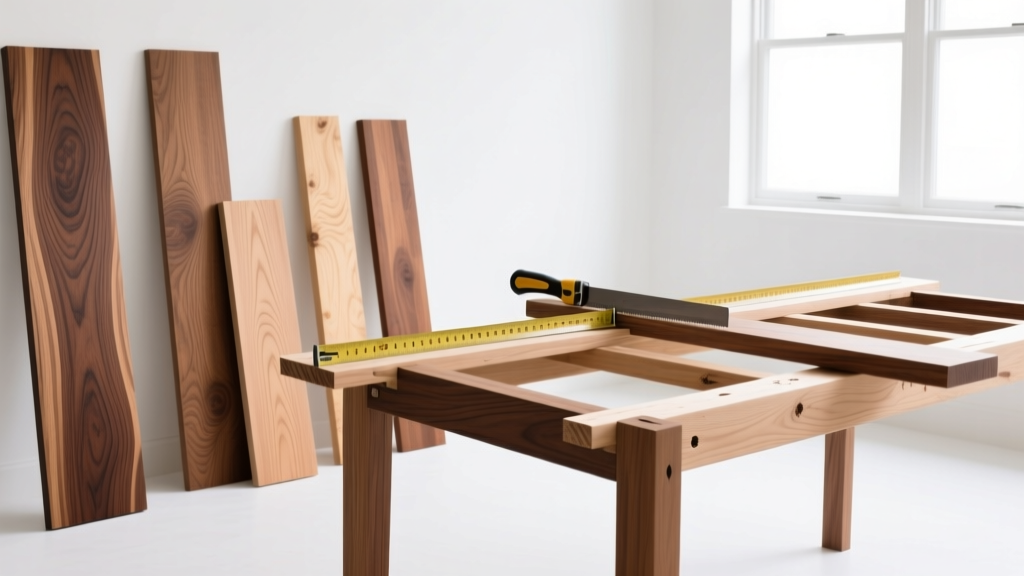
The 4-Pillar Table Wood Selection Framework
Selecting the correct lumber for a table requires balancing mechanical durability, dimensional stability, workability, and budget. Relying solely on aesthetics leads to premature finish failure, warped tops, and structural joint degradation. Professional millworkers and furniture makers evaluate the types of wood for tables using a strict four-pillar framework before purchasing a single board foot.
- Surface Durability (Janka Hardness): Resistance to denting from dropped utensils, heavy dishware, and daily impact.
- Dimensional Stability (T/R Ratio): The wood's resistance to warping, cupping, and splitting across wide panel glue-ups.
- Workability & Finish Compatibility: How the species interacts with modern polyurethanes, hardwax oils, and epoxy resins.
- Yield & Cost Efficiency: The true cost per usable board foot after accounting for waste, sapwood removal, and milling.
Hardness & Durability Matrix: The Janka Scale
The Janka hardness test measures the force required to embed a 0.444-inch steel ball halfway into the wood. For high-traffic dining tables, a minimum Janka rating of 900 lbf is recommended to prevent permanent denting. Below is a comparative matrix of premium table species, updated with 2026 market pricing for FAS (First and Second) grade lumber.
| Wood Species | Janka Hardness (lbf) | Tangential Shrinkage | T/R Ratio | Avg. Price / BF (2026) | Best Table Application |
|---|---|---|---|---|---|
| Hard Maple | 1,450 | 14.9% | 2.1 | $7.50 - $9.50 | Heavy-use commercial dining |
| White Oak | 1,360 | 10.5% | 1.8 | $9.00 - $12.00 | Premium residential dining |
| Black Walnut | 1,010 | 10.0% | 1.4 | $14.00 - $18.00 | Executive desks, coffee tables |
| American Cherry | 950 | 9.2% | 1.8 | $8.50 - $11.00 | Low-traffic console tables |
| Genuine Teak | 1,155 | 5.1% | 1.3 | $32.00 - $45.00 | Outdoor & patio tables |
Source reference for mechanical properties: The Wood Database Janka Hardness Scale.
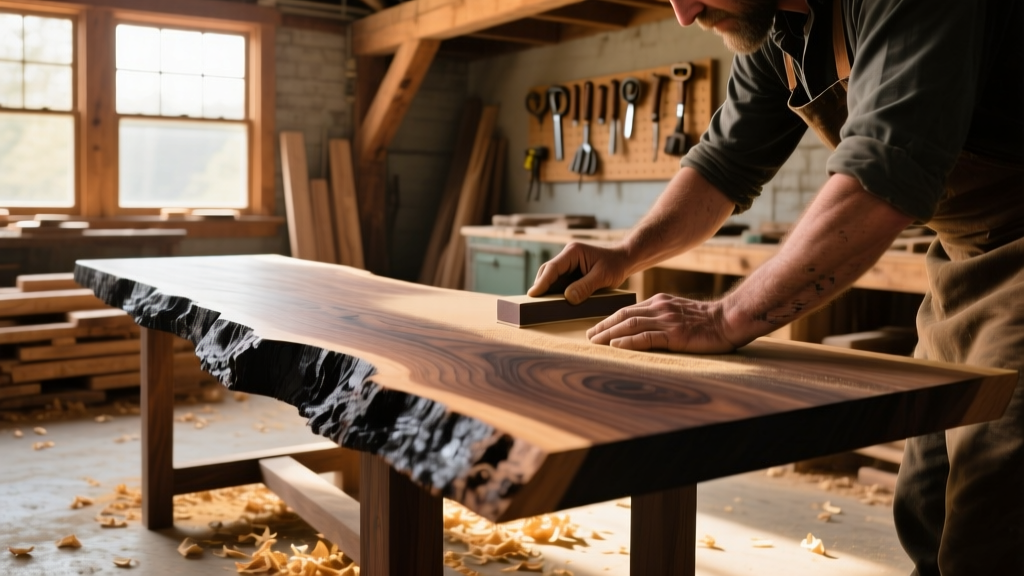
Wood Movement & Stability: Avoiding the Warp
Wood is hygroscopic; it constantly exchanges moisture with the surrounding environment. When building wide table tops (typically 36 to 48 inches wide), tangential shrinkage dictates how much the board will cup across its width. The most critical metric for table builders is the T/R Ratio (Tangential shrinkage divided by Radial shrinkage).
Expert Rule of Thumb: A T/R ratio closer to 1.0 indicates highly stable wood that shrinks evenly in all directions, drastically reducing cupping. Black Walnut (1.4) and Teak (1.3) are exceptionally stable. Hard Maple (2.1) is prone to severe cupping if not properly quartered or alternated during panel glue-ups.
Quartersawn vs. Plainsawn for Table Tops
If you are building a table wider than 30 inches using White Oak or Hard Maple, specify quartersawn (QS) lumber. Quartersawing aligns the growth rings perpendicular to the board face, exposing the highly stable radial plane. While QS lumber carries a 20% to 30% price premium over plainsawn, it reduces tangential movement by nearly half, preventing the tabletop from tearing itself apart at the glue lines during seasonal humidity swings.
Use-Case Decision Trees
Match your project requirements to the correct species using these specific decision pathways.
Scenario A: High-Traffic Family Dining Table
- Requirement: Must withstand dropped forks, heavy ceramic plates, and frequent cleaning with chemical sprays.
- Selection: Hard Maple or White Oak.
- Finish Protocol: Apply a 2-part commercial waterborne polyurethane (e.g., Bona Traffic HD or Milesi). Avoid penetrating hardwax oils like Rubio Monocoat for high-traffic dining, as they require annual re-oiling and offer lower chemical resistance to acidic foods.
Scenario B: Live-Edge Coffee Table with Epoxy River
- Requirement: High dimensional stability to prevent the wood from pulling away from the epoxy pour during seasonal contraction.
- Selection: Black Walnut.
- Edge Case Warning: Walnut's T/R ratio of 1.4 makes it the most stable domestic hardwood for epoxy encapsulation. Always seal the live edge with a thin coat of shellac before pouring epoxy to prevent micro-bubbles from outgassing out of the porous bark cambium layer.
Scenario C: Uncovered Outdoor Patio Table
- Requirement: Natural rot resistance, UV tolerance, and immunity to wood-boring insects.
- Selection: Genuine Teak or Ipe.
- Workability Warning: Teak contains high levels of natural silica and oils. You must wipe all glue joints and finish surfaces with acetone or naphtha immediately before assembly to ensure adhesion. Standard PVA wood glues will fail on untreated Teak.
Sourcing & Milling Specifications
When ordering lumber for a table from a specialty hardwood dealer, vague requests lead to wasted material. Use these exact specifications to ensure you receive table-grade stock:
The Professional Lumber Order Checklist
- Grade: Specify FAS (First and Second) for long, wide, clear cuttings. Avoid #1 Common unless you are intentionally seeking character marks and knots for a rustic table.
- Moisture Content (MC): Demand kiln-dried (KD) lumber metered to 6% - 8% MC for indoor, climate-controlled environments. Lumber dried to 12% MC (standard for exterior construction) will shrink and crack when brought into a modern HVAC-controlled home.
- Milling: Order S2S (Surfaced Two Sides) to 7/8' or 13/16' thickness. This leaves you exactly 1/16' of material to remove via drum sander or hand plane after the panel glue-up to achieve a final 3/4' thickness.
- Width Constraints: Request random widths but specify a minimum average width of 6' to minimize the number of glue lines in your tabletop, reducing visible seams and structural weak points.
Expert Edge Cases & Troubleshooting
Even with the right species, table builds fail due to improper mechanical accommodation of wood movement. According to the Architectural Woodwork Institute (AWI) standards, solid wood panels must never be rigidly fastened to their aprons or bases.
Z-Clips and Figure-8 Fasteners
Never glue or screw a solid wood tabletop directly into a wooden apron. As the top expands across its width in high-humidity summer months, a rigidly attached top will either crack down the center or bow the apron outward. Use Z-clips or figure-8 fasteners installed in slots routed into the apron. This allows the tabletop to slide laterally by up to 3/8' over the course of a year, accommodating the hygroscopic expansion detailed in the Wood Movement guidelines.
Preventing Finish Failure on Open-Grain Woods
Species like White Oak and Ash have large, open pores. If you attempt to apply a high-gloss film finish (like lacquer or polyurethane) directly to the raw wood, the finish will sink into the pores, creating a pockmarked, uneven surface. You must apply a paste wood grain filler (such as Aqua Coat or Timbermate) tinted to match the wood, sanded back to bare wood, before applying your topcoat. Skipping this step is the most common cause of amateur finish rejection on open-grain table tops.
Written by
David NakamuraDavid Nakamura is a licensed architect (AIA) and construction technology writer focused on sustainable building methods, mass timber engineering, and high-performance building envelopes. He holds a Master of Architecture from the University of Washington and is a certified Passive House Consultant (CPHC). David spent eight years at the Seattle firm Mithun, where he led the design of three LEED Platinum projects, before founding his own practice specializing in net-zero residential design. He serves on the editorial advisory board of GreenBuilder Magazine and has authored peer-reviewed papers on cross-laminated timber (CLT) connections for the Journal of Structural Engineering. In his spare time, David teaches woodworking at Pratt Fine Arts Center and kayaks the Puget Sound.
More from David Nakamura
View all
Construction Cost
Labor Cost to Build a Deck Per Sq Ft: 2026 Installation Guide
Discover the exact labor cost to build a deck per sq ft in 2026. This installation guide breaks down contractor rates, complexity factors, and hidden fees.
Aug 4, 2026

Construction Cost
How Much Does It Cost to Build a 3 Bedroom House? Financing Guide
Learn exactly how much it costs to build a 3 bedroom house and explore 2026 financing options, construction loan types, and budget frameworks for your build.
Aug 4, 2026

Construction Cost
Cost to Build a Tennis Court: 2026 Guide
How much does it cost to build a tennis court in 2026? Breakdowns for asphalt, concrete, and synthetic surfaces plus fencing and lighting.
Jul 30, 2026