Identifying Types of Wood Boring Beetles Before Timber Installation
Learn to identify common types of wood boring beetles and apply pre-installation inspection and treatment best practices to protect structural timber.

The Hidden Threat in Reclaimed and Structural Timber
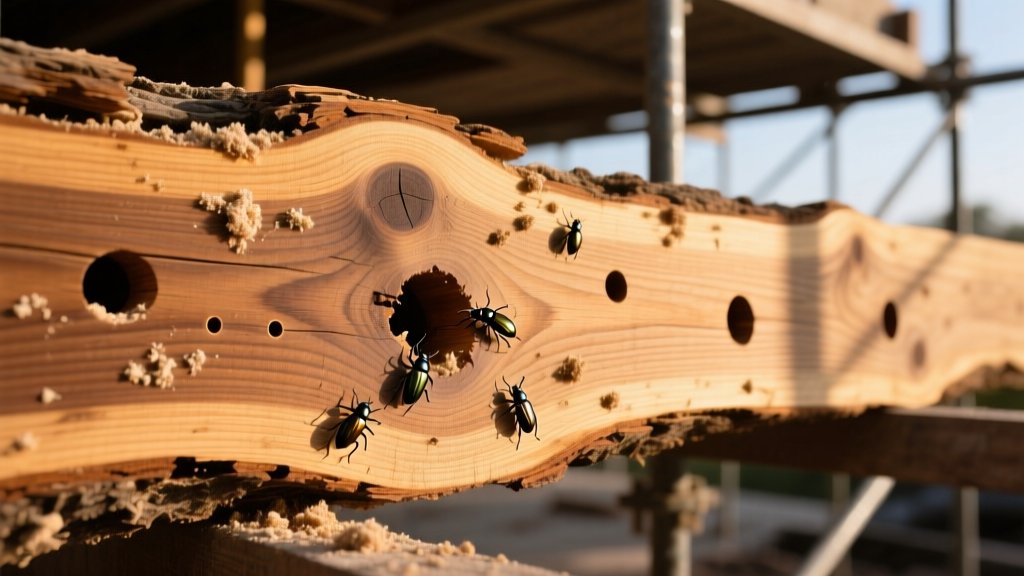
Integrating reclaimed lumber, heavy timber framing, and custom hardwood flooring adds immense architectural value to modern builds. However, introducing untreated or improperly inspected wood to a job site carries a severe biological risk: wood-boring beetles. If installed before an active infestation is identified and eradicated, these insects can compromise structural integrity, destroy high-end finishes, and require tens of thousands of dollars in remediation. Understanding the specific types of wood boring beetles and implementing rigorous pre-installation protocols is non-negotiable for contractors and architects.
The 4 Primary Types of Wood Boring Beetles in Construction
Accurate identification dictates your treatment strategy. Different species target different wood densities, require specific moisture levels, and leave distinct signatures. According to University of Kentucky Entomology, the vast majority of structural damage in North America is caused by four distinct families.
| Beetle Family | Common Name | Target Wood | Exit Hole Size/Shape | Frass Texture |
|---|---|---|---|---|
| Lyctidae | True Powderpost | Hardwoods (Oak, Ash, Hickory) | 1/32' to 1/16' (Round) | Fine, like talcum powder |
| Anobiidae | Deathwatch / False Powderpost | Softwoods & Hardwoods | 1/16' to 1/8' (Round) | Gritty, pellet-like |
| Cerambycidae | Old House Borer | Softwoods (Pine, Spruce, Fir) | 1/4' to 3/8' (Oval) | Coarse, sawdust-like |
| Bostrichidae | False Powderpost | Hardwoods & Bamboo | 1/8' to 3/8' (Round) | Meal-like, tightly packed |
Moisture Content Thresholds for Beetle Survival
Wood moisture content (MC) is the primary limiting factor for Anobiid and Cerambycid beetles. Lyctid powderpost beetles can thrive in wood with an MC as low as 8%, making them a persistent threat in climate-controlled interiors. Conversely, Anobiid beetles (Deathwatch) require an MC above 14% to complete their life cycle. If your structural timber is properly kiln-dried and maintained below 12% MC, Anobiid infestations will naturally halt, though Lyctids may still pose a risk.
Pre-Installation Inspection Protocol: Step-by-Step
Visual inspection alone is insufficient. A rigorous pre-installation protocol requires specific tools and methodical evaluation.
- Deploy Pin-Type Moisture Meters: Use a calibrated pin-type meter like the Delmhorst J-2000 or a pinless scanner like the Wagner Orion 920. Test the end-grain and the center of the timber thickness. Reject any structural softwood intended for interior use if the MC exceeds 14%.
- Examine the End-Grain: Beetles preferentially lay eggs in the open pores of the end-grain. Use a 10x jeweler's loupe to inspect the end-grain for oviposition sites (tiny eggs inserted into wood pores).
- Perform the Frass Rub Test: If you find exit holes, collect the frass (wood dust) and rub it between your fingers. As noted by Penn State Extension, Lyctid frass feels like fine flour, while Anobiid frass feels gritty and contains distinct fecal pellets. This dictates your chemical treatment choice.
- Utilize Borescopes for Hollow Timbers: For large glulam beams or reclaimed box beams, drill a discreet 1/4' hole and insert an articulating borescope camera to check for internal tunneling and structural voiding that is invisible from the exterior.
Treatment and Remediation Best Practices
If an active infestation is detected prior to installation, or if you are proactively treating high-risk reclaimed wood, surface-level insecticides are useless. You must use borate-based penetrating treatments.
Borate Treatments: Bora-Care and Tim-bor
Disodium octaborate tetrahydrate (DOT) is the industry standard for wood preservation. Products like Bora-Care (liquid) and Tim-bor (water-soluble powder) penetrate raw wood and remain toxic to beetles indefinitely.
Cost and Coverage Data (2026 Estimates):
- Bora-Care (1 Gallon): Retails for $130 - $150. At a 1:1 dilution for active infestations, it covers approximately 800 board feet. At a 1:4 dilution for preventative pre-treatment, it covers up to 4,000 board feet.
- Tim-bor Professional (1.5 lb pouch): Retails for $35 - $45. Mixed at a 10% solution (1.5 lbs per gallon of water), it covers roughly 1,000 sq ft of wood surface.
Application Technique for Maximum Penetration
Apply the borate solution using a low-pressure pump sprayer (40-60 PSI). The wood must be sprayed to the point of refusal (surface runoff). For thick timbers exceeding 4 inches in depth, surface spraying will not reach the core. In these cases, contractors must drill 1/8' holes every 12 inches along the timber and inject the borate solution directly into the heartwood using a pressurized injection rod.
Installation Safeguards and Environmental Controls
Proper installation practices prevent re-infestation and create an environment hostile to wood-boring insects.
- Ground Clearance: Maintain a minimum 18-inch clearance between any structural timber and the soil. This prevents splash-back moisture accumulation and physical contact with soil-dwelling insect vectors.
- Proper Stickering During Storage: When staging timber on-site before installation, use dry, treated 'stickers' (spacers) every 24 inches to allow 360-degree air circulation. Never stack timber directly on concrete, which wicks moisture and raises the MC of the bottom boards into the Anobiid danger zone (>14%).
- Vapor Retarders: In crawlspaces and basements, install a minimum 10-mil cross-laminated polyethylene vapor barrier over 100% of the exposed earth to control ambient humidity and keep floor joist MC below 12%.
'Kiln-drying lumber to a core temperature of 133°F for a minimum of 30 minutes is the only guaranteed method to sterilize wood and kill all life stages of wood-boring beetles prior to transport and installation.' — USDA Forest Products Laboratory Guidelines
Frequently Asked Questions (FAQ)
Can wood-boring beetles spread to adjacent non-infested framing?
Yes, but it depends on the species and the finish. Old House Borers (Cerambycidae) frequently emerge and lay eggs in adjacent untreated softwoods. True Powderpost beetles (Lyctidae) will only infest adjacent hardwoods with open pores (like oak or ash) and will ignore softwoods like pine or drywall.
Does painting over exit holes stop the infestation?
No. Painting over exit holes is a cosmetic fix that traps the insects inside. The larvae will continue to consume the interior of the timber and will simply chew new exit holes through the paint when they emerge, ruining the finish and leaving structural damage unaddressed.
Is fumigation required for structural timber?
Whole-structure fumigation (using Vikane gas) is typically reserved for post-construction, whole-home infestations where localized treatment is impossible. For pre-installation timber, localized borate injection and surface spraying are vastly more cost-effective and provide permanent residual protection, whereas fumigation leaves no residual chemical barrier.
Written by
Elena RodriguezElena Rodriguez is a civil engineer and technical writer specializing in concrete technology, masonry systems, and ASTM/ACI compliance. She earned her B.S. in Civil Engineering from Texas A&M University and spent a decade at a materials testing laboratory, performing over 2,000 concrete compressive strength tests and masonry prism evaluations. Elena is an ACI-certified Field Testing Technician (Grade I) and a member of ASTM Committee C12 on Natural Building Stone. She currently consults on forensic engineering cases involving concrete failures and moisture intrusion. Based in San Antonio, TX, Elena is a proud member of the Society of Women Engineers (SWE) and coaches her daughter's FIRST Robotics team.
More from Elena Rodriguez
View all
Walls & Panels
Cost Analysis: Light Gauge Steel Framing Advantages and Disadvantages
Evaluate light gauge steel framing advantages and disadvantages through a strict cost analysis lens, comparing material, labor, and lifecycle expenses.
Aug 4, 2026

Walls & Panels
Gypsum Board Types: Exact Specifications, Thickness & Dimensions
Compare standard, Type X, and moisture-resistant gypsum board types. Get exact specifications, thicknesses, dimensions, and ASTM standards for your project.
Aug 4, 2026

Fire Resistance
Best Fire-Resistant Outdoor Decking Materials: 2026 Buyer Guide
Discover the best fire-resistant outdoor decking materials for 2026. Compare Class A PVC, aluminum, and hardwood options for WUI compliance and safety.
Aug 4, 2026