Evaluating Types of Wood for Construction: A Cost & Value Guide
Compare the cost, structural value, and ROI of various types of wood for construction, from SPF framing to premium engineered timber.

The True Cost of Lumber: Beyond the Price Tag
Selecting the right materials for a structural envelope requires looking past the initial invoice. When evaluating different types of wood for construction, the true cost encompasses structural capacity (Fb and E values), moisture-induced shrinkage, waste factors, and long-term warranty liabilities. A cheaper board foot of lumber that requires closer joist spacing or results in drywall callbacks due to shrinkage ultimately destroys project margins. This analysis breaks down the cost-to-value ratio of primary construction lumber categories, providing a data-driven framework for builders, architects, and developers.
- Highest ROI for Floor Joists: Southern Yellow Pine (SYP) #2 Grade
- Best Value for Wall Studs: SPF (Spruce-Pine-Fir) Stud Grade
- Best Value for Long-Span Beams: 2.0E LVL (Laminated Veneer Lumber)
- Highest Hidden Cost Risk: S-GRN (Surfaced Green) framing lumber in climate-controlled builds
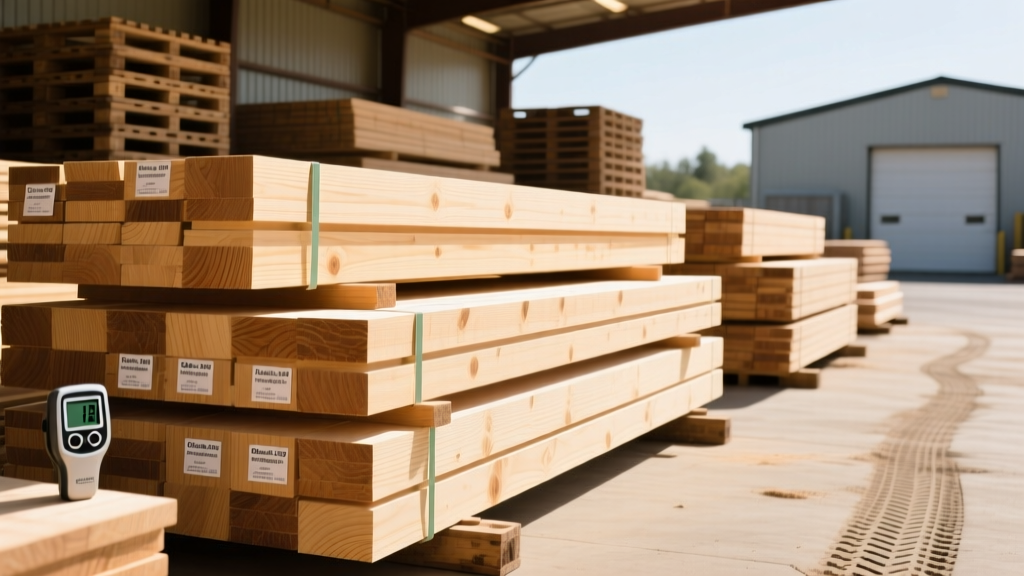
Softwood Framing Lumber: SPF, Douglas Fir, and Southern Pine
Dimensional softwood remains the backbone of light-frame construction. However, treating all 2x lumber as a commodity is a critical estimating error. The three primary species groups—SPF, SYP, and DF-L—offer vastly different structural properties that directly impact framing labor and material volume.
Structural Capacity vs. Cost Breakdown
The value of framing lumber is best measured by its allowable bending stress (Fb) and modulus of elasticity (E). Higher Fb values allow for wider on-center (o.c.) spacing or longer spans, reducing the total number of joists required.
| Species Group (Grade #2) | Fb (psi) | E (psi) | Est. Cost per MBF (2026) | Optimal Application & Value Insight |
|---|---|---|---|---|
| SPF (Spruce-Pine-Fir) | 1,350 | 1,600,000 | $420 - $480 | Vertical wall studs. High Fb not required; low cost maximizes margin. |
| SYP (Southern Yellow Pine) | 1,800 | 1,700,000 | $500 - $580 | Floor joists and rafters. 33% higher Fb than SPF allows 19.2" or 24" o.c. spacing. |
| DF-L (Douglas Fir-Larch) | 1,500 | 1,900,000 | $620 - $750 | Heavy load-bearing headers and beams. Superior stiffness (E) minimizes floor bounce. |
According to the USDA Forest Products Laboratory Wood Handbook, Southern Yellow Pine consistently outperforms other softwoods in bending strength and fastener withdrawal resistance. While SYP carries a 15% to 20% price premium over SPF per thousand board feet (MBF), its superior Fb value often allows framers to step down from 2x10 to 2x8 joists, or increase spacing from 16" to 19.2" o.c., resulting in a net material savings of 4% to 7% on the floor system.
Engineered Wood Products (EWP): The High-Value Alternative
When spans exceed 20 feet or load requirements surpass the capacity of solid sawn timber, Engineered Wood Products (EWPs) transition from a premium upgrade to a cost necessity. EWPs eliminate the natural defects (knots, slope of grain) that limit solid lumber.
LVL and Glulam Cost Analysis
Laminated Veneer Lumber (LVL) is manufactured in distinct stiffness grades, primarily 1.9E and 2.0E. Upgrading from a 1.9E to a 2.0E LVL beam typically costs 8% to 12% more per linear foot. However, the 2.0E grade can span up to 18 inches further under identical loads. In open-concept residential builds, this extra span can eliminate the need for a mid-span steel column and concrete footing, saving $1,500 to $2,500 in structural steel and labor.
Unlike pressure-treated solid lumber, standard LVL and Glulam beams are highly susceptible to edge-swelling and delamination if exposed to weather during the framing stage. If your site has a history of delayed drying-in, factor in the cost of specialized weather-resistant EWP coatings or specify solid-sawn heavy timber, which tolerates temporary moisture exposure far better without structural degradation.
Cross-Laminated Timber (CLT) represents the frontier of commercial wood construction. While CLT panels cost between $8.00 and $13.00 per square foot (depending on 3-ply vs. 5-ply thickness), the APA - The Engineered Wood Association notes that CLT acts as both the structural frame and the finished ceiling, eliminating the need for secondary fireproofing, drywall, and acoustic drop ceilings. This dual-purpose value drastically reduces overall project schedules and trade stacking costs.
Hardwoods and Heavy Timber: Architectural ROI
Specifying hardwoods or heavy timber (minimum 5x5 nominal dimensions) is rarely about structural necessity; it is about architectural exposure and lifecycle durability. White Oak and Black Locust command $2,800 to $4,500+ per MBF, making them prohibitive for hidden framing. However, their value emerges in specific high-wear or high-moisture applications.
- White Oak (Quercus alba): Contains tyloses that naturally block water penetration. Highly valued for exterior decking, boardwalks, and marine construction where composite materials lack the required structural shear strength.
- Douglas Fir Heavy Timber: Offers a predictable charring rate of 1.5 inches per hour. In Type IV (Heavy Timber) commercial construction, exposed DF beams provide inherent 2-hour fire resistance without the recurring maintenance costs of intumescent paint applied to structural steel.
Hidden Costs: Moisture, Grading, and Waste Factors
The most severe budget overruns in wood construction stem from ignoring the grading stamp's moisture content indicators. Lumber is stamped either S-DRY (surfaced dry, maximum 19% moisture content) or S-GRN (surfaced green, moisture content above 19%).
The S-GRN Liability
Purchasing S-GRN lumber might save 5% to 8% on the initial lumber package. However, as S-GRN lumber acclimates to the interior HVAC environment (typically dropping to 8%-12% MC), it shrinks. A 2x10 joist can shrink up to 3/8" in width. When stacked in multi-story construction (e.g., top plates, rim joists, and floor joists), this shrinkage compounds. In a three-story building, cumulative vertical shrinkage can exceed 1.5 inches, leading to:
- Severe drywall cracking at wall-to-ceiling intersections.
- Binding and shearing of rigid plumbing stacks.
- Door frame racking and window casing separation.
Value Engineering Rule: Always specify S-DRY or KD19 (Kiln-Dried to 19%) for all interior framing and multi-story load-bearing walls. The 8% upfront premium prevents warranty callbacks that routinely cost 3x to 5x the initial material savings.
Pressure-Treated End-Cut Failures
When using pressure-treated Southern Yellow Pine for sill plates or deck framing, cutting the board exposes untreated heartwood. Failing to apply an end-cut preservative (such as a copper naphthenate or MCA-based solution) to field cuts voids the manufacturer's warranty and invites localized rot. Factor $45 to $60 per job site for end-cut preservative and the labor to apply it; omitting this step compromises the entire value proposition of using treated lumber.
Decision Framework: Matching Wood Type to Project Budget
To maximize the ROI of your lumber package, apply this four-step decision framework during the estimating phase:
- Segment by Structural Demand: Do not order a single species for the entire frame. Use SYP #2 for floor joists and rafters (maximizing span), and SPF Stud grade for interior non-load-bearing and standard exterior walls (minimizing cost).
- Calculate the EWP Crossover Point: When a solid sawn beam requires three or more 2x12s nailed together (built-up beam), switch to a single-ply 1.9E or 2.0E LVL. The LVL will be cheaper when factoring in the labor cost of crowning, aligning, and nailing multiple plies, plus it will not twist or shrink.
- Audit the Moisture Profile: Review the grading stamps on the lumber takeoff. Reject any S-GRN material destined for interior climate-controlled spaces. Verify that all treated lumber orders include compatible hot-dipped galvanized or stainless steel fasteners to prevent galvanic corrosion, which degrades connection strength.
- Factor in Waste and Cull Rates: Standard framing lumber carries a 5% to 8% cull rate (warped, bowed, or split boards unfit for structural use). Engineered wood products (I-joists and LVL) have a near-zero cull rate. Adjust your waste factor in the estimating software accordingly to prevent over-ordering.
Sourcing and Market Trends Impacting Lumber Value
Lumber pricing remains subject to global supply chain dynamics, Canadian harvest quotas, and North American housing starts. To lock in value, builders should leverage certified sustainable sourcing. According to the National Lumber Grades Authority (NLGA), adhering to strict grading rules ensures that the structural properties assumed in architectural plans match the physical material on site. Furthermore, specifying SFI (Sustainable Forestry Initiative) or FSC-certified lumber increasingly satisfies municipal green building mandates, allowing developers to secure density bonuses and tax incentives that far outweigh the negligible per-board-foot premium of certified wood.
Written by
Sarah WhitfieldSarah Whitfield is a chartered quantity surveyor (MRICS) and construction cost analyst with 15 years of experience in material pricing, procurement strategy, and project budgeting. She earned her degree in Construction Management from the University of Reading (UK) and has worked on projects ranging from $2M custom homes to $180M mixed-use developments across North America and Europe. Sarah currently leads cost estimating for BuildMat Insight, maintaining a proprietary database of 4,000+ material price points updated quarterly. She is a frequent contributor to RSMeans cost data panels and has presented at the International Cost Engineering Council (ICEC) congress. Based in Denver, CO, Sarah is an avid trail runner and volunteer mentor for Women in Construction.
More from Sarah Whitfield
View all
Wood & Lumber
What Are the Different Types of Wood? A Builder's Guide
Compare structural softwoods, finish hardwoods, and engineered lumber. Analyze Janka ratings, MOE values, and 2026 pricing for construction.
Aug 4, 2026

Walls & Panels
Steel Framing vs Wood Framing: Corrosion and Moisture Defense
Compare steel framing vs wood framing for moisture resistance. Learn about galvanized coatings, condensation risks, and corrosion protection strategies.
Jul 21, 2026

Stone & Masonry
How to Cut Stone Veneer: Wet Saw vs Grinder Comparison
Compare the best tools for cutting stone veneer. We review wet saws, angle grinders, and chop saws to help you achieve clean, chip-free cuts.
Jul 21, 2026