Types of Wood Boards Compared: Framing, Finish, and Sheet Goods
Compare types of wood boards for construction. Expert analysis of dimensional framing lumber, finish hardwoods, and engineered sheet goods with costs.
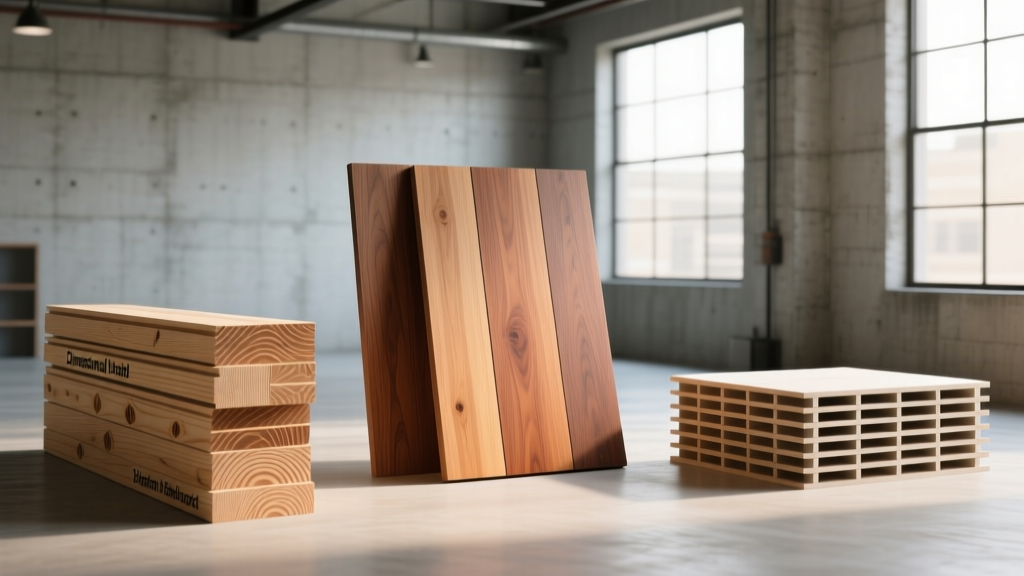
Selecting the correct lumber requires navigating nominal sizing, moisture content stamps, and species-specific load capacities. The phrase 'types of wood boards' encompasses vastly different material categories, each governed by distinct grading agencies and structural testing protocols. Misapplying a finish-grade board for structural sheathing, or using green framing lumber in a climate-controlled interior, leads to catastrophic fastener withdrawal failures, drywall pops, and severe warping. This comparison review dissects dimensional lumber, appearance boards, and engineered sheet goods to provide exact specifications for structural and finish applications.
The Core Matrix: Dimensional vs. Finish vs. Engineered
Before evaluating specific species, it is critical to understand the three primary manufacturing categories. The following matrix outlines the baseline specifications and 2026 market pricing for standard construction and millwork applications.
| Board Category | Primary Application | Governing Standard / Grade | Target Moisture Content (MC) | Avg. Cost (2026) |
|---|---|---|---|---|
| Dimensional Softwood | Framing, joists, load-bearing walls | SPIB / WWPA (#2 & Btr) | Max 19% (S-DRY / KD) | $3.80 - $5.20 / 8ft 2x4 |
| Finish Hardwood | Cabinetry, trim, furniture, flooring | NHLA (FAS, Select, #1 Common) | 6% - 8% (Kiln-Dried) | $5.50 - $9.00 / board foot |
| Engineered Sheet Goods | Sheathing, subfloor, cabinet boxes | APA - The Engineered Wood Assoc. | Varies (Exposure 1 / Exterior) | $55.00 - $85.00 / 4x8 sheet |
Dimensional Lumber: Structural Framing and Load Paths
Dimensional lumber is the backbone of light-frame construction. When evaluating types of wood boards for structural use, the grade stamp provides the exact engineering data required for compliance with the International Residential Code (IRC). According to the American Wood Council span tables, the species and grade dictate the allowable bending stress (Fb) and modulus of elasticity (E).
Species Comparison: SPF vs. Southern Yellow Pine (SYP)
- SPF (Spruce-Pine-Fir): The standard for interior wall framing. It is lightweight, easy to cut, and holds paint well. However, its specific gravity is lower, meaning fastener withdrawal strength is roughly 20% to 30% lower than denser softwoods.
- Southern Yellow Pine (SYP): Essential for floor joists, roof rafters, and load-bearing headers. SYP boasts a high specific gravity (0.55 average), providing superior nail-holding capacity and bending strength. A #2 grade SYP 2x10 can span significantly further than an equivalent SPF board under the same live load conditions.
- Douglas Fir-Larch: Highly preferred in seismic and high-wind zones due to its excellent shear strength and dimensional stability when subjected to cyclic moisture changes.
Finish and Appearance Boards: Trim, Cabinetry, and Millwork
Unlike structural lumber graded for load-bearing capacity, finish boards are graded by the National Hardwood Lumber Association (NHLA) based on the percentage of clear, defect-free cuttings that can be yielded from a board.
Decoding NHLA Hardwood Grades
- FAS (First and Seconds): The premium tier. Requires a minimum board size of 6 inches wide and 8 feet long, yielding at least 83.3% clear face cuttings. Mandatory for long, continuous runs of baseboard, crown molding, and high-end architectural millwork where finger-joints are unacceptable.
- Select: Similar clear-face requirements to FAS, but allows for slightly smaller minimum board sizes (4 inches wide, 6 feet long). Ideal for cabinet face frames and furniture components.
- #1 Common: The most cost-effective grade for cabinetry. Yields 66.6% clear cuttings in smaller segments. Perfect for kitchen cabinet doors and drawer fronts where the board is cut into shorter pieces, allowing the millworker to cut around knots and mineral streaks.
Hardwood vs. Softwood Appearance Boards
For painted trim (baseboards, window casings), paint-grade softwoods like Ponderosa Pine or MDF-wrapped pine are standard. However, for stain-grade applications, hardwoods like Red Oak, White Oak, and Hard Maple are required. White Oak (Janka hardness: 1,360 lbf) is vastly superior to Red Oak (1,290 lbf) for high-traffic stair treads and flooring due to its closed-cell tylose structure, which provides natural rot resistance and prevents water from wicking through the end grain.
Engineered Sheet Goods: Plywood, OSB, and MDF
When project dimensions exceed the maximum width of solid lumber (typically 12 inches for hardwoods), engineered sheet goods become necessary. The USDA Forest Products Laboratory provides extensive data on the mechanical properties of these composite types of wood boards.
Structural Panels: Plywood vs. OSB
| Property | CDX Plywood (3/4 inch) | OSB (Oriented Strand Board, 3/4 inch) |
|---|---|---|
| Shear Strength | Higher (cross-laminated veneers) | Slightly lower, but meets IRC shear wall specs |
| Moisture Recovery | Excellent (dries out and retains strength) | Poor (edges swell permanently if exposed to bulk water) |
| Fastener Holding | Superior at panel edges | Adequate, but prone to blowout near edges |
Interior Composites: MDF vs. Particleboard
For cabinet box construction, 3/4-inch Medium Density Fiberboard (MDF) has largely replaced particleboard in high-end millwork. MDF features a uniform density profile and zero grain direction, allowing for perfectly machined dados and rabbets. However, MDF is exceptionally heavy (a 4x8 sheet weighs over 90 lbs) and requires specialized carbide-tipped tooling, as the high resin content rapidly dulls standard high-speed steel (HSS) saw blades.
Moisture Content (MC) and Acclimation Protocols
The most common failure mode in woodworking and framing is ignoring equilibrium moisture content (EMC). Wood is hygroscopic; it continuously exchanges moisture with the surrounding air until it reaches EMC.
- Framing Lumber (S-DRY): Stamped S-DRY indicates a maximum MC of 19% at the time of surfacing. If installed immediately in a winter-heated home (where indoor relative humidity can drop below 20%), the lumber will rapidly dry to an EMC of 6% to 8%. This causes severe tangential shrinkage, resulting in nail pops in drywall and squeaking floor joists.
- Hardwood Flooring & Trim: Must be acclimated to the interior environment for a minimum of 7 to 14 days before installation. Use a pin-type moisture meter to verify the MC is within 2% of the subfloor's MC.
Decision Framework: Matching Board Type to Project Load
Use this conditional logic to specify the correct material for your next build:
- IF building a load-bearing exterior shear wall THEN use SYP or Douglas Fir #2 or better, stamped S-DRY, sheathed with 1/2-inch CDX Plywood (Exposure 1).
- IF fabricating paint-grade interior crown molding THEN use finger-jointed pine or MDF-core moulding to prevent seasonal grain-telegraphing through the paint film.
- IF constructing a wet-area subfloor (bathroom) THEN use 3/4-inch tongue-and-groove plywood with a phenol-formaldehyde exterior glue line, avoiding OSB due to edge-swell risks from plumbing condensation.
- IF building stain-grade library shelving THEN use 3/4-inch birch plywood with solid hardwood edge-banding, as solid lumber wider than 8 inches will warp under the sustained load of books.
Frequently Asked Questions
What is the difference between nominal and actual board dimensions?
Nominal dimensions refer to the rough-sawn size of the log before drying and planing. A '2x4' is nominally 2 inches by 4 inches. After kiln-drying (which shrinks the wood) and surface planing (which smooths it), the actual dimensions are reduced to 1.5 inches by 3.5 inches. Always use actual dimensions for structural engineering and spatial planning.
Can I use pressure-treated lumber for indoor framing?
No. Pressure-treated lumber (typically SYP treated with Alkaline Copper Quaternary - ACQ or Copper Azole) is strictly rated for ground contact or exterior moisture exposure. The high moisture content at the time of treatment (often above 35%) and the corrosive nature of the chemical preservatives make it unsuitable for interior framing, where it will shrink excessively and corrode standard zinc-plated fasteners and electrical boxes.
How do I calculate board feet for hardwood pricing?
Hardwoods are sold by the board foot (BF), not by linear foot. The formula is: (Thickness in inches × Width in inches × Length in inches) ÷ 144. For example, a piece of walnut measuring 1 inch thick, 6 inches wide, and 96 inches long equals exactly 4 board feet [(1 × 6 × 96) ÷ 144 = 4].
Written by
Sarah WhitfieldSarah Whitfield is a chartered quantity surveyor (MRICS) and construction cost analyst with 15 years of experience in material pricing, procurement strategy, and project budgeting. She earned her degree in Construction Management from the University of Reading (UK) and has worked on projects ranging from $2M custom homes to $180M mixed-use developments across North America and Europe. Sarah currently leads cost estimating for BuildMat Insight, maintaining a proprietary database of 4,000+ material price points updated quarterly. She is a frequent contributor to RSMeans cost data panels and has presented at the International Cost Engineering Council (ICEC) congress. Based in Denver, CO, Sarah is an avid trail runner and volunteer mentor for Women in Construction.
More from Sarah Whitfield
View all
Wood & Lumber
What Are the Different Types of Wood? A Builder's Guide
Compare structural softwoods, finish hardwoods, and engineered lumber. Analyze Janka ratings, MOE values, and 2026 pricing for construction.
Aug 4, 2026

Walls & Panels
Steel Framing vs Wood Framing: Corrosion and Moisture Defense
Compare steel framing vs wood framing for moisture resistance. Learn about galvanized coatings, condensation risks, and corrosion protection strategies.
Jul 21, 2026

Stone & Masonry
How to Cut Stone Veneer: Wet Saw vs Grinder Comparison
Compare the best tools for cutting stone veneer. We review wet saws, angle grinders, and chop saws to help you achieve clean, chip-free cuts.
Jul 21, 2026