Austin Retaining Wall Contractors Cost: Limestone vs Concrete Guide
Compare Austin retaining wall contractors cost for limestone vs concrete. Get current pricing, installation steps, and material pros and cons for your project.

The Austin Terrain: Why Material Choice Dictates Contractor Pricing
Building a retaining wall in Central Texas is not a standard landscaping project; it is a geotechnical challenge. When evaluating Austin retaining wall contractors cost, homeowners quickly discover that local geology—specifically the Edwards Plateau caliche bedrock and the Blackland Prairie expansive clay—drives labor and material expenses far above national averages. The decision between natural Texas Hill Country limestone and engineered concrete (poured or CMU block) fundamentally alters the excavation, drainage, and masonry phases of your project.
Limestone offers an authentic, mortarless aesthetic that blends seamlessly with the local environment, but it requires highly skilled masons to achieve structural integrity without mortar. Concrete, conversely, provides predictable engineering metrics and faster installation times for structural cores, though achieving a natural look requires additional veneer application. This guide breaks down the exact contractor costs, installation methodologies, and hidden fees specific to the Austin metro area.
Limestone vs. Concrete: Material & Labor Cost Matrix
Contractor quotes in Austin are typically broken down by the square foot of the wall's exposed face. The following matrix reflects current market rates for professional installation, including materials, labor, and standard site preparation.
| Material System | Material Cost (per sq. ft.) | Labor & Install (per sq. ft.) | Total Austin Cost | Expected Lifespan |
|---|---|---|---|---|
| Dry-Stack Hill Country Limestone | $25 - $40 | $35 - $55 | $60 - $95 | 50+ Years |
| Mortared Limestone Veneer over CMU | $35 - $50 | $45 - $65 | $80 - $115 | 75+ Years |
| Poured Concrete (Exposed Form) | $20 - $30 | $40 - $60 | $60 - $90 | 50+ Years |
| Poured Concrete (Stucco Finish) | $28 - $40 | $50 - $70 | $78 - $110 | 50+ Years |
Step-by-Step Installation: Where the Costs Actually Hide
Understanding the installation sequence reveals why contractors price limestone and concrete differently. The National Concrete Masonry Association (NCMA) outlines strict engineering guidelines for segmental and masonry walls, but local Austin conditions force adaptations to these standard practices.
Phase 1: Excavation and Base Preparation (The Caliche Tax)
In West Austin (e.g., Westlake, Bee Cave), contractors frequently strike caliche—a concrete-like natural cement that binds soil and rock. Standard trenching excavators cannot penetrate deep caliche layers.
- Limestone Walls: Require a wider trench (typically 24 to 36 inches wide) to accommodate the massive base stones. If caliche is present, contractors must deploy a hydraulic breaker or rock saw, adding $15 to $25 per linear foot to the excavation bid.
- Concrete Walls: Poured concrete requires precise, narrow trenching for wooden or aluminum forms. While the trench is narrower, it must be perfectly level. Any over-excavation in unstable clay requires backfilling with compacted crushed limestone, not native soil.
Phase 2: Drainage and Backfill (Critical for Texas Flash Floods)
Austin's intense, short-duration rain events generate massive hydrostatic pressure behind retaining walls. Failure to install adequate drainage is the primary cause of wall blowouts in Central Texas.
- Perforated Pipe Placement: A 4-inch SDR-35 PVC perforated drain pipe is laid at the base of the wall, wrapped in geotextile fabric to prevent clay silt from clogging the perforations.
- Aggregate Backfill: For both limestone and concrete walls, the immediate 12 inches behind the wall face must be backfilled with clean 1-inch washed river rock or crushed limestone. Never allow a contractor to use native Austin clay for backfill.
- Weeep Holes: Mortared limestone and poured concrete walls require weep holes (PVC pipes inserted through the wall face) every 4 to 6 feet to allow water to escape. Dry-stack limestone naturally weeps through the stone joints, eliminating the need for PVC weep holes and slightly reducing material costs.
Phase 3: Laying the Courses
This is where the labor divergence between limestone and concrete becomes most apparent.
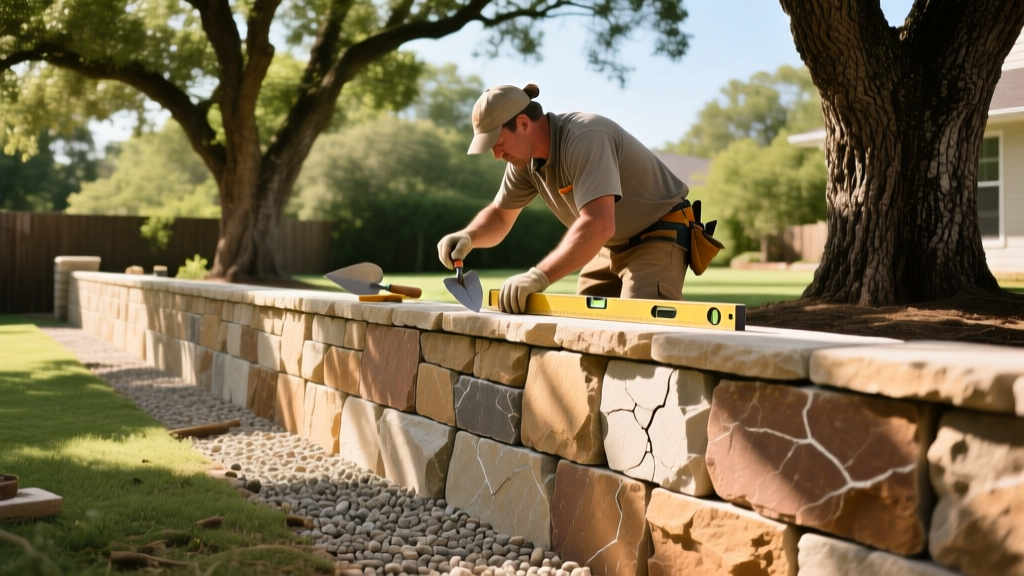
Dry-Stack Limestone: Masons must individually select, shape, and place irregular Hill Country stones (such as Weathered Ledge or Cordova Creek). Because there is no mortar, structural integrity relies entirely on the wall's batter (the backward lean, typically 1 inch per foot of height) and the mass of the stones. This artisanal process is slow, requiring highly skilled masons who charge $65 to $95 per hour in the Austin market.
Concrete CMU (Concrete Masonry Units): Stacking 8x8x16 inch concrete blocks is fast and requires less specialized labor. However, to meet structural codes, the cores must be filled with pea gravel and vertical #4 rebar. If the homeowner desires a stone aesthetic, a natural limestone veneer must then be mortared to the CMU face, effectively combining the labor costs of both systems.
Hidden Contractor Fees in Austin: What Quotes Don't Tell You
When comparing bids, scrutinize the line items. Many contractors provide a low base price but exclude site-specific necessities.
- Engineering Stamps: The City of Austin Development Services requires a licensed structural engineer's stamp for any retaining wall exceeding 4 feet in height (measured from the bottom of the footing). Engineering plans typically cost $1,500 to $3,000.
- Edwards Aquifer Recharge Zone Restrictions: If your property is in the Edwards Aquifer contributing zone, environmental regulations limit impervious cover and dictate how drainage water is dispersed. Contractors may need to install specialized rain gardens or French drains to comply, adding $2,000+ to the project.
- Utility Locating: While Texas 811 marks public lines, private lines (irrigation, landscape lighting, septic) are not marked. Hitting a private irrigation main during excavation will result in immediate repair surcharges.
Decision Framework: When to Choose Limestone Over Concrete
Selecting between these materials should not be based solely on the initial quote. Use this framework to align the material with your property's specific constraints.
Choose Dry-Stack Limestone If:
- Your wall is under 4 feet tall (avoiding permit and engineering fees).
- Your property features natural limestone outcroppings or a Hill Country architectural style.
- You prefer a permeable wall that naturally manages hydrostatic pressure without weep holes.
- The wall features sweeping curves, which are easily achieved with irregular stone but difficult with rigid concrete forms.
Choose Poured Concrete or CMU If:
- The wall exceeds 4 feet in height and must support a structural surcharge (e.g., a driveway, pool deck, or building foundation).
- You require perfectly straight, vertical lines or modern architectural aesthetics.
- Site access is limited; pumping concrete or carrying uniform CMU blocks is often easier than maneuvering 300-pound natural boulders into tight side yards.
FAQ: Austin Retaining Wall Permits and Regulations
Do I need a permit for a 3-foot limestone wall in Austin?
No. The City of Austin exempts retaining walls that are 4 feet or less in height, provided they are not supporting a surcharge load or located in a critical environmental zone. However, HOA approvals (common in Circle C or Steiner Ranch) may still apply.
Can I mortar limestone directly to an existing concrete wall?
Yes, but the existing concrete must be scarified (roughened) and coated with a masonry bonding agent. Standard thin-set mortar will fail under the weight of natural limestone; contractors must use a Type S masonry mortar or a high-strength polymer-modified veneer mortar.
How long does installation take?
A standard 50-foot long, 3-foot tall dry-stack limestone wall takes a three-man crew approximately 7 to 10 days. A poured concrete wall of the same dimensions requires 2 days for forming, 1 day for the pour, and 3 days for curing and stripping forms, though it requires heavy machinery access.
Written by
Elena RodriguezElena Rodriguez is a civil engineer and technical writer specializing in concrete technology, masonry systems, and ASTM/ACI compliance. She earned her B.S. in Civil Engineering from Texas A&M University and spent a decade at a materials testing laboratory, performing over 2,000 concrete compressive strength tests and masonry prism evaluations. Elena is an ACI-certified Field Testing Technician (Grade I) and a member of ASTM Committee C12 on Natural Building Stone. She currently consults on forensic engineering cases involving concrete failures and moisture intrusion. Based in San Antonio, TX, Elena is a proud member of the Society of Women Engineers (SWE) and coaches her daughter's FIRST Robotics team.
More from Elena Rodriguez
View all
Walls & Panels
Cost Analysis: Light Gauge Steel Framing Advantages and Disadvantages
Evaluate light gauge steel framing advantages and disadvantages through a strict cost analysis lens, comparing material, labor, and lifecycle expenses.
Aug 4, 2026

Walls & Panels
Gypsum Board Types: Exact Specifications, Thickness & Dimensions
Compare standard, Type X, and moisture-resistant gypsum board types. Get exact specifications, thicknesses, dimensions, and ASTM standards for your project.
Aug 4, 2026

Fire Resistance
Best Fire-Resistant Outdoor Decking Materials: 2026 Buyer Guide
Discover the best fire-resistant outdoor decking materials for 2026. Compare Class A PVC, aluminum, and hardwood options for WUI compliance and safety.
Aug 4, 2026