Broom Finish Concrete vs Smooth: The Ultimate Flatwork Guide
Compare broom finish concrete vs smooth trowel finishes. Explore slip resistance, costs, maintenance, and ideal applications for flatwork.

The Core Difference: Timing and Surface Paste
When evaluating broom finish concrete vs smooth finishes for flatwork, the distinction is not merely aesthetic; it fundamentally alters the surface physics, durability, and maintenance profile of the slab. Both finishes begin with the exact same concrete mix design—typically a 3,000 to 4,000 PSI air-entrained mix for exterior applications. The divergence occurs during the final stages of the bleeding process, when the cement paste (the 'cream') rises to the surface.
Broom Finish Concrete: Texture, Grip, and Application
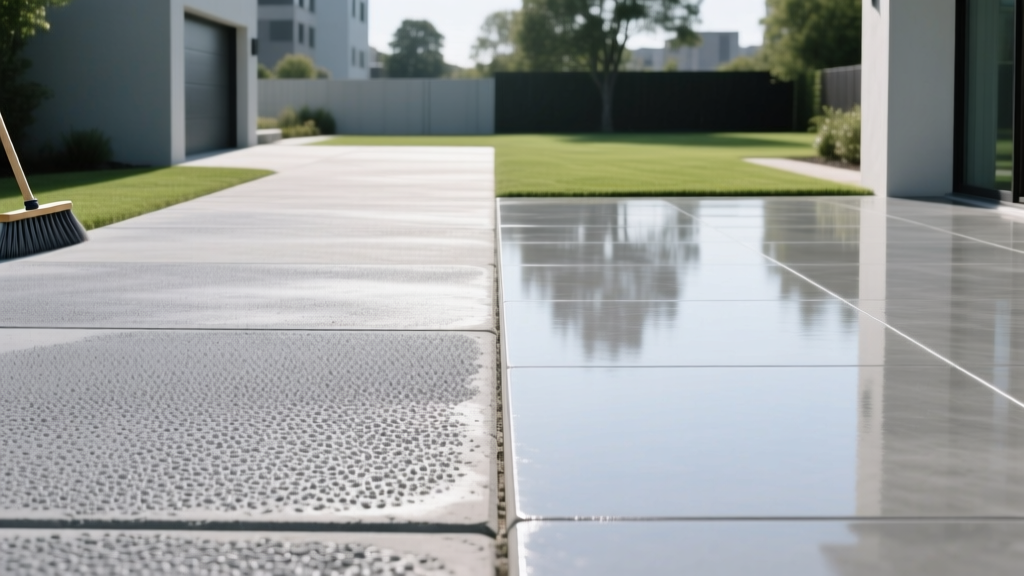
A broom finish is achieved by dragging a specialized concrete broom across the freshly floated surface. This pulls the cement paste into ridges and valleys, creating a highly textured profile. It is the undisputed standard for exterior flatwork where water drainage and pedestrian safety are paramount.
Bristle Selection and Stroke Depth
The aggressiveness of a broom finish is dictated by the bristle material and the moisture content of the concrete at the time of application:
- Nylon Bristles (Light Texture): Creates shallow grooves (approx. 1/16 inch deep). Ideal for patios and barefoot areas where a harsh texture would be uncomfortable.
- Palmyra or Corn Bristles (Medium to Heavy Texture): Creates deeper grooves (1/8 inch or more). The standard for public sidewalks, commercial ramps, and steep driveways where maximum water channeling is required.
Pros and Cons of Broom Finishes
- Pros: Exceptional slip resistance (Dynamic Coefficient of Friction [DCOF] typically > 0.65 when wet); excellent water runoff channeling; lowest labor cost; hides minor surface imperfections and trowel marks.
- Cons: Rough texture can be harsh on bare feet; deep grooves trap dirt, moss, and snow; harder to clean; snow shovels and plows can catch on heavy ridges.
Smooth (Troweled) Finish: Density, Aesthetics, and Risks
When homeowners request a 'smooth' finish, they are usually referring to a steel troweled surface. However, in concrete terminology, there is a critical distinction between a float finish and a steel trowel finish. A float finish (using a magnesium or aluminum bull float) leaves a slightly sandy, porous texture that is relatively slip-resistant. A true smooth finish requires a steel trowel, which burns the surface, sealing the pores and creating a dense, glass-like sheen.
The Mechanics of Steel Troweling
Steel troweling is typically done in multiple passes. The first pass is done with the trowel blade nearly flat. Subsequent passes are done with the blade tilted at a steeper angle, often using a mechanical power trowel for large areas. This process forces the aggregate slightly below the surface and brings a very thin, dense layer of cement paste to the top. According to guidelines from the National Ready Mixed Concrete Association (NRMCA), over-troweling is a primary cause of surface delamination, as it seals the surface too tightly, preventing underlying moisture from escaping.
Pros and Cons of Smooth Finishes
- Pros: Sleek, modern aesthetic; extremely easy to clean and sweep; highly resistant to oil and chemical penetration (due to surface density); ideal for indoor spaces and garages.
- Cons: Highly slippery when wet (DCOF can drop below 0.40); shows every trowel mark, discoloration, and imperfection; higher labor cost; requires precise timing and skilled labor.
Head-to-Head Comparison Matrix
| Metric | Broom Finish | Smooth (Steel Trowel) |
|---|---|---|
| Wet Slip Resistance (DCOF) | 0.65 - 0.85 (High) | 0.30 - 0.45 (Low/Hazardous) |
| Surface Density | Moderate (Open Pores) | Very High (Sealed Pores) |
| Average Installed Cost (2026) | $8.00 - $12.00 / sq ft | $9.50 - $14.50 / sq ft |
| Maintenance & Cleaning | High (Traps debris, needs pressure washing) | Low (Easy to sweep and mop) |
| Snow Removal | Difficult (Plows catch on ridges) | Easy (Blades glide smoothly) |
Application-Specific Decision Framework
Choosing between broom finish concrete vs smooth should be dictated by the specific environmental and functional demands of the project site.
Driveways and Public Sidewalks
Verdict: Broom Finish. Driveways are exposed to rain, snow, and vehicular fluid leaks. A medium-to-heavy broom finish provides the necessary traction for both pedestrians and vehicle tires on inclines. Furthermore, public sidewalks must comply with local municipal codes regarding slip resistance, which almost universally mandate a broomed or heavily textured surface to mitigate liability.
Pool Decks and Patios
Verdict: Light Broom or Exposed Aggregate. A heavy broom finish will tear up bare feet and pool floats. A light nylon broom finish provides adequate wet slip resistance without being abrasive. Alternatively, a smooth steel trowel finish around a pool is a severe safety hazard and should never be specified unless heavily treated with a post-applied anti-slip polymer coating.
Garages and Interior Slabs
Verdict: Smooth (Steel Trowel) or Power Troweled. Interior environments are protected from rain, eliminating the primary slip hazard. A dense, steel-troweled finish resists oil stains, tire marks, and dusting. For garages, a power-troweled finish followed by a penetrating silicate densifier and a polyurethane topcoat will yield a showroom-quality floor that withstands heavy rolling loads.
Common Failure Modes by Finish Type
Understanding how each finish fails is critical for long-term flatwork performance. The American Concrete Institute (ACI) frequently cites improper finishing techniques as the leading cause of premature surface degradation.
Scaling and Spalling (The Over-Troweling Trap)
Smooth finishes are highly susceptible to scaling in freeze-thaw climates if the finisher works the surface too late or adds water to the surface to ease troweling. This creates a weak, non-air-entrained layer of cement paste on top of the durable, air-entrained concrete below. When water penetrates this weak crust and freezes, it pops off in flakes (scaling). Broom finishes are slightly more forgiving because the grooves allow for minor surface imperfections to be hidden, but the underlying mix must still maintain a strict water-to-cement ratio of 0.45 or lower.
Crazing and Plastic Shrinkage
Smooth, hard-troweled surfaces are prone to crazing—a network of fine, shallow cracks resembling a spiderweb. This occurs when the surface dries much faster than the underlying concrete, causing the surface crust to shrink and crack. Broom finishes rarely show crazing because the physical act of dragging the broom disrupts the surface tension and closes micro-cracks as they form.
Cost Breakdown and Maintenance Realities
As of 2026, the baseline cost for a standard 4-inch thick exterior concrete slab with a broom finish ranges from $8.00 to $12.00 per square foot, fully installed. This assumes standard forming, a 3,000 PSI mix, and basic control joint sawing.
Opting for a smooth, steel-troweled finish increases the labor cost. Finishers must make multiple passes with hand trowels or rent walk-behind power trowels, extending their time on-site by several hours. Expect to pay a premium of $1.50 to $2.50 per square foot for a true smooth finish. Additionally, smooth exterior finishes often require the application of a clear, anti-slip additive broadcast into a sealer, adding another $0.75 to $1.25 per square foot in material and labor costs to ensure the surface is safe when wet.
Ultimately, the choice between broom finish concrete vs smooth is a trade-off between safety and aesthetics. For any exterior surface exposed to the elements, the broom finish remains the most practical, durable, and cost-effective choice. For interior spaces or covered areas where cleaning and visual appeal take priority, the dense, smooth troweled finish is the superior specification.
Written by
Elena RodriguezElena Rodriguez is a civil engineer and technical writer specializing in concrete technology, masonry systems, and ASTM/ACI compliance. She earned her B.S. in Civil Engineering from Texas A&M University and spent a decade at a materials testing laboratory, performing over 2,000 concrete compressive strength tests and masonry prism evaluations. Elena is an ACI-certified Field Testing Technician (Grade I) and a member of ASTM Committee C12 on Natural Building Stone. She currently consults on forensic engineering cases involving concrete failures and moisture intrusion. Based in San Antonio, TX, Elena is a proud member of the Society of Women Engineers (SWE) and coaches her daughter's FIRST Robotics team.
More from Elena Rodriguez
View all
Walls & Panels
Cost Analysis: Light Gauge Steel Framing Advantages and Disadvantages
Evaluate light gauge steel framing advantages and disadvantages through a strict cost analysis lens, comparing material, labor, and lifecycle expenses.
Aug 4, 2026

Walls & Panels
Gypsum Board Types: Exact Specifications, Thickness & Dimensions
Compare standard, Type X, and moisture-resistant gypsum board types. Get exact specifications, thicknesses, dimensions, and ASTM standards for your project.
Aug 4, 2026

Fire Resistance
Best Fire-Resistant Outdoor Decking Materials: 2026 Buyer Guide
Discover the best fire-resistant outdoor decking materials for 2026. Compare Class A PVC, aluminum, and hardwood options for WUI compliance and safety.
Aug 4, 2026