Troubleshooting Foundation Cracks: Concrete vs Cinder Block Repair Methods
Diagnose and repair foundation leaks and structural cracks. Compare concrete vs cinder block troubleshooting methods, products, and 2026 repair costs.

Diagnostic Matrix: Identifying Your Foundation Wall Type
When moisture intrusion or structural cracking compromises a basement, the repair protocols for concrete vs cinder block foundations diverge entirely. Misdiagnosing the wall type behind finished drywall or rigid foam insulation leads to failed waterproofing and wasted capital. Poured concrete walls fail primarily through matrix shrinkage and hydrostatic bowing, while Concrete Masonry Unit (CMU) walls fail at the mortar joints and trap water within their hollow cores.
Before selecting a repair method, use this diagnostic matrix to confirm your wall composition and baseline failure signature:
| Diagnostic Feature | Poured Concrete Wall | Cinder Block (CMU) Wall |
|---|---|---|
| Visual Cue (Exposed) | Monolithic surface; smooth or board-formed wood grain texture. | Modular grid; typically 8x8x16 inch units separated by 3/8-inch mortar joints. |
| Acoustic Test | Solid, high-pitch thud when struck with a knuckle or hammer. | Hollow, lower-pitch echo (unless fully grouted and reinforced with rebar). |
| Primary Crack Pattern | Vertical shrinkage cracks or horizontal mid-wall shear. | Stair-step cracking tracking precisely along the mortar joints. |
| Moisture Behavior | Seeps uniformly through porous matrix or concentrates at cold joints. | Pools inside hollow cores; leaks manifest at the floor-wall joint or weep holes. |
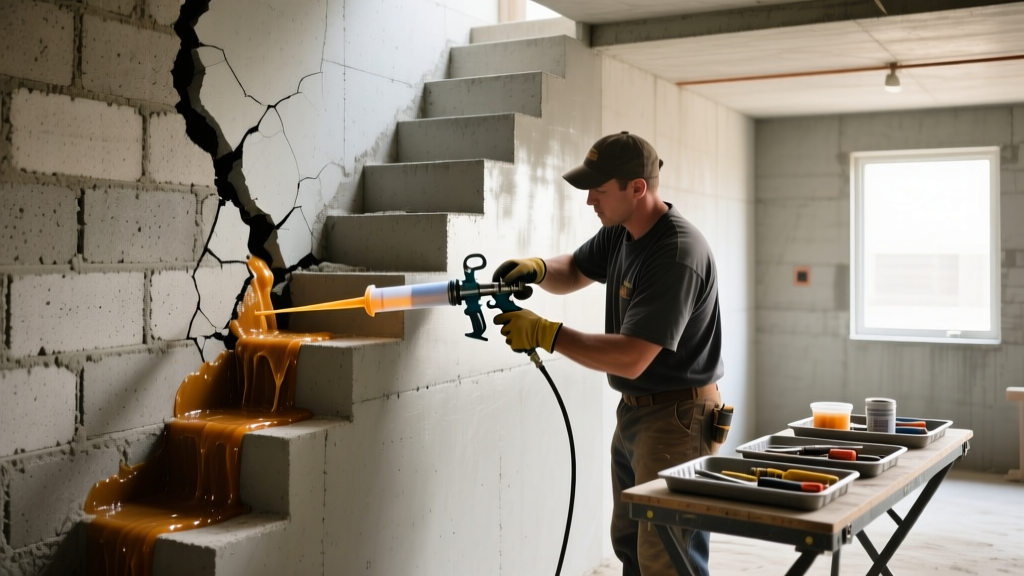
Troubleshooting Poured Concrete Failures
Symptom: Horizontal Bowing and Mid-Wall Cracking
Horizontal cracking in poured concrete is a critical structural red flag. It indicates that lateral hydrostatic pressure from saturated exterior soil has exceeded the wall's tensile strength. Water weighs 62.4 pounds per cubic foot; a saturated clay backfill can exert thousands of pounds of lateral force against a basement wall.
The Repair Protocol: Do not simply patch the crack. The wall must be stabilized against further deflection. For walls with less than 2 inches of inward bowing, carbon fiber reinforcement straps (such as Fortress Stabilization or Simpson Strong-Tie systems) are the 2026 industry standard. These straps are bonded to the wall using a high-modulus structural epoxy (e.g., Simpson Strong-Tie FX-70). The carbon fiber provides a tensile strength up to 10 times greater than steel, halting further movement. For walls bowed beyond 2 inches, steel I-beam bracing or exterior excavation with helical tie-back anchors is mandatory.
Symptom: Cold Joint Seepage
A cold joint occurs where two separate pours of concrete meet—most commonly where the foundation wall meets the footing, or where a pour was paused overnight. These joints are microscopic fault lines that inevitably leak under hydrostatic pressure.
The Repair Protocol: Rigid epoxies will fail here because cold joints experience slight thermal expansion and contraction. Instead, route out the joint and inject a hydrophilic polyurethane resin (such as Sika Injection-101). Hydrophilic resins react with moisture, expanding up to 20 times their liquid volume to form a flexible, watertight gel that permanently seals the joint while accommodating minor structural movement.
Troubleshooting Cinder Block (CMU) Failures
Symptom: Stair-Step Cracking and Mortar Degradation
Cinder block walls rarely crack through the block itself; they fail at the mortar joints. Stair-step cracking is the hallmark of differential settlement, where one corner of the foundation sinks faster than the rest. Over time, the mortar degrades due to acidic groundwater, compromising the wall's compressive integrity.
The Repair Protocol: First, address the settlement by installing helical piers or resistance push piers beneath the footing to stabilize the soil. Once movement is arrested, the degraded mortar must be removed to a depth of 3/4 inch and repointed. For below-grade CMU repair, use a Type S mortar mix, which offers a compressive strength of 1,800 psi and high tensile bond strength, making it ideal for resisting lateral soil pressure. If the wall is historic or constructed with soft, low-strength blocks, downgrade to Type N mortar (750 psi) to prevent the harder mortar from causing the blocks themselves to spall and crack during freeze-thaw cycles.
Symptom: Hollow-Core Moisture Pooling
Standard 8-inch cinder blocks are hollow. When exterior damp-proofing (the black asphalt spray) fails, water permeates the outer shell of the block and pools inside the hollow cores. This trapped water eventually leaks through the inner shell or drains down to the floor slab, causing chronic efflorescence and mold.
The Repair Protocol: You cannot easily inject the hundreds of hollow cores in a basement. The most effective interior troubleshooting method is to install an interior weep hole system paired with a sub-slab French drain. Contractors drill 1/2-inch holes into the bottom course of the CMU wall, allowing the trapped core water to drain into a perimeter trench. The trench is filled with washed gravel and a perforated pipe that routes the water to a sump pump. Finally, apply a crystalline waterproofing coating (such as Xypex Concentrate) to the interior masonry. Unlike paint-on sealers that peel, crystalline products use a catalytic reaction with free lime and moisture to grow insoluble dendritic crystals deep within the CMU pores, permanently blocking capillary water migration.
2026 Repair Product & Cost Matrix
When budgeting for foundation repairs, costs vary significantly based on whether you are addressing a monolithic pour or a modular masonry wall. Below is a breakdown of professional-grade materials and average installed costs for 2026.
| Repair Method / Product | Target Wall Type | Primary Function | Estimated Installed Cost (2026) |
|---|---|---|---|
| Carbon Fiber Straps (Fortress / Simpson) | Poured Concrete | Arrests horizontal bowing & shear cracks. | $800 - $1,200 per strap |
| Polyurethane Injection (Sika Injection-101) | Poured Concrete | Seeps into cold joints & shrinkage cracks. | $25 - $35 per linear foot |
| Helical Tie-Backs | Both (CMU & Poured) | Pulls bowed walls back to plumb from exterior. | $1,500 - $2,200 per anchor |
| Type S Tuckpointing | Cinder Block (CMU) | Restores structural integrity to failed joints. | $10 - $15 per square foot |
| Crystalline Coating (Xypex Concentrate) | Cinder Block (CMU) | Blocks capillary water through porous masonry. | $4.50 - $6.00 per square foot |
| Interior Core Weep Holes + Trench | Cinder Block (CMU) | Drains trapped water from hollow block cores. | $60 - $85 per linear foot |
Decision Framework: Repair vs. Rebuild Thresholds
Not all foundation walls can be saved. Use these structural thresholds to determine if troubleshooting and repair are viable, or if partial reconstruction is required:
- Shear Displacement: If a horizontal crack in a poured wall or a stair-step crack in a CMU wall exhibits more than 1/2 inch of vertical shear displacement (one side of the crack has dropped significantly compared to the other), the wall has lost its load-bearing capacity. Carbon fiber and epoxy will not restore vertical load transfer; the affected section must be rebuilt.
- CMU Spalling Depth: If the outer face of the cinder blocks is spalling (flaking off) to a depth greater than 1.5 inches due to chronic freeze-thaw cycles, the structural cross-section of the block is compromised. Surface coatings will not adhere properly, and wall replacement is recommended.
- Multiple Failed Cold Joints: If a poured wall features three or more active, leaking cold joints combined with severe honeycombing (areas where the concrete aggregate failed to bind with cement paste during the original pour), the concrete matrix is fundamentally defective. Interior trenching and exterior membrane replacement are the only long-term solutions.
Accurate troubleshooting requires understanding the fundamental material science of your foundation. For comprehensive technical standards regarding masonry joint reinforcement and poured wall deflection limits, consult the guidelines published by the National Concrete Masonry Association (NCMA) and the American Concrete Institute (ACI).
Written by
Elena RodriguezElena Rodriguez is a civil engineer and technical writer specializing in concrete technology, masonry systems, and ASTM/ACI compliance. She earned her B.S. in Civil Engineering from Texas A&M University and spent a decade at a materials testing laboratory, performing over 2,000 concrete compressive strength tests and masonry prism evaluations. Elena is an ACI-certified Field Testing Technician (Grade I) and a member of ASTM Committee C12 on Natural Building Stone. She currently consults on forensic engineering cases involving concrete failures and moisture intrusion. Based in San Antonio, TX, Elena is a proud member of the Society of Women Engineers (SWE) and coaches her daughter's FIRST Robotics team.
More from Elena Rodriguez
View all
Walls & Panels
Cost Analysis: Light Gauge Steel Framing Advantages and Disadvantages
Evaluate light gauge steel framing advantages and disadvantages through a strict cost analysis lens, comparing material, labor, and lifecycle expenses.
Aug 4, 2026

Walls & Panels
Gypsum Board Types: Exact Specifications, Thickness & Dimensions
Compare standard, Type X, and moisture-resistant gypsum board types. Get exact specifications, thicknesses, dimensions, and ASTM standards for your project.
Aug 4, 2026

Fire Resistance
Best Fire-Resistant Outdoor Decking Materials: 2026 Buyer Guide
Discover the best fire-resistant outdoor decking materials for 2026. Compare Class A PVC, aluminum, and hardwood options for WUI compliance and safety.
Aug 4, 2026