What Is the Cost Per Square Foot to Build a Home in Florida (2026)?
Analyze the cost per square foot to build a home in Florida across Miami, Orlando, Tampa, and Jacksonville, including 2026 labor and material data.

The Baseline: Statewide Averages vs. National Benchmarks
Calculating the exact cost per square foot to build a home in Florida requires discarding national averages. While the National Association of Home Builders (NAHB) places the national baseline for custom construction between $150 and $200 per square foot, Florida's unique environmental and regulatory landscape shifts this baseline dramatically. In 2026, the statewide average to build a custom, single-family home ranges from $165 to $285 per square foot, with ultra-luxury or highly specialized coastal builds exceeding $400 per square foot.
This premium is not arbitrary. It is driven by three non-negotiable factors: the strict enforcement of the Florida Building Code (FBC), complex subsurface soil conditions requiring specialized foundation engineering, and localized labor shortages in high-growth micro-markets. Understanding the cost per square foot to build a home in Florida means understanding how these variables fluctuate across the state's distinct geographic regions.
- Statewide Average: $165 - $285 / sq. ft.
- South Florida (HVHZ): $220 - $350+ / sq. ft.
- Central Florida: $160 - $240 / sq. ft.
- North Florida / Panhandle: $145 - $210 / sq. ft.
Regional Breakdown: Where Your Dollar Goes Further
Florida is not a monolith. The cost per square foot to build a home in Florida varies by up to 40% depending on the county, driven by local wind-borne debris regions, soil composition, and union labor density.
South Florida (Miami-Dade, Broward, Palm Beach)
Building in South Florida means navigating the High-Velocity Hurricane Zone (HVHZ). The FBC mandates the most stringent wind-load and impact-resistance standards in the country here. Expect to pay between $220 and $350 per square foot for a standard custom build. The premium is driven by the mandatory use of Miami-Dade County Notice of Acceptance (NOA) approved materials. For example, installing PGT WinGuard or CGI Sentinel impact-resistant windows and doors can add $18 to $25 per square foot of glazed opening area compared to standard code-minimum shutters. Furthermore, the shallow limestone bedrock in Miami-Dade often requires rock-chiseling and specialized augercast pile foundations, adding $15,000 to $30,000 to site prep costs before framing even begins.
Central Florida (Orlando, Kissimmee, The Villages)
Central Florida offers a more moderate cost per square foot, typically ranging from $160 to $240. The primary cost driver here is not wind code, but soil. The region is notorious for 'sugar sand' and organic muck. Geotechnical engineers frequently require over-excavation, soil stabilization (mixing lime or Portland cement into the subgrade), or deep driven timber piles to prevent differential settlement. While labor rates are more favorable than in South Florida, the cost of engineered foundations and retaining walls for graded lots can quickly consume the savings.
Tampa Bay & The Gulf Coast
The Gulf Coast (Hillsborough, Pinellas, Sarasota) sits in a transitional zone. Costs range from $175 to $260 per square foot. The defining factor here is salt-air corrosion and flood zone elevation. Homes built within Coastal High Hazard Areas (V-Zones) must be elevated on pilings with breakaway walls, which drastically increases the structural framing cost per square foot. Additionally, all exterior hardware, from Simpson Strong-Tie hurricane clips to roofing nails, must be specified as hot-dipped galvanized or stainless steel (Type 304 or 316) to resist salt spray, adding a 5% to 8% premium to the framing and roofing material packages.
North Florida & The Panhandle (Jacksonville, Tallahassee)
If you are looking for the lowest cost per square foot to build a home in Florida, the Panhandle and northern borders are your target. Ranging from $145 to $210 per square foot, this region benefits from lower labor costs, less stringent wind-borne debris requirements (outside of immediate coastal strips), and stable, clay-heavy soils that easily support traditional shallow spread footings. Wood-frame construction is also more prevalent here compared to the Concrete Block Structure (CBS) dominance in the southern two-thirds of the state, which slightly reduces material and masonry labor costs.
Regional Cost & Engineering Matrix
| Region | Base Cost / Sq Ft | Premium Cost / Sq Ft | Primary Foundation Type | Dominant Framing |
|---|---|---|---|---|
| South FL (HVHZ) | $220 | $350+ | Augercast Piles / Deep Driven | CBS (Concrete Block) |
| Central FL | $160 | $240 | Stabilized Spread Footings | CBS / Wood Frame Hybrid |
| Gulf Coast | $175 | $260 | Elevated Timber/Concrete Piles | CBS (Reinforced) |
| North FL / Panhandle | $145 | $210 | Shallow Spread Footings | Wood Frame (2x6) |
Hidden Cost Drivers Unique to Florida Construction
When budgeting the cost per square foot to build a home in Florida, line items that are optional in other states are mandatory, code-enforced expenses here.
Hurricane Codes and Impact Resistance
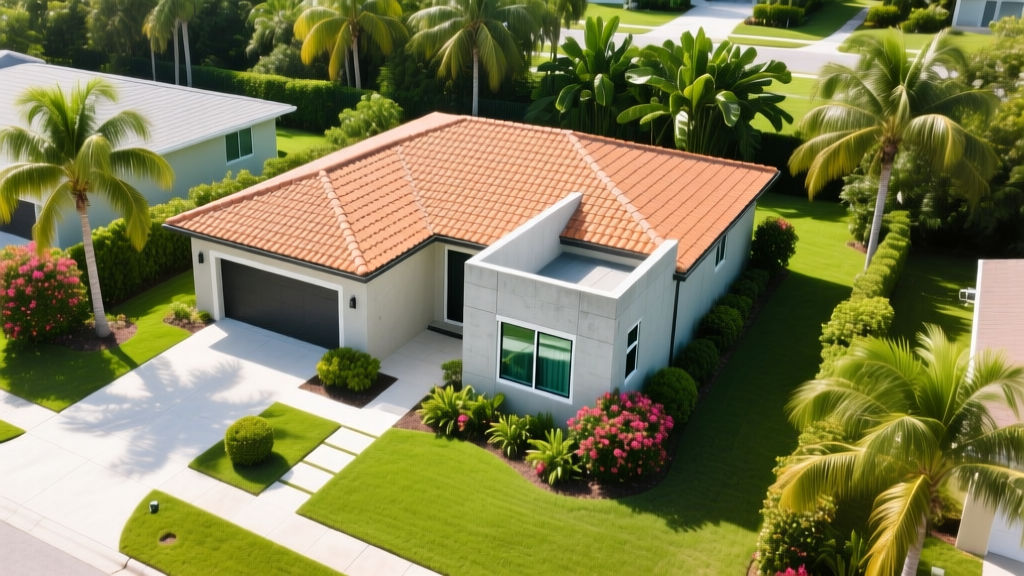
The FBC requires a continuous load path from the roof to the foundation. This means utilizing specialized hardware like Simpson Strong-Tie H2.5A hurricane clips at every truss-to-top-plate connection. While the clips themselves are cheap, the labor to install and inspect them adds up. More significantly, the roof geometry impacts both build cost and long-term insurance. A hip roof (which slopes inward on all sides) performs significantly better in high winds than a gable roof. While a hip roof costs roughly 10% to 15% more to frame and shingle due to complex cuts and wasted material, it yields substantial discounts on the Florida OIR-B1-1802 Wind Mitigation Inspection form, lowering annual insurance premiums.
Soil Conditions and Foundation Engineering
Never purchase a lot in Florida without a Phase I Environmental Site Assessment and a preliminary geotechnical soil boring report. Hitting organic peat or high-water-table muck at 4 feet deep in Central Florida can turn a $12,000 slab-on-grade foundation into a $45,000 structural slab supported by 40-foot driven timber piles. According to FEMA building science publications, mitigating subsurface risks during the design phase is vastly more cost-effective than repairing differential settlement post-construction.
'In Florida, you aren't just building a house; you are engineering a bunker that breathes. Skimping on the building envelope's water-resistive barrier or wind-load path to save $10 per square foot upfront will cost you tenfold in insurance premiums and structural repairs within the first five years.'
Material Selections for the Subtropical Climate
To optimize your cost per square foot without sacrificing resilience, material selection must align with the local microclimate.
- Exterior Walls: In South and Central Florida, 8-inch CBS (Concrete Block Structure) with a stucco finish and a liquid-applied water-resistive barrier (like Sto Gold Coat) is the standard. It resists rot, termites, and wind-borne debris. In North Florida, 2x6 wood framing at 16 inches on-center with ZIP System sheathing provides excellent thermal performance and structural shear strength at a lower cost.
- Roofing: Concrete barrel tiles are popular for aesthetics and longevity but require heavy structural reinforcement to support the dead load. For a more cost-effective and highly wind-resistant option, specify a standing seam metal roof (24-gauge minimum) with concealed fasteners, rated for 150+ MPH uplift.
- Insulation: Open-cell spray foam applied to the underside of the roof deck creates an unvented, conditioned attic. This protects HVAC ductwork from extreme heat and humidity, improving energy efficiency and preventing condensation-related mold, a critical factor in Florida's climate.
Actionable Steps for Your Florida Build Budget
To accurately forecast and control the cost per square foot to build a home in Florida, implement the following framework before breaking ground:
- Commission Early Geotech Testing: Spend the $2,500 on soil borings before finalizing architectural plans. Design the foundation to the soil, not the other way around.
- Allocate a 15% Weather Contingency: Florida's hurricane season (June 1 through November 30) guarantees construction delays. Budget for extended scaffolding rentals, crane remobilization, and material storage.
- Design for the OIR-B1-1802 Form: Sit down with your architect and a licensed Florida insurance agent. Design the roof pitch, window protection, and door thresholds specifically to check the mitigation boxes that yield the highest windstorm insurance discounts.
- Value-Engineer the Glazing: If building outside the HVHZ, compare the cost of impact glass versus code-approved accordion shutters. While impact glass offers superior aesthetics and UV protection, high-quality aluminum accordion shutters can save $10,000 to $20,000 on a 3,000-square-foot home without violating wind-borne debris codes.
Ultimately, the cost per square foot to build a home in Florida is an investment in resilience. By understanding regional code variations, respecting the soil, and prioritizing the building envelope, you can construct a home that withstands the elements while maintaining strict financial discipline.
Written by
Sarah WhitfieldSarah Whitfield is a chartered quantity surveyor (MRICS) and construction cost analyst with 15 years of experience in material pricing, procurement strategy, and project budgeting. She earned her degree in Construction Management from the University of Reading (UK) and has worked on projects ranging from $2M custom homes to $180M mixed-use developments across North America and Europe. Sarah currently leads cost estimating for BuildMat Insight, maintaining a proprietary database of 4,000+ material price points updated quarterly. She is a frequent contributor to RSMeans cost data panels and has presented at the International Cost Engineering Council (ICEC) congress. Based in Denver, CO, Sarah is an avid trail runner and volunteer mentor for Women in Construction.
More from Sarah Whitfield
View all
Wood & Lumber
What Are the Different Types of Wood? A Builder's Guide
Compare structural softwoods, finish hardwoods, and engineered lumber. Analyze Janka ratings, MOE values, and 2026 pricing for construction.
Aug 4, 2026

Walls & Panels
Steel Framing vs Wood Framing: Corrosion and Moisture Defense
Compare steel framing vs wood framing for moisture resistance. Learn about galvanized coatings, condensation risks, and corrosion protection strategies.
Jul 21, 2026

Stone & Masonry
How to Cut Stone Veneer: Wet Saw vs Grinder Comparison
Compare the best tools for cutting stone veneer. We review wet saws, angle grinders, and chop saws to help you achieve clean, chip-free cuts.
Jul 21, 2026