How Much Did The Sphere Cost To Build? Complete Cost Breakdown
Discover how much the Las Vegas Sphere cost to build. We break down the $2.3 billion budget, steel tonnage, LED pricing, and acoustic engineering costs.

The $2.3 Billion Question: Final Costs vs. Initial Estimates
When commercial estimators, developers, and architects ask how much did the Sphere cost to build, the answer requires looking past the initial 2018 feasibility studies. Originally projected at $1.2 billion, the final construction cost of the Las Vegas Sphere ballooned to an estimated $2.3 billion by its 2023 completion. Looking back from a 2026 perspective, the venue remains the ultimate case study in mega-project budget escalation, bespoke material procurement, and the financial risks of pioneering untested architectural technologies.
Budget Escalation Data Highlight
- 2018 Initial Estimate: $1.2 Billion
- 2020 Pandemic Pause Cost: $400 Million (Sunk costs during halt)
- 2023 Final Actual Cost: $2.3 Billion
- Total Cost Overrun: 91.6%
- Cost Per Seat: ~$127,777 (Based on 18,000 max capacity)
- Cost Per Square Foot: ~$2,628 (Based on 875,000 sq. ft. total facility)
According to analysis by the Engineering News-Record (ENR), the nearly 100% budget overrun was not solely due to inflation. It was driven by massive mid-project design enhancements, the custom fabrication of never-before-used audiovisual components, and severe supply chain disruptions for specialized structural steel.
Material & Engineering Cost Drivers
To understand the true cost breakdown, estimators must separate the traditional structural shell from the highly customized technological interior and exterior envelopes.
1. The Exosphere and Custom LED Pucks
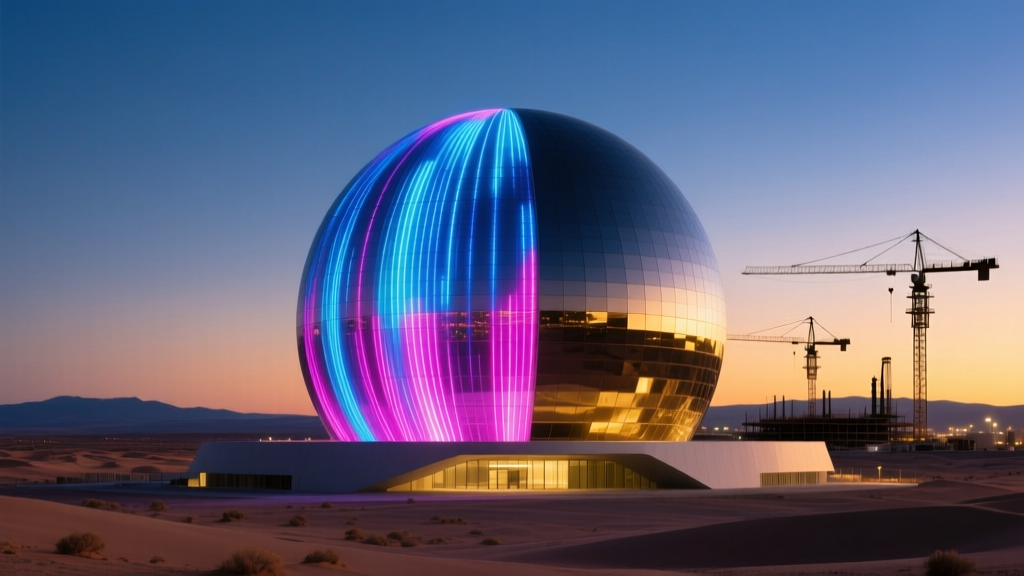
The exterior of the Sphere, known as the Exosphere, is the world’s largest LED screen. It encompasses 580,000 square feet of illuminated surface area. Rather than using off-the-shelf LED panels, the project required the engineering of 1.2 million custom "pucks." Each puck contains multiple LED diodes, custom printed circuit boards (PCBs), and weatherproof housings designed to withstand Mojave Desert UV exposure and high winds.
- Component Count: 1.2 million custom LED pucks.
- Estimated Facade Cost: $400M - $500M (including custom tooling, PCB fabrication, and high-altitude installation).
- Installation Complexity: Required specialized rigging and sequential power-mapping, drastically increasing labor hours compared to standard curtain-wall installations.
2. Structural Steel and Geodesic Framing
The Sphere’s roof and structural skeleton required approximately 13,000 tons of steel. Because the structure is essentially a massive geodesic dome, the steel nodes and connections are highly complex, non-repetitive 3D intersections. Unlike standard orthogonal commercial steel framing, every connection point required custom CNC machining and rigorous ultrasonic welding inspections. The premium for this complex steel fabrication pushed structural costs well above the $15-$20 per square foot baseline typical for standard arenas.
3. Interior Acoustic Treatments and Holoplot Audio
The interior wraparound screen spans 160,000 square feet, but the hidden cost lies in the acoustic engineering. To prevent audio from bouncing off the massive curved LED surfaces, the venue utilizes 300,000 square feet of custom mobile acoustic absorption panels. Furthermore, the audio system relies on Holoplot’s beamforming technology. The system deploys 167,000 individual speaker drivers hidden behind the acoustically transparent screen. This bespoke audio infrastructure alone represents a nine-figure investment, fundamentally altering the standard AV budget line item for entertainment venues.
Comparative Matrix: Sphere vs. Traditional Mega-Venues
How does the Sphere's cost profile compare to other recent mega-stadiums? The table below illustrates the shift in capital allocation from traditional concrete and steel toward proprietary technology.
| Venue (Completion Year) | Total Cost | Cost Per Seat | Tech/AV Budget % | Primary Cost Driver |
|---|---|---|---|---|
| Las Vegas Sphere (2023) | $2.3 Billion | ~$127,700 | ~35-40% | Custom LED & Beamforming Audio |
| SoFi Stadium, LA (2020) | $5.5 Billion | ~$78,500 | ~10-15% | Massive Earthwork & Dual-Field Roof |
| Allegiant Stadium, LV (2020) | $1.9 Billion | ~$29,200 | ~8-12% | ETFE Roof & Black Glass Facade |
Hidden Costs: Site Preparation and Foundation Engineering
While the technology grabs headlines, the substructure presented severe estimating challenges. The Sphere was built on a tight 18-acre parcel adjacent to the Venetian Resort.
Building a massive, deep foundation next to an existing, heavily loaded casino structure requires extensive secant pile shoring and continuous dewatering. The Las Vegas valley's alluvial soils and high water table near the Strip meant that excavation for the Sphere's basement and structural footings required millions of dollars in specialized soil retention and groundwater management that standard geotechnical baseline reports often underestimate.
Furthermore, the MSG Entertainment project required the relocation of existing municipal utilities and the construction of a massive dedicated power substation. The Exosphere's LED array and interior systems draw up to 13 megawatts of power at peak operation, necessitating heavy infrastructure upgrades with local utility providers before vertical construction could even begin.
Estimator Takeaways: Managing Mega-Project Budget Overruns
For commercial cost estimators and project managers analyzing the Sphere's financial trajectory, several critical lessons emerge for future tech-heavy builds:
- Bespoke Tooling Costs Scale Exponentially: When a project requires custom manufacturing (like the 1.2M LED pucks), estimators must account for the R&D, prototyping, and factory tooling costs, not just the per-unit assembly cost.
- Contingency for Unproven Tech: Standard commercial projects carry a 5-10% contingency. Projects integrating first-of-their-kind structural geometries and proprietary AV systems require a 20-30% design contingency to account for mid-build engineering pivots.
- Labor Inefficiencies in Non-Standard Geometries: Productivity rates for steel erection and cladding drop significantly on curved, non-repetitive surfaces. Estimators must apply severe labor-hour multipliers for geodesic and spherical framing compared to orthogonal structures.
Frequently Asked Questions
How much did the Sphere cost to build per square foot?
Based on the reported 875,000 square feet of total interior space and the $2.3 billion final price tag, the Sphere cost approximately $2,628 per square foot to construct. This is roughly 4 to 5 times higher than the cost per square foot of a standard Class-A commercial office building or traditional arena.
What was the most expensive single component of the Sphere?
While structural steel represents a massive material cost, the combined interior and exterior LED media surfaces (the Exosphere and the 16K interior wrap) represent the largest single capital expenditure, estimated to account for over $600 million of the total budget when factoring in custom fabrication, processing hardware, and installation.
Did the pandemic cause the Sphere's budget to double?
The 2020 pandemic halt contributed to the overrun by extending the project timeline, increasing financing costs, and triggering supply chain inflation for steel and microchips. However, the primary drivers of the jump from $1.2B to $2.3B were deliberate design enhancements to the AV technology, the expansion of the haptic seating systems, and the complexities of the custom geodesic steel roof.
Written by
Elena RodriguezElena Rodriguez is a civil engineer and technical writer specializing in concrete technology, masonry systems, and ASTM/ACI compliance. She earned her B.S. in Civil Engineering from Texas A&M University and spent a decade at a materials testing laboratory, performing over 2,000 concrete compressive strength tests and masonry prism evaluations. Elena is an ACI-certified Field Testing Technician (Grade I) and a member of ASTM Committee C12 on Natural Building Stone. She currently consults on forensic engineering cases involving concrete failures and moisture intrusion. Based in San Antonio, TX, Elena is a proud member of the Society of Women Engineers (SWE) and coaches her daughter's FIRST Robotics team.
More from Elena Rodriguez
View all
Walls & Panels
Cost Analysis: Light Gauge Steel Framing Advantages and Disadvantages
Evaluate light gauge steel framing advantages and disadvantages through a strict cost analysis lens, comparing material, labor, and lifecycle expenses.
Aug 4, 2026

Walls & Panels
Gypsum Board Types: Exact Specifications, Thickness & Dimensions
Compare standard, Type X, and moisture-resistant gypsum board types. Get exact specifications, thicknesses, dimensions, and ASTM standards for your project.
Aug 4, 2026

Fire Resistance
Best Fire-Resistant Outdoor Decking Materials: 2026 Buyer Guide
Discover the best fire-resistant outdoor decking materials for 2026. Compare Class A PVC, aluminum, and hardwood options for WUI compliance and safety.
Aug 4, 2026