How Much Did the Taj Mahal Cost to Build? A Modern Cost Comparison
Discover how much the Taj Mahal cost to build in 1653, adjusted for modern inflation, and compare its price to today's luxury construction mega-projects.

The Historical Ledger: 32 Million Mughal Rupees
When attempting to answer the question of how much did the taj mahal cost to build, historical records point to a widely accepted figure: approximately 32 million Mughal rupees upon its completion in 1653. Commissioned by Emperor Shah Jahan, the 42-acre complex required a workforce of 20,000 artisans, masons, and laborers over a 21-year construction period. However, translating a 17th-century imperial budget into modern construction estimating metrics requires moving beyond basic Consumer Price Index (CPI) calculators, which fail to account for the radical shifts in labor valuation and material extraction technologies.
Using standard CPI inflation, 32 million 1653 rupees equates to roughly $1 billion USD today. However, economic historians argue this is a massive underestimate. When adjusting for the relative share of GDP and the unskilled wage equivalence (the true cost of commanding 20,000 laborers for two decades), the modern equivalent of the Taj Mahal's original budget is estimated between $70 billion and $100 billion USD. This reflects the true economic burden of the project on the Mughal Empire.
According to the UNESCO World Heritage Centre, the complex is a masterclass in Mughal architecture, combining Persian, Islamic, and Indian styles. But from a pure construction management perspective, it was a logistical marvel of material sourcing, featuring Makrana marble from Rajasthan, jade from China, and turquoise from Tibet.
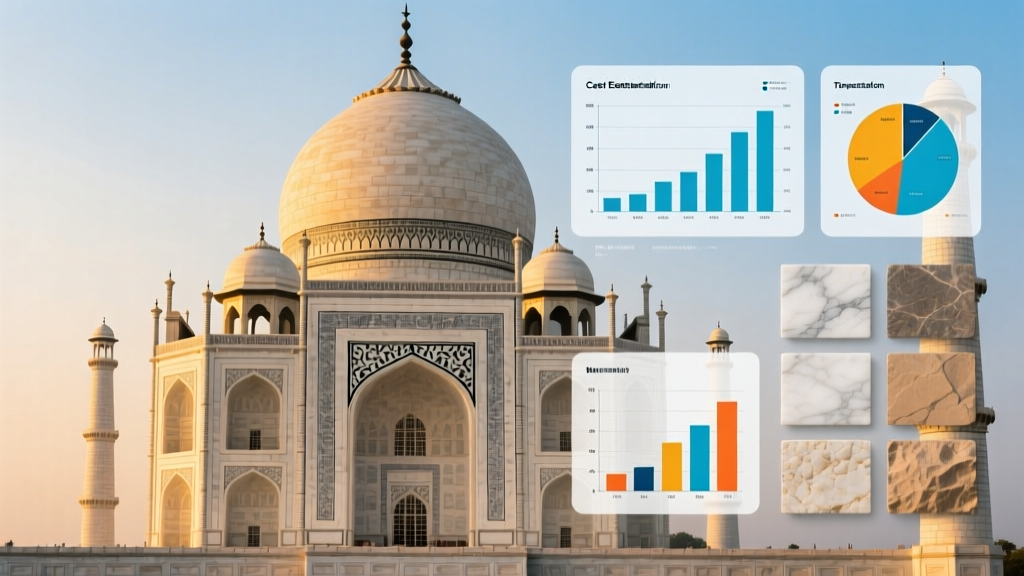
Rebuilding the Taj Mahal Today: Material & Labor Breakdown
If a modern general contractor were to bid on rebuilding the Taj Mahal today using authentic, load-bearing masonry techniques rather than modern concrete-veneer shortcuts, the cost estimation requires a granular breakdown of specialty materials and heritage-grade labor.
| Material / Trade | Specification | Modern Unit Cost | Est. Total Cost |
|---|---|---|---|
| Makrana White Marble | ASTM C503 (Exterior), Solid Block | $250 - $400 / sq ft | $4.2 Billion |
| Red Sandstone | Fatehpur Sikri quarry, Ashlar masonry | $45 - $85 / sq ft | $850 Million |
| Pietra Dura (Parchin Kari) | Semi-precious stone inlay (Lapis, Jade) | $1,200 - $2,500 / sq ft | $3.5 Billion |
| Heritage Masonry Labor | Master carvers, 10-year project timeline | $150 / hr (burdened) | $6.8 Billion |
| Heavy Scaffolding & Cranes | Steel scaffolding, tower cranes (24 mo) | Lump Sum | $450 Million |
The most significant cost driver in an authentic rebuild is the Pietra Dura inlay work. Sourcing high-grade lapis lazuli from Afghanistan and carnelian from Arabia to meet the exacting translucency standards of the original Architectural Encyclopedia records would require specialized global supply chains that no longer operate at a 17th-century scale.
Authentic Masonry vs. Modern Veneer Systems
Modern commercial construction rarely utilizes solid, load-bearing marble due to seismic vulnerabilities and sheer weight. If a developer commissioned a 'Taj Mahal Replica' for a luxury resort or casino today, the structural engineering would shift from solid masonry to a reinforced concrete core with a ventilated marble rainscreen facade.
Authentic Solid Masonry
- Structural System: Load-bearing rubble masonry core faced with 2-foot thick marble blocks.
- Seismic Rating: Poor. Highly susceptible to shear failure in modern earthquake zones.
- Estimated Cost: $15B - $22B USD.
- Timeline: 12 - 15 Years.
Modern Concrete & Veneer
- Structural System: Post-tensioned concrete core with 2-inch Makrana marble veneer on aluminum honeycomb backing.
- Seismic Rating: Excellent. Meets modern IBC (International Building Code) standards.
- Estimated Cost: $2.5B - $4B USD.
- Timeline: 3 - 5 Years.
A critical, often-overlooked cost in the original build was the scaffolding. Shah Jahan's engineers constructed a colossal brick scaffold to support the dome during construction. It was so massive that the Emperor decreed anyone who removed the bricks could keep them, leading to its dismantling by local peasants overnight. Today, erecting and leasing heavy-duty steel scaffolding and tower cranes to reach the 240-foot apex of the main dome would cost upwards of $450 million in modern equipment rentals and labor.
Taj Mahal vs. Modern Global Mega-Projects
To contextualize the sheer scale of the Taj Mahal's construction budget, we must compare its modern equivalent cost against contemporary architectural marvels. The data reveals that the Taj Mahal, when adjusted for labor and material scarcity, remains one of the most expensive structures ever conceived.
| Project | Completion Year | Original Cost | Inflation-Adjusted Cost | Primary Material |
|---|---|---|---|---|
| The Taj Mahal | 1653 | 32M Rupees | $70B - $100B | Solid Marble / Sandstone |
| Burj Khalifa | 2010 | $1.5 Billion | $2.1 Billion | Steel / Glass / Concrete |
| Sydney Opera House | 1973 | $102 Million | $750 Million | Precast Concrete / Ceramic Tile |
| The Shard (London) | 2012 | $1.9 Billion | $2.5 Billion | Steel / Glass |
The stark contrast lies in the labor-to-material ratio. Modern mega-projects like the Burj Khalifa rely on industrialized materials (steel, glass, Portland cement) that benefit from economies of scale. The Taj Mahal relied entirely on artisanal, hand-carved materials where the labor cost exponentially exceeded the raw material cost.
Estimating a 'Taj-Inspired' Luxury Estate
For high-end residential builders and architects looking to incorporate Taj Mahal-inspired elements into luxury custom estates, the cost estimating framework must focus on specific architectural features rather than full-scale replication.
- White Marble Cladding: Sourcing ASTM C503 compliant white marble (such as Carrara or high-grade Makrana) for exterior facades typically runs $85 to $150 per square foot installed, including the aluminum honeycomb backing required for seismic safety and weight reduction.
- Chhatri (Elevated Domes): Incorporating scaled-down, structural fiberglass-reinforced concrete (GFRC) domes with a marble veneer finish costs approximately $40,000 to $65,000 per unit, significantly reducing the structural load compared to traditional masonry.
- Reflecting Pool Engineering: The iconic central reflecting pool requires advanced UV-resistant waterproofing and dark basalt lining to achieve the mirror effect. Budget $120 to $180 per square foot for commercial-grade water feature engineering, including hidden filtration vaults and auto-leveling sensors.
- Pietra Dura Accents: For interior feature walls or foyer medallions, importing authentic hand-cut stone inlay from Agra-based heritage workshops costs between $800 and $1,500 per square foot. Expect a 6-to-9-month lead time for customs and artisanal fabrication.
Frequently Asked Questions
Who paid for the construction of the Taj Mahal?
The project was funded entirely by the imperial treasury of the Mughal Empire under Shah Jahan. Unlike modern public works funded by municipal bonds or taxes, the Taj Mahal was financed through the vast agricultural and trade revenues of the empire, which at the time accounted for roughly 25% of the global GDP.
How long would it take to build the Taj Mahal with modern technology?
Using modern tower cranes, diamond-wire stone cutters, and CNC routers for the inlay work, a structural replica could be completed in 3 to 5 years. The original 21-year timeline was dictated by the manual extraction, transport via elephant caravans, and hand-carving of millions of tons of stone.
Is the Taj Mahal made entirely of solid marble?
No. A common misconception is that the entire structure is solid white marble. The core structural walls are actually made of brick and rubble masonry. The iconic white Makrana marble serves as a thick exterior cladding and interior veneer, a technique that modern construction still utilizes to manage weight and material costs.
Written by
Elena RodriguezElena Rodriguez is a civil engineer and technical writer specializing in concrete technology, masonry systems, and ASTM/ACI compliance. She earned her B.S. in Civil Engineering from Texas A&M University and spent a decade at a materials testing laboratory, performing over 2,000 concrete compressive strength tests and masonry prism evaluations. Elena is an ACI-certified Field Testing Technician (Grade I) and a member of ASTM Committee C12 on Natural Building Stone. She currently consults on forensic engineering cases involving concrete failures and moisture intrusion. Based in San Antonio, TX, Elena is a proud member of the Society of Women Engineers (SWE) and coaches her daughter's FIRST Robotics team.
More from Elena Rodriguez
View all
Walls & Panels
Cost Analysis: Light Gauge Steel Framing Advantages and Disadvantages
Evaluate light gauge steel framing advantages and disadvantages through a strict cost analysis lens, comparing material, labor, and lifecycle expenses.
Aug 4, 2026

Walls & Panels
Gypsum Board Types: Exact Specifications, Thickness & Dimensions
Compare standard, Type X, and moisture-resistant gypsum board types. Get exact specifications, thicknesses, dimensions, and ASTM standards for your project.
Aug 4, 2026

Fire Resistance
Best Fire-Resistant Outdoor Decking Materials: 2026 Buyer Guide
Discover the best fire-resistant outdoor decking materials for 2026. Compare Class A PVC, aluminum, and hardwood options for WUI compliance and safety.
Aug 4, 2026