How to Maintain Deck Framing Materials Against Rot and Rust
Learn how to inspect and maintain deck framing materials. Discover repair techniques for wood rot, steel rust, and moisture protection.
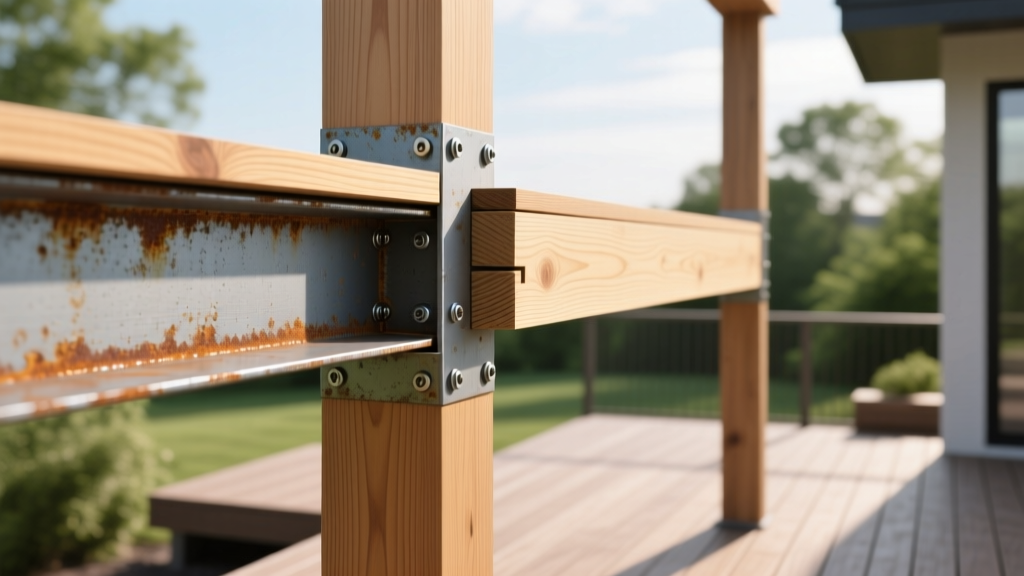
The Hidden Vulnerability of Deck Substructures
Homeowners routinely invest in premium composite or PVC deck boards rated for 25 to 50 years of surface wear, yet entirely neglect the substructure beneath. The reality of outdoor construction is that deck framing materials dictate the actual lifespan of the entire project. When pressure-treated lumber decays or light-gauge steel corrodes, the surface boards become irrelevant because the structural integrity has failed. According to the North American Deck and Railing Association (NADRA), substructure failure and ledger board detachment are the leading causes of catastrophic deck collapses.
Material-Specific Maintenance Protocols
Maintaining deck framing materials requires a targeted approach based on the specific substrate used in your build. Each material interacts with moisture, UV exposure, and galvanic corrosion differently.
Pressure-Treated Lumber (PT)
Standard PT lumber (typically Southern Yellow Pine treated with micronized copper azole or alkaline copper quaternary) remains the most common framing material. The American Wood Council's DCA 6 prescriptive deck construction guide mandates specific treatment levels based on proximity to the ground. For maintenance, you must verify that posts buried in or resting on concrete footings are rated UC4B (Ground Contact). UC4A (Above Ground) joists and beams require annual inspections for end-grain checking. Apply a copper naphthenate solution (like Copper Green) to any exposed cut ends or deep checks to restore the chemical envelope and prevent fungal ingress.
Light-Gauge Steel Framing
Steel framing eliminates biological rot but introduces galvanic and atmospheric corrosion risks. Most residential steel joists utilize a G90 galvanized coating. In coastal environments or regions where de-icing salts are used, this coating can degrade. Inspect the web and flanges of steel C-channels for white rust (zinc oxide) or red rust. If red rust appears, wire-brush the area to bare metal, apply a phosphoric acid converter (like Ospho), and finish with a cold galvanizing compound (zinc-rich paint) to restore the sacrificial anode layer.
Aluminum and Composite Framing
While marketed as maintenance-free, aluminum framing requires hardware verification. The primary maintenance task for aluminum substructures is checking for galvanic corrosion where dissimilar metals meet. Ensure that all fasteners penetrating aluminum joists are either 304/316 stainless steel or feature a high-grade polymer coating. Never allow standard galvanized steel hangers to rest directly against bare aluminum without a dielectric separator pad.
Framing Material Failure Matrix
| Material | Primary Threat | Inspection Frequency | Key Maintenance Action | Expected Lifespan |
|---|---|---|---|---|
| PT Lumber (UC4A) | Fungal decay, moisture trapping | Annually (Spring) | Apply joist tape, seal end-grains | 15–25 Years |
| PT Lumber (UC4B) | Ground-contact rot, insect damage | Bi-annually | Probe post bases with steel awl | 25–40 Years |
| G90 Steel | Atmospheric red rust | Every 2 Years | Touch-up scratches with zinc paint | 30–50 Years |
| Aluminum | Galvanic corrosion at fasteners | Every 3 Years | Verify dissimilar metal separation | 50+ Years |
The Annual Inspection Checklist: A Step-by-Step Flow
The University of Minnesota Extension emphasizes that systematic inspections are the only way to catch substructure degradation before it becomes a safety hazard. Follow this precise sequence every spring:
- The Ledger Board Pull Test: The ledger board connects the deck to the house and bears up to 50% of the structural load. Check for lag screws or structural screws (e.g., Simpson Strong-Tie SDS). If you see standard nails, the connection is non-compliant and requires immediate retrofitting. Verify that the Z-flashing above the ledger is intact and that water is not wicking behind the house's weather-resistant barrier.
- Joist Hanger Hardware Audit: Inspect every joist hanger. A standard 2x8 joist hanger requires 10 to 14 specific 1.5-inch joist hanger nails. Count the fasteners. Missing nails drastically reduce the shear capacity of the connection. Look for nails driven at an angle (sheared nails) and replace them.
- The Awl Probe Test for Posts: Take a sharp steel awl and probe the base of every support post, especially where the post meets the concrete footing or post base hardware. If the awl penetrates the wood deeper than 1/8 inch with minimal pressure, advanced heart rot is present, and the post must be replaced or sistered.
- Cross-Bracing and Blocking Verification: Check the solid wood blocking between joists. Blocking prevents joists from twisting under load (lateral torsional buckling). Ensure the blocking is tightly fitted and nailed; loose blocking transfers dynamic loads unevenly, leading to fastener fatigue.
Moisture Management and Flashing Repairs
Water is the universal enemy of deck framing materials. When wood remains above a 20% moisture content for extended periods, wood-decaying fungi activate. The most effective maintenance upgrade for an existing wooden substructure is the retroactive application of butyl-based joist tape (such as Trex Protect or DeckWise WiseWrap).
Expert Insight: Capillary action draws water upward through the end-grain of wooden joists. If your deck boards trap moisture against the joists, the top edge of the joist will rot first, compromising the screw-holding power of your deck boards. Applying a 2-inch-wide strip of self-adhering flashing tape over the top of every joist creates an impenetrable moisture barrier and extends the framing lifespan by decades.
If you discover that the ledger board flashing has failed, do not simply caulk the gap. Caulk is a temporary cosmetic fix that will inevitably crack under thermal expansion. The proper repair involves removing the first row of deck boards, installing a peel-and-stick membrane (like Grace Vycor) that integrates with the house wrap, and capping it with a custom-bent aluminum or PVC Z-flashing drip cap.
When to Repair vs. Replace: Cost and Structural Thresholds
Determining whether to patch a failing frame or replace it requires understanding structural thresholds and current 2026 material costs.
- Sistering Joists (Repair): If a joist has localized rot or severe sagging but the ends are solid, you can 'sister' a new pressure-treated joist alongside it. Bolt the two together using 1/2-inch galvanized carriage bolts in a staggered pattern every 16 inches. Cost: $12 to $18 per linear foot.
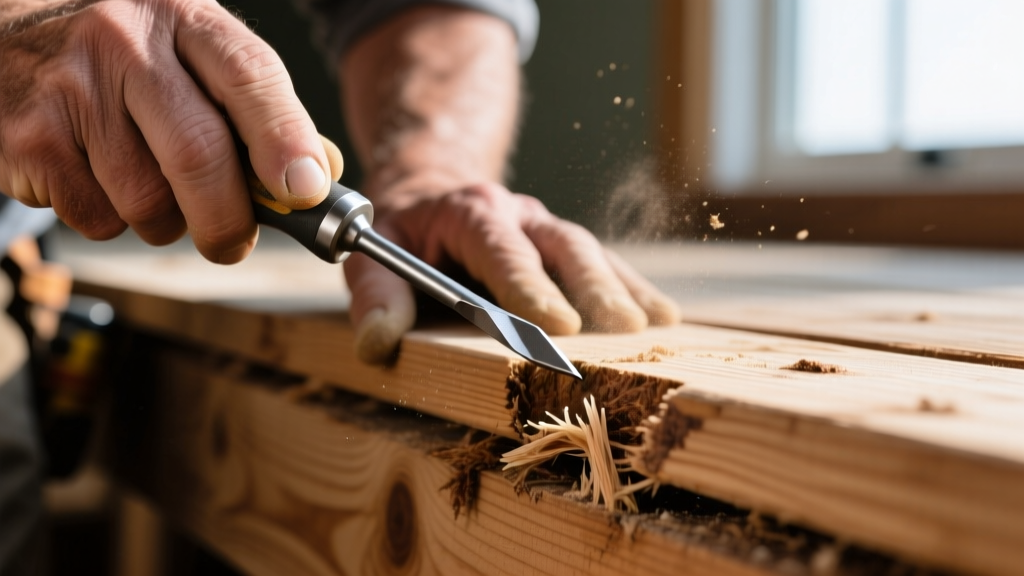
- Epoxy Consolidation (Repair): For minor surface rot on heavy timber beams (e.g., 6x6 or 4x12), dig out the soft wood, apply a liquid wood hardener, and fill the void with a two-part structural epoxy like Abatron WoodEpox. This restores compressive strength but should never be used on tension members or joist ends. Cost: $40 to $60 per repair zone.
- Full Member Replacement (Replace): If rot extends more than 20% into the cross-section of a structural beam, or if the bottom chord of a truss is compromised, replacement is mandatory. Cost: $45 to $85 per linear foot, heavily dependent on temporary shoring requirements.
Frequently Asked Questions
Can I use standard deck screws to frame a deck?
No. Standard deck screws are designed for shear strength (holding boards down) but lack the tensile strength and head geometry required for structural framing connections. You must use structural screws (like Simpson Strong-Drive) or hot-dipped galvanized nails specifically rated for the hardware you are using.
How do I protect steel deck framing from composite decking chemicals?
Some early-generation composite decking contained high levels of salt or acidic compounds that accelerated steel corrosion. Modern composite boards are largely inert, but you should still use a physical barrier. Applying a rubberized underlayment or joist tape between the composite board and the steel joist prevents moisture trapping and eliminates direct contact.
Is it worth upgrading to steel framing during a major wood repair?
If more than 40% of your wooden substructure requires replacement, upgrading to light-gauge steel or structural aluminum framing is highly recommended. While the initial material cost for steel framing is roughly 20% to 30% higher than pressure-treated lumber in 2026, it eliminates future rot, is perfectly straight (preventing surface waviness), and is fire-resistant, which is a critical factor in wildland-urban interface zones.
Written by
Elena RodriguezElena Rodriguez is a civil engineer and technical writer specializing in concrete technology, masonry systems, and ASTM/ACI compliance. She earned her B.S. in Civil Engineering from Texas A&M University and spent a decade at a materials testing laboratory, performing over 2,000 concrete compressive strength tests and masonry prism evaluations. Elena is an ACI-certified Field Testing Technician (Grade I) and a member of ASTM Committee C12 on Natural Building Stone. She currently consults on forensic engineering cases involving concrete failures and moisture intrusion. Based in San Antonio, TX, Elena is a proud member of the Society of Women Engineers (SWE) and coaches her daughter's FIRST Robotics team.
More from Elena Rodriguez
View all
Walls & Panels
Cost Analysis: Light Gauge Steel Framing Advantages and Disadvantages
Evaluate light gauge steel framing advantages and disadvantages through a strict cost analysis lens, comparing material, labor, and lifecycle expenses.
Aug 4, 2026

Walls & Panels
Gypsum Board Types: Exact Specifications, Thickness & Dimensions
Compare standard, Type X, and moisture-resistant gypsum board types. Get exact specifications, thicknesses, dimensions, and ASTM standards for your project.
Aug 4, 2026

Fire Resistance
Best Fire-Resistant Outdoor Decking Materials: 2026 Buyer Guide
Discover the best fire-resistant outdoor decking materials for 2026. Compare Class A PVC, aluminum, and hardwood options for WUI compliance and safety.
Aug 4, 2026