Choosing the Best Materials for Building a Durable Sundial Deck
Discover the best materials for building a durable sundial deck. Compare thermal expansion, UV resistance, and inlay compatibility for precision designs.
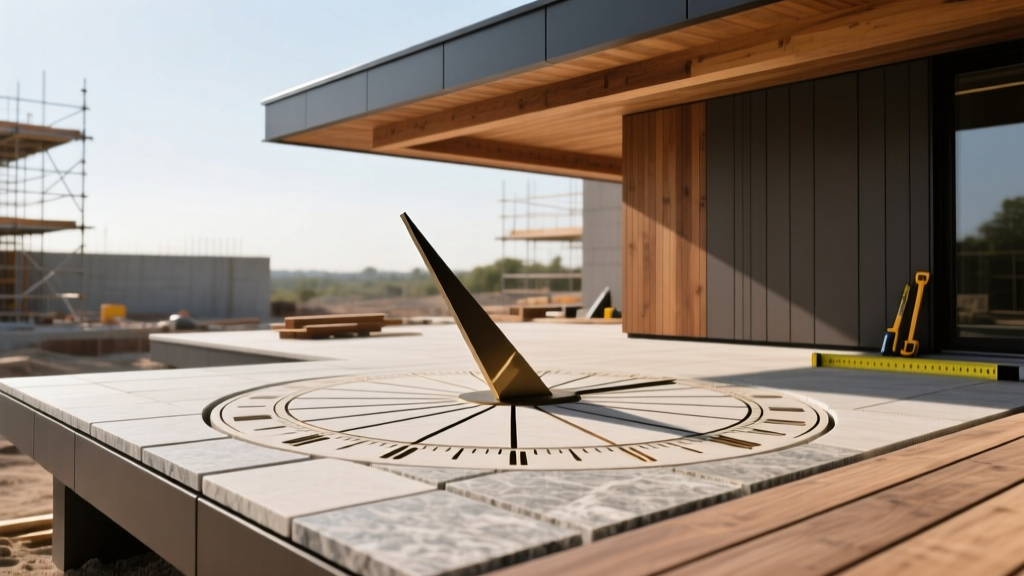
The Engineering Reality of a Sundial Deck
A sundial deck is not merely a sun-drenched patio; it is a precision horological instrument scaled to architectural proportions. The fundamental requirement of any horizontal sundial is that the relationship between the gnomon (the shadow-casting element) and the hour lines (the dial face) remains mathematically absolute. When evaluating the best materials for building a durable sundial deck, standard decking criteria like slip resistance and basic aesthetics take a backseat to dimensional stability and machinability.
If your deck surface expands and contracts longitudinally with seasonal temperature shifts, the hour markers will physically migrate. A shadow that accurately points to 2:00 PM in the cool spring will read 2:14 PM in the heat of late summer if the underlying decking material has a high Coefficient of Thermal Expansion (CTE). Therefore, the selection framework for a sundial deck requires a bifurcated approach: choosing a hyper-stable material for the central dial face, and integrating it with standard perimeter decking.
Phase 1: The Material Selection Matrix
To isolate the optimal materials, we must evaluate candidates across three non-negotiable metrics: Longitudinal CTE, UV Reflectance (for shadow contrast), and Machinability (the ability to route clean channels for brass or bronze inlays). According to data published by the U.S. Forest Products Laboratory, wood movement is highly directional, a factor we can exploit.
| Material Category | Longitudinal CTE (in/in/°F) | Shadow Contrast | Inlay Machinability | Estimated Cost (per sq. ft.) |
|---|---|---|---|---|
| Thermally Modified Ash | ~0.000001 (Near Zero) | Excellent (Matte) | Superior (Routes like hardwood) | $14.00 - $18.50 |
| Extruded Aluminum (Powder Coated) | ~0.000013 (Low) | Good (Depends on finish) | Poor (Requires CNC/welding) | $19.00 - $26.00 |
| Capped Composite (e.g., Trex, TimberTech) | ~0.000030 (High) | Good | Moderate (Melts if routed fast) | $9.00 - $14.00 |
| Cellular PVC (e.g., AZEK) | ~0.000045 (Very High) | Poor (Glare issues) | Excellent | $11.00 - $16.00 |

Phase 2: Deep Dive into the Top Two Dial Face Materials
Based on the matrix above, only two materials meet the strict engineering requirements for the central sundial face: Thermally Modified Wood and Extruded Aluminum. Here is how to select between them based on your specific project parameters.
Option A: Thermally Modified Ash (The Traditionalist's Choice)
Thermally modified timber (TMT) is baked in a low-oxygen environment at temperatures exceeding 400°F, altering its cellular structure. This process, governed by standards from organizations like the American Wood Protection Association, practically eliminates the wood's equilibrium moisture content (EMC) and locks its longitudinal dimensions. Brands like Thermory or Kebony offer ash profiles that are incredibly stable.
- The Advantage: TMT can be routed with standard carbide bits to create 1/4-inch deep, 1/2-inch wide channels for embedding solid brass hour lines. The matte, darkened grain of modified ash provides exceptional contrast against the sharp shadow of a steel gnomon.
- The Edge Case: While longitudinal movement is near zero, tangential (width) movement still occurs at roughly 1.5%. You must install the dial face boards with a 1/8-inch gap and use hidden edge fasteners (like the CAMO Edge system) to allow lateral breathing without shifting the board lengthwise.
Option B: Extruded Aluminum Decking (The Modernist's Choice)
If your design leans contemporary, marine-grade extruded aluminum decking (such as Wahoo Decks or Knotwood) offers a CTE that is roughly one-third that of composites. While aluminum does expand, the movement is predictable and minimal enough that, over a standard 10-foot dial radius, the time distortion remains under 15 seconds.
- The Advantage: Impervious to rot, insects, and moisture. Aluminum decking systems often feature integrated water-shedding channels, keeping the dial face perfectly dry and free of debris that could obscure hour lines.
- The Edge Case: You cannot easily route aluminum on-site for inlays. The hour lines must be applied using marine-grade epoxy (such as West System 105 resin with 206 hardener) over surface-mounted brass strips, or the aluminum panels must be sent to a CNC fabricator to have the dial waterjet-cut prior to installation.
Phase 3: The Perimeter and Subframe Framework
You do not need to build the entire 400-square-foot deck out of expensive thermally modified ash. The selection framework dictates using high-stability materials only for the sundial face (typically a 10x10 or 12x12 central octagon or circle), while utilizing standard capped composites for the surrounding perimeter.
Framing Material Selection
For the joists directly beneath the sundial face, avoid standard pressure-treated pine if possible. As pine dries and twists over the first two years, it will torque the hyper-stable dial face boards above it. Instead, use light-gauge steel framing (like Fortress Evolution or Trex Elevations) for the central dial zone. Steel joists have a CTE of roughly 0.0000065, ensuring the structural skeleton remains as dimensionally rigid as the dial face itself.
Phase 4: Inlay Integration and Calibration
Selecting the material is only half the battle; integrating the hour lines requires specific adhesives and tolerances. When embedding brass or bronze rods into routed channels in thermally modified ash:
- Channel Routing: Use a template guide and a 1/2-inch straight carbide bit. Route to a depth of 3/8 inch. The brass rod should be 1/4 inch thick, leaving 1/8 inch at the bottom for adhesive.
- Adhesive Selection: Do not use standard construction adhesive. Use a flexible, marine-grade polyurethane (like Sikaflex-291). This allows the brass (which has a high CTE) to expand and contract independently of the wood without popping out of the channel.
- Calibration: Install the brass inlays on the day of the Vernal or Autumnal Equinox. Use a GPS-synced atomic clock app to mark the exact shadow tip at solar noon, adjusting for your specific longitude and the Equation of Time.
Cost and ROI Breakdown (2026 Estimates)
Building a precision sundial deck commands a premium over standard patios, primarily due to the fabrication labor and specialized materials. Below is a realistic cost framework for a 400 sq. ft. deck featuring a 144 sq. ft. central sundial face.
| Project Component | Material Choice | Estimated Cost Range |
|---|---|---|
| Perimeter Decking (256 sq. ft.) | Premium Capped Composite | $3,500 - $4,800 |
| Sundial Face (144 sq. ft.) | Thermally Modified Ash | $2,000 - $2,600 |
| Steel Subframe (Central Zone) | Light-Gauge Steel Joists | $1,200 - $1,800 |
| Gnomon & Inlay Fabrication | Custom Machined Steel/Brass | $1,500 - $3,000 |
| Specialized Labor (CNC/Routing) | Finish Carpentry Premium | $2,500 - $4,000 |
Final Decision Matrix
To finalize your material selection, apply this quick diagnostic framework based on your site conditions and maintenance tolerance:
- Choose Thermally Modified Ash if: You want a warm, natural aesthetic, possess the budget for hidden fasteners and marine-grade epoxy, and want the ability to route custom inlays on-site using standard woodworking tools.
- Choose Extruded Aluminum if: The deck is in a high-moisture or coastal salt-spray environment, you prefer a zero-maintenance surface, and you are willing to outsource the dial face cutting to a professional metal fabricator prior to assembly.
- Avoid Composites and PVC for the Dial Face if: You live in a region with extreme seasonal temperature deltas (e.g., the Midwest or Northeast US), where a 100°F swing between winter and summer will physically tear the inlay channels apart.
For further technical guidelines on structural load limits and fastener spacing when mixing heavy hardwoods with composite perimeters, always consult the latest installation bulletins from the North American Decking and Railing Association (NADRA). By respecting the physics of thermal movement and selecting materials based on dimensional stability rather than just color, your sundial deck will remain a functional, accurate timepiece for decades.
Written by
Elena RodriguezElena Rodriguez is a civil engineer and technical writer specializing in concrete technology, masonry systems, and ASTM/ACI compliance. She earned her B.S. in Civil Engineering from Texas A&M University and spent a decade at a materials testing laboratory, performing over 2,000 concrete compressive strength tests and masonry prism evaluations. Elena is an ACI-certified Field Testing Technician (Grade I) and a member of ASTM Committee C12 on Natural Building Stone. She currently consults on forensic engineering cases involving concrete failures and moisture intrusion. Based in San Antonio, TX, Elena is a proud member of the Society of Women Engineers (SWE) and coaches her daughter's FIRST Robotics team.
More from Elena Rodriguez
View all
Walls & Panels
Cost Analysis: Light Gauge Steel Framing Advantages and Disadvantages
Evaluate light gauge steel framing advantages and disadvantages through a strict cost analysis lens, comparing material, labor, and lifecycle expenses.
Aug 4, 2026

Walls & Panels
Gypsum Board Types: Exact Specifications, Thickness & Dimensions
Compare standard, Type X, and moisture-resistant gypsum board types. Get exact specifications, thicknesses, dimensions, and ASTM standards for your project.
Aug 4, 2026

Fire Resistance
Best Fire-Resistant Outdoor Decking Materials: 2026 Buyer Guide
Discover the best fire-resistant outdoor decking materials for 2026. Compare Class A PVC, aluminum, and hardwood options for WUI compliance and safety.
Aug 4, 2026