When Foundation Repair Exceeds the Cost to Build a Basement
Compare major foundation repair methods like underpinning and wall reconstruction against the total cost to build a basement from scratch.

The Tipping Point: Repairing vs. Replacing a Basement Foundation
Homeowners facing severe structural settlement often start by exploring localized foundation repair methods. However, when hydrostatic pressure, expansive clay soils, or chronic water intrusion have catastrophically compromised a below-grade structure, piecemeal repairs become a financial sinkhole. In these extreme scenarios, structural engineers must evaluate whether the cumulative expense of advanced underpinning and wall reconstruction surpasses the cost to build a basement entirely from scratch beneath the existing footprint. This analysis requires a granular understanding of 2026 material costs, soil mechanics, and structural load paths.
Do not attempt cosmetic repairs if you observe horizontal shear cracks at the cold joint, stair-step cracking in CMU walls exceeding 1/4 inch in width, or inward bowing greater than 2 inches. These indicate that lateral earth pressure has exceeded the wall's moment capacity, requiring immediate professional engineering intervention.
Major Foundation Repair Methods and 2026 Pricing
Before deciding to demolish and rebuild, contractors will typically propose advanced stabilization techniques. The viability of these methods depends on the specific failure mode of the foundation.
1. Deep Foundation Underpinning (Helical and Push Piers)
When a basement floor slab or footing settles due to poorly consolidated fill soil, underpinning transfers the structural load to stable bedrock or dense load-bearing strata. Chance helical piers and Foundation Supportworks push piers are the industry standards. Installation requires hydraulic torque motors generating 7,000 to 10,000 lbs of torque to drive the steel shafts past the active soil zone. In 2026, the installed cost ranges from $1,800 to $2,600 per pier, with most residential retrofits requiring 15 to 25 piers.
2. Bowed Wall Reconstruction and Carbon Fiber Reinforcement
For walls bowing inward due to hydrostatic pressure, carbon fiber straps (such as CarbonArmor or Simpson Strong-Tie systems) are epoxied to the concrete surface to provide tensile strength. While carbon fiber costs between $800 and $1,200 per strap, it only halts movement; it does not straighten severely bowed walls. For walls deflected more than 2 inches, contractors must use earth anchors (like Grip-Tite) or completely excavate the exterior, rebuild the wall with steel-reinforced concrete, and apply exterior dimpled drainage mats like Platon.
3. Floor Slab Replacement and Mudjacking
If the basement walls are sound but the floor slab has heaved or settled, polyurethane foam jacking ($5 to $8 per square foot) can lift the concrete. However, if the slab is shattered or lacks a proper vapor barrier, complete demolition and repouring a 4-inch slab with 3,000 PSI concrete and #4 rebar grid is required, costing $9 to $14 per square foot.
| Repair Method | Best Application | 2026 Cost Range | Expected Lifespan |
|---|---|---|---|
| Helical Piers | Footprint settlement, sinking footings | $1,800 - $2,600 / pier | 75+ Years |
| Carbon Fiber Straps | Minor bowing (< 2 inches), tensile cracking | $800 - $1,200 / strap | Lifetime of structure |
| Exterior Wall Rebuild | Severe shear, horizontal collapse, water rot | $400 - $600 / linear ft | 50+ Years |
| Polyurethane Slab Jacking | Sunken floor slabs, void filling | $5 - $8 / sq ft | 10 - 20 Years |
The True Cost to Build a Basement Under an Existing Home
When localized repairs exceed 50% of the cost of a full replacement, the most economically sound decision is to demolish the failing structure and execute a full basement retrofit. The cost to build a basement beneath an existing house—often referred to as benching or underpinning excavation—is a highly complex engineering feat. According to industry benchmarks tracked by the National Association of Home Builders, retrofitting a 1,000-square-foot basement in 2026 typically ranges from $65,000 to $95,000, depending on site access and soil conditions.
"The cost to build a basement via retrofit is rarely just about pouring concrete. You are paying for structural shoring of the live house, precision soil excavation in confined spaces, and advanced dewatering systems to manage the local water table during construction."
The Step-by-Step Basement Retrofit Sequence
- Structural Shoring: Steel I-beams and hydraulic jacks are installed in the existing basement to support the home's live load while the old foundation is removed.
- Benching and Excavation: Mini-excavators dig out the soil in 3-foot benches to prevent trench collapse. Soil spoils are removed via conveyor belts or basement window hatches.
- Footing Formation: New continuous footings are formed and poured. Per guidelines from the American Concrete Institute, footings must extend below the local frost line and utilize minimum 3,000 PSI concrete with continuous #5 rebar.
- Wall Pouring and Waterproofing: Poured concrete walls (superior to CMU for lateral strength) are formed. Exterior surfaces are coated with modified bitumen and covered with a dimpled drain mat connected to an interior French drain system.
- Slab and Backfill: A 4-inch gravel base, 10-mil polyethylene vapor barrier, and 4-inch reinforced concrete slab are installed.
Decision Framework: When to Repair vs. When to Rebuild
Determining whether to pursue targeted repairs or absorb the full cost to build a basement requires a strict engineering and financial framework. Use the following decision matrix to guide your choice:
- ✅ Choose Targeted Repair If: The foundation failure is localized (e.g., one corner settling), the walls are plumb with only minor shrinkage cracking, and the total repair estimate is under $25,000.
- ❌ Choose Full Rebuild (Cost to Build a Basement) If: Multiple walls exhibit horizontal shear failure, the floor slab is severely heaved by expansive clay, chronic water intrusion has caused mold and rot, or repair quotes exceed $45,000.
The 50% Rule in Foundation Engineering
Structural engineers frequently apply the 50% Rule: if the cost to stabilize, waterproof, and cosmetically restore a failing basement exceeds 50% of the cost to demolish and pour a new one, replacement is the superior long-term investment. A rebuilt basement comes with modern waterproofing warranties (often 25 to 50 years), updated egress windows for code compliance, and a guaranteed increase in property appraisal value that piecemeal repairs cannot match.
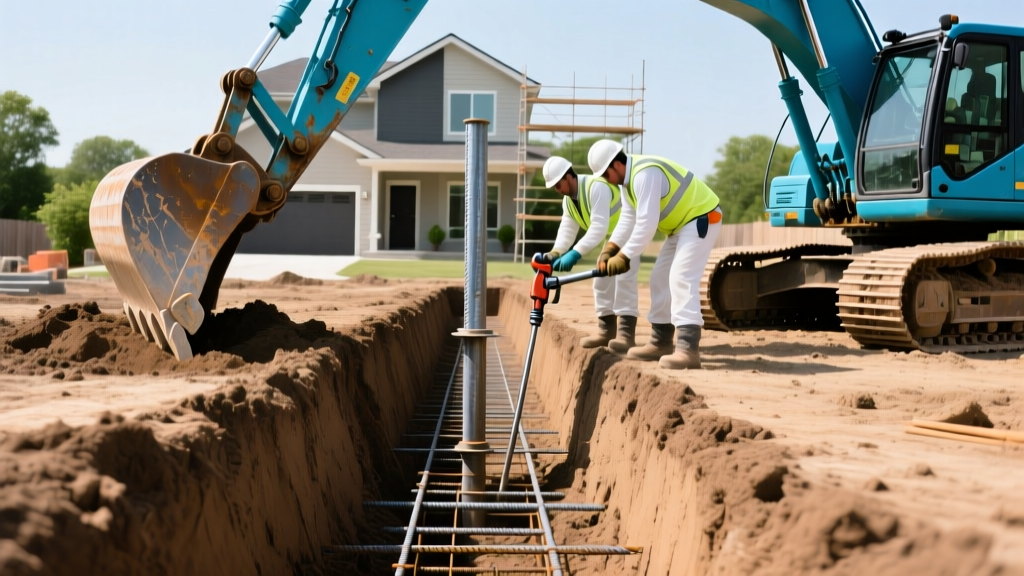
Hidden Variables That Skew Basement Construction Costs
When budgeting for the cost to build a basement, homeowners must account for subterranean variables that can inflate quotes by 20% to 40%:
- High Water Tables: If the excavation hits the water table, contractors must install continuous wellpoint dewatering systems, adding $4,000 to $8,000 to the project.
- Ledge and Bedrock: Blasting or mechanical breaking of shallow bedrock can add $15 to $25 per cubic yard of removed material.
- Zero-Lot-Line Access: If the home is built on a property line, exterior excavation for waterproofing may be impossible, forcing the use of interior negative-side waterproofing crystalline coatings (like Xypex), which cost $8 to $12 per square foot.
Frequently Asked Questions
Can I just use epoxy injection for a bowing basement wall?
No. Epoxy injection is strictly for repairing non-structural shrinkage cracks to prevent water seepage. It provides zero structural resistance against lateral earth pressure. Bowing walls require carbon fiber reinforcement, steel I-beam bracing, or exterior wall anchors to counteract the hydrostatic load.
Does homeowners insurance cover the cost to build a basement if mine collapses?
Standard homeowners insurance policies explicitly exclude foundation damage caused by soil settlement, expansive clay, hydrostatic pressure, or normal wear and tear. Insurance will only cover foundation replacement if the collapse is the direct result of a covered peril, such as a sudden burst pipe undermining the footing or a vehicle striking the structure.
How long does a full basement retrofit take compared to standard repairs?
While installing helical piers or carbon fiber straps typically takes 3 to 5 days, the full process to excavate and absorb the cost to build a basement under an existing home requires 6 to 10 weeks. This accounts for structural shoring, soil removal, concrete curing times (minimum 7 days before backfilling), and interior finishing.
Written by
Elena RodriguezElena Rodriguez is a civil engineer and technical writer specializing in concrete technology, masonry systems, and ASTM/ACI compliance. She earned her B.S. in Civil Engineering from Texas A&M University and spent a decade at a materials testing laboratory, performing over 2,000 concrete compressive strength tests and masonry prism evaluations. Elena is an ACI-certified Field Testing Technician (Grade I) and a member of ASTM Committee C12 on Natural Building Stone. She currently consults on forensic engineering cases involving concrete failures and moisture intrusion. Based in San Antonio, TX, Elena is a proud member of the Society of Women Engineers (SWE) and coaches her daughter's FIRST Robotics team.
More from Elena Rodriguez
View all
Walls & Panels
Cost Analysis: Light Gauge Steel Framing Advantages and Disadvantages
Evaluate light gauge steel framing advantages and disadvantages through a strict cost analysis lens, comparing material, labor, and lifecycle expenses.
Aug 4, 2026

Walls & Panels
Gypsum Board Types: Exact Specifications, Thickness & Dimensions
Compare standard, Type X, and moisture-resistant gypsum board types. Get exact specifications, thicknesses, dimensions, and ASTM standards for your project.
Aug 4, 2026

Fire Resistance
Best Fire-Resistant Outdoor Decking Materials: 2026 Buyer Guide
Discover the best fire-resistant outdoor decking materials for 2026. Compare Class A PVC, aluminum, and hardwood options for WUI compliance and safety.
Aug 4, 2026