2026 Metal Roofing Material Cost and Installation Guide
Analyze 2026 metal roofing material cost by profile, gauge, and climate. Expert installation steps to prevent hidden budget leaks.

The True Breakdown of Metal Roofing Material Cost in 2026
Calculating the exact metal roofing material cost requires moving beyond average square-foot estimates and analyzing the interplay between alloy composition, gauge thickness, and paint systems. In 2026, raw material volatility and advanced coating technologies have shifted the pricing landscape. A standard 29-gauge corrugated panel will cost a fraction of a 24-gauge standing seam system, but the long-term performance and installation requirements differ drastically. Understanding these variables is the first step in preventing budget overruns during your installation.
| Metal Profile | Gauge / Material | Material Cost per Sq. Ft. (2026) | Expected Lifespan |
|---|---|---|---|
| Exposed Fastener (Corrugated/R-Panel) | 29-Gauge Galvalume Steel | $5.50 - $8.50 | 25 - 35 Years |
| Standing Seam (Mechanical Lock) | 24-Gauge Galvalume Steel | $12.50 - $18.00 | 50+ Years |
| Stone-Coated Steel | 26-Gauge Zincalume | $11.00 - $16.00 | 40 - 50 Years |
| Coastal Standing Seam | 0.032" Aluminum | $15.00 - $22.00 | 50+ Years |
| Premium Architectural | 0.8mm Zinc Alloy | $25.00 - $35.00 | 80 - 100 Years |
When evaluating these figures, note that material costs represent only 40% to 50% of the total project expense. The remainder is dictated by labor, structural reinforcement, and specialized accessories. Furthermore, opting for a Kynar 500 (PVDF) paint finish over a standard silicone-modified polyester (SMP) coating will add $1.50 to $2.50 per square foot but prevents the chalking and UV fading that plagues cheaper panels after a decade of sun exposure.
Hidden Cost Triggers: Pitch, Penetrations, and Profiles
The baseline material cost per square foot assumes a simple, unbroken gable roof with a standard 6:12 pitch. Real-world architectural features introduce severe cost multipliers that contractors must account for during the estimation phase.
Never install standard asphalt-saturated felt underlayment beneath metal panels. Metal roofs trap immense heat, causing standard felt to melt, adhere to the metal, and degrade prematurely. You must budget for a high-temperature synthetic underlayment (approx. $0.65/sq. ft.) or a peel-and-stick rubberized asphalt membrane (approx. $1.85/sq. ft.) in valleys and eaves. Failing to specify high-temp materials will void most manufacturer warranties.
- Roof Pitch Multipliers: Once a roof exceeds an 8:12 pitch, installers require specialized scaffolding and roof jacks. Labor costs increase by 20% to 35%, and material waste jumps from a standard 5% to 10-12% due to the difficulty of handling 20-foot panels on steep inclines.
- Penetrations and Flashing: Every HVAC curb, plumbing vent, and skylight requires custom-fabricated step flashing or Z-flashing. Budget an additional $25 to $45 per penetration for the specialized rubber boots, metal collars, and polyurethane sealants required to maintain a watertight envelope.
- Valley Complexity: Open valleys on metal roofs require W-valley flashing and specialized closure strips. A roof with four valleys will add roughly $400 to $600 in accessory materials alone compared to a simple gable design.
Installation Sequence: Where Budget Leaks Happen
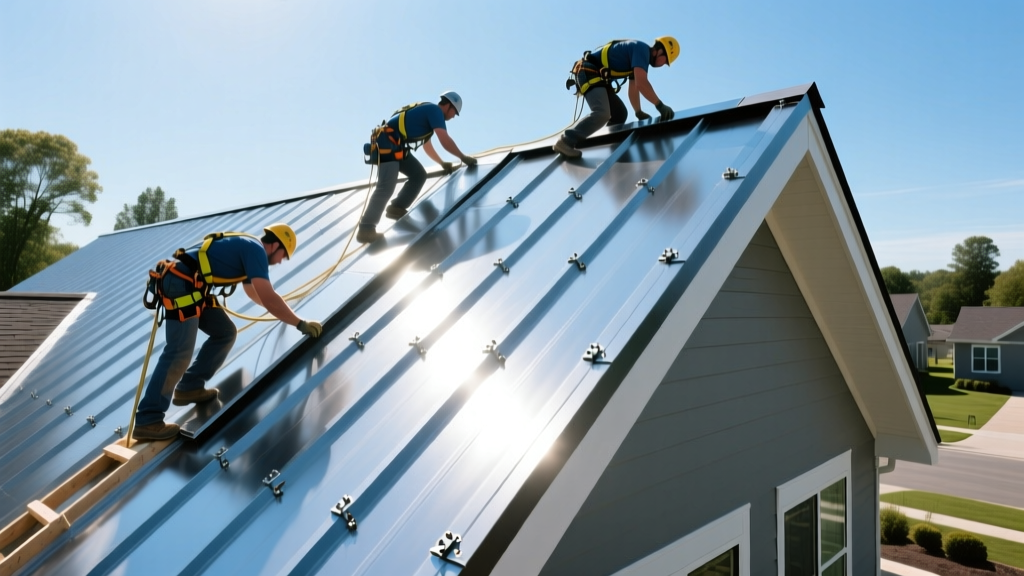
Proper installation dictates whether your metal roof lasts 20 years or 60 years. Thermal expansion is the primary enemy of metal roofing; steel panels can expand up to one inch per 100 feet of length during a 100°F temperature swing. If the installation sequence ignores this physics reality, the panels will buckle, tear out fasteners, or suffer from "oil-canning" (visible stress wrinkling).
- Decking Preparation and Planar Alignment: Standing seam systems require a perfectly flat substrate. Any warped OSB or uneven rafters will telegraph through the metal, causing severe oil-canning. Budget $2.00 to $4.00 per square foot for decking shimming or replacement if the existing roof deck is compromised.
- High-Temp Underlayment Deployment: Roll out the high-temp synthetic underlayment horizontally, starting from the eave. Overlap horizontal seams by a minimum of 4 inches and vertical seams by 6 inches. Secure with cap nails, not standard staples, to prevent wind-tear before the panels are laid.
- Drip Edge and Starter Trim: Install the drip edge over the underlayment at the eaves, but under the underlayment at the rakes (gables). This specific overlapping sequence prevents wind-driven rain from being forced up and under the metal panels. Use color-matched butyl tape ($38 per 50ft roll) beneath all overlapping trim pieces.
- Panel Layout and Concealed Clipping: For standing seam, attach the female leg of the panel to the deck using fixed clips at the eave (to anchor the panel) and sliding/slotted clips for the remainder of the field. This allows the panel to expand and contract freely toward the ridge. Never pin a panel rigidly at both ends.
- Mechanical Seaming and Ridge Cap: Use a mechanical seamer to fold the panel legs together, creating a 1.5-inch or 2-inch structural seam. Finish with a vented ridge cap that utilizes foam closure strips to block debris and pests while allowing hot attic air to exhaust.
Fasteners, Trim, and Underlayment: The Accessory Trap
Contractors often quote the primary panel cost accurately but underestimate the accessory package. The metal roofing material cost is incomplete without factoring in the specialized hardware required to keep the system secure and sealed. According to the National Roofing Contractors Association (NRCA), improper fastener selection is the leading cause of premature metal roof failure.
- Lap Screws and Washers: For exposed fastener systems, you must use color-matched #10 or #12 lap screws featuring EPDM or neoprene sealing washers. Standard zinc-plated screws will rust within five years, streaking the panels. Budget $0.15 to $0.25 per screw; a standard square requires roughly 80-100 screws.
- Butyl Sealant Tape: A non-hardening, 100% butyl tape is mandatory between all end-laps and trim overlaps. Silicone caulk is strictly prohibited in concealed joints as it loses adhesion under thermal cycling and traps moisture. Expect to use 2 to 3 rolls of butyl tape per roofing square.
- Closure Strips: High-density polyethylene foam closure strips are required at the eave and ridge to seal the corrugated profile against wind-driven rain and insects. These cost roughly $1.20 per linear foot and are easily omitted by budget-cutting installers.
Decision Framework: Matching Material to Climate
Selecting a metal profile based solely on upfront cost leads to catastrophic failures in extreme climates. Use the U.S. Department of Energy's cool roof guidelines to leverage reflective pigments, but match the base alloy to your specific environmental stressors.
| Climate Zone | Recommended Material | Technical Justification |
|---|---|---|
| Coastal / Salt Spray | 0.032" Aluminum or Zinc | Steel will rust at cut edges despite Galvalume coatings. Aluminum forms a protective oxide layer that halts saltwater corrosion. |
| Heavy Snow / Alpine | 24-Gauge Standing Seam | Exposed fasteners will sheer under the weight of sliding ice. Standing seam sheds snow efficiently; pair with staggered snow guards ($25-$45 each) to prevent avalanche loading on gutters. |
| High Wind / Hurricane | Mechanical Lock Standing Seam | Concealed clips and mechanically seamed edges withstand uplift pressures exceeding 150 mph (UL 580 Class 90), whereas exposed fastener systems risk pull-through. |
| Arid / High UV | Steel with PVDF (Kynar) Coating | PVDF resins reflect UV radiation and resist chalking. SMP coatings will chalk and fade rapidly in intense, direct desert sunlight. |
Frequently Asked Questions
Does installing metal roofing over existing shingles save money?
While it saves $1.50 to $3.00 per square foot in tear-off and disposal fees, installing metal over existing asphalt shingles is generally discouraged. The uneven surface of the shingles causes the metal panels to undulate, leading to oil-canning and compromised clip engagement. Furthermore, it traps moisture against the roof deck, accelerating wood rot. If a retrofit is unavoidable, you must install 1x4 or 2x4 wooden battens (strapping) over the shingles to create a flat, vented air gap before attaching the metal panels.
How much does thermal expansion affect fastener placement?
Thermal expansion is the most critical engineering factor in metal roofing. A 40-foot steel panel can expand nearly half an inch from a cold winter night to a hot summer afternoon. If an installer drives a fastener tight against the panel's pre-drilled hole without allowing for lateral movement, the panel will buckle or the fastener head will snap. This is why standing seam systems utilize slotted clip holes and why exposed fastener systems require neoprene washers that compress to create a seal without rigidly pinning the metal to the deck.
Are stone-coated metal roofs worth the premium over standard steel?
Stone-coated steel costs roughly 30% more than standard painted steel panels. The premium pays for acoustic dampening (it eliminates the "tin rain" sound during storms) and aesthetic integration into historic or HOA-restricted neighborhoods that ban reflective metal roofs. However, the granular coating can trap debris and moisture in low-slope applications, making it less ideal for roofs with a pitch below 4:12 compared to smooth standing seam profiles.
Written by
Sarah WhitfieldSarah Whitfield is a chartered quantity surveyor (MRICS) and construction cost analyst with 15 years of experience in material pricing, procurement strategy, and project budgeting. She earned her degree in Construction Management from the University of Reading (UK) and has worked on projects ranging from $2M custom homes to $180M mixed-use developments across North America and Europe. Sarah currently leads cost estimating for BuildMat Insight, maintaining a proprietary database of 4,000+ material price points updated quarterly. She is a frequent contributor to RSMeans cost data panels and has presented at the International Cost Engineering Council (ICEC) congress. Based in Denver, CO, Sarah is an avid trail runner and volunteer mentor for Women in Construction.
More from Sarah Whitfield
View all
Wood & Lumber
What Are the Different Types of Wood? A Builder's Guide
Compare structural softwoods, finish hardwoods, and engineered lumber. Analyze Janka ratings, MOE values, and 2026 pricing for construction.
Aug 4, 2026

Walls & Panels
Steel Framing vs Wood Framing: Corrosion and Moisture Defense
Compare steel framing vs wood framing for moisture resistance. Learn about galvanized coatings, condensation risks, and corrosion protection strategies.
Jul 21, 2026

Stone & Masonry
How to Cut Stone Veneer: Wet Saw vs Grinder Comparison
Compare the best tools for cutting stone veneer. We review wet saws, angle grinders, and chop saws to help you achieve clean, chip-free cuts.
Jul 21, 2026