TPO Roof Materials vs EPDM & PVC: 2026 Commercial Roofing Guide
Compare TPO roof materials against EPDM and PVC for commercial flat roofs. Analyze 2026 costs, mil thicknesses, seam strength, and lifespan.

The Single-Ply Membrane Hierarchy
Specifying low-slope or flat commercial roofing requires navigating the triad of single-ply membranes: Thermoplastic Polyolefin (TPO), Polyvinyl Chloride (PVC), and Ethylene Propylene Diene Monomer (EPDM). While EPDM has historically dominated the black membrane market and PVC remains the premium choice for chemical resistance, modern TPO roof materials have captured over 40% of the commercial low-slope market share. This shift is driven by advancements in polymer stabilization, heat-weldable seam technology, and the energy-saving benefits of highly reflective white membranes. Evaluating these materials requires moving beyond basic marketing claims to examine chemical composition, mil thickness tolerances, and real-world installation variables.
Chemical Composition and Reinforcement Scrim
The fundamental difference between these membranes lies in their polymer chains and reinforcement layers. Understanding these chemical distinctions dictates how the roof will perform under thermal shock, UV degradation, and mechanical stress.
TPO (Thermoplastic Polyolefin)
TPO is a blend of polypropylene and ethylene-propylene rubber, polymerized together to create a flexible yet highly durable thermoplastic. Unlike PVC, TPO roof materials do not require liquid plasticizers to maintain flexibility. This is a critical advantage, as plasticizer migration over time is the primary cause of brittleness in older PVC roofs. Modern TPO membranes utilize a polyester scrim reinforcement sandwiched between the top and bottom TPO plies, providing dimensional stability and high tensile strength (typically exceeding 300 lbf/inch per ASTM D6878 standards).
PVC (Polyvinyl Chloride)
PVC relies on a chlorine-based polymer structure, making it inherently fire-resistant and highly impervious to animal fats, oils, and industrial chemicals. However, PVC requires the addition of plasticizers (often phthalates) to remain pliable. While premium manufacturers like Sika Sarnafil use advanced polymeric plasticizers that resist leaching, lower-tier PVC membranes can become brittle as these chemicals evaporate over a 15-to-20-year lifespan.
EPDM (Ethylene Propylene Diene Monomer)
EPDM is a thermoset synthetic rubber. Because it is thermoset, it cannot be heat-welded; seams must be joined using liquid adhesives or double-sided butyl tape. This creates a distinct vulnerability: while the membrane itself can last 30+ years, the glued seams are often the first point of failure, requiring costly maintenance and resealing every 7 to 10 years.
2026 Cost Analysis: Material vs. Installed Pricing
Pricing for commercial single-ply systems fluctuates based on petroleum costs, resin availability, and regional labor rates. The table below outlines the 2026 baseline costs for material-only and fully installed systems (including insulation, fasteners, and labor) across standard mil thicknesses.
| Material Type | Thickness (Mil) | Membrane Cost (Per Sq. Ft.) | Installed System Cost (Per Sq. Ft.) | Expected Lifespan |
|---|---|---|---|---|
| TPO (Standard) | 45-mil | $1.35 - $1.60 | $4.50 - $6.00 | 15 - 20 Years |
| TPO (Heavy Duty) | 60-mil | $1.85 - $2.30 | $5.50 - $7.50 | 20 - 25 Years |
| TPO (Premium) | 80-mil | $2.60 - $3.10 | $7.00 - $9.00 | 25 - 30 Years |
| PVC (Standard) | 50-mil | $2.40 - $2.90 | $6.50 - $8.50 | 20 - 25 Years |
| EPDM (Black) | 60-mil | $1.50 - $1.90 | $5.00 - $7.00 | 20 - 30 Years |
Top-Tier TPO Roof Materials: Brand and Model Specifics
Not all TPO is manufactured equally. The market is segmented between budget import membranes and premium domestically engineered products. When drafting specifications, facility managers and architects should target the following proven product lines:
- GAF EverGuard Extreme: Engineered specifically for high-heat environments and buildings with high solar loads. It features a specialized UV-resistant top ply and is available in thicknesses up to 115-mil. It carries an industry-leading warranty against premature weathering.
- Carlisle Sure-Weld TPO: The industry workhorse. Carlisle's 60-mil and 80-mil membranes feature a thicker weathering top ply (minimum 24-mils above the scrim), which provides superior protection against hail and foot traffic compared to competitors who balance the ply thickness equally above and below the scrim.
- Elevate (formerly Firestone) UltraPly TPO: Known for its patented Weathertightness warranty options and highly consistent hot-air welding window, making it a favorite among roofing contractors who rely on robotic welders for large-scale warehouse projects.
Performance Matrix: Heat Welding, Puncture, and UV
Choosing the right membrane requires matching material properties to the building's operational environment. The following matrix compares the physical performance characteristics critical to commercial roofing consultants.
| Performance Metric | TPO (60-mil) | PVC (60-mil) | EPDM (60-mil) |
|---|---|---|---|
| Seam Joining Method | Hot-Air Welded (Thermoplastic) | Solvent / Hot-Air Welded | Adhesive / Tape (Thermoset) |
| Seam Strength | Exceptional (Membrane tears before seam) | Exceptional (Chemical fusion) | Moderate (Adhesive degradation over time) |
| Chemical / Grease Resistance | Poor to Moderate | Exceptional | Poor |
| Puncture Resistance (ASTM D4833) | High (with polyester scrim) | Moderate to High | Moderate |
| Solar Reflectance (White) | 0.80 - 0.85 (Initial) | 0.75 - 0.80 (Initial) | N/A (Typically Black) |
For facilities featuring rooftop HVAC units that exhaust animal fats (such as restaurants or food processing plants), PVC remains the mandatory choice. The oils will break down the molecular structure of TPO roof materials, leading to rapid membrane disintegration around exhaust vents. For standard retail, warehouse, and office applications, TPO provides the optimal balance of seam integrity and solar reflectance, qualifying for Department of Energy Cool Roof incentives and LEED certification points.
Installation Edge Cases and Failure Modes
The longevity of a TPO system is inextricably linked to installation precision. While the membrane itself is highly resistant to UV and ozone, improper field execution leads to specific, documented failure modes.
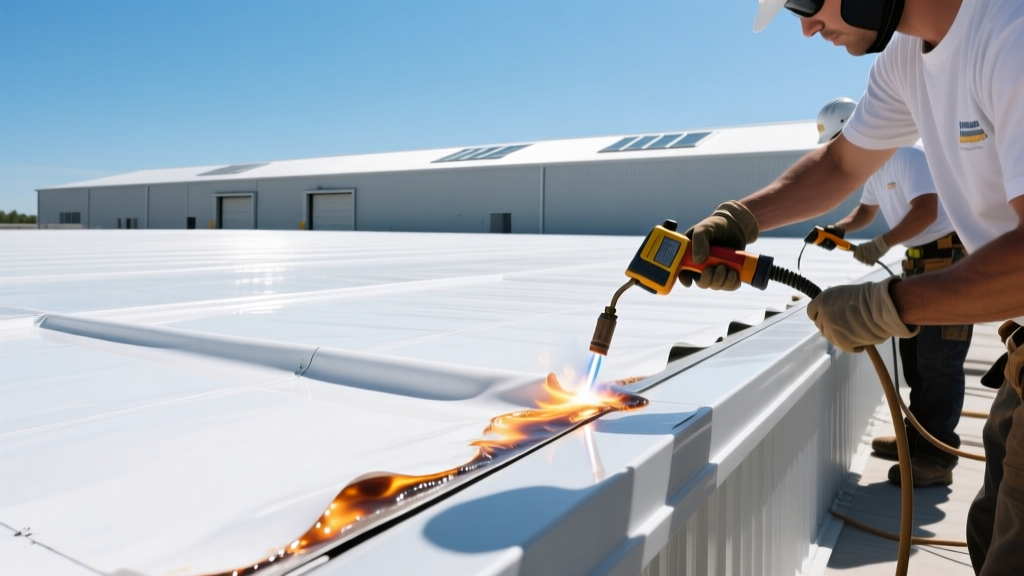
Hot-Air Welding Temperature Windows
TPO seams are fused using hot-air welders that blow air at temperatures between 1,000°F and 1,150°F. The exact temperature must be calibrated daily based on ambient humidity, wind speed, and cloud cover. If the air is too cool, the weld results in a 'cold seam' that will peel under wind uplift. If too hot, the membrane scorches, degrading the polymer and creating micro-fissures. According to the National Roofing Contractors Association (NRCA), contractors must perform test welds every morning and after any significant weather shift, peeling the test strip to verify that the scrim tears rather than the weld separating.
Ponding Water and Biological Growth
While TPO is completely waterproof, constant ponding water (standing water for more than 48 hours) encourages algae and biological growth on white membranes. This biological layer drastically reduces the solar reflectance index (SRI), increasing the building's cooling loads. To mitigate this, specifications must mandate a minimum slope of 1/4 inch per foot, utilizing tapered polyiso insulation to direct water to interior drains or scuppers. The Whole Building Design Guide explicitly warns against relying on membrane flexibility to bridge structural deflections that cause ponding.
Decision Framework: When to Specify TPO Over PVC or EPDM
Selecting the correct membrane requires a systematic evaluation of the building's use, budget, and climate zone. Use the following framework to finalize your specification:
- Specify TPO when: The project demands a highly reflective, energy-efficient white roof on a standard commercial building (warehouses, retail big-box, offices) with a mid-range budget, and where no airborne oils, greases, or heavy industrial chemicals are present.
- Specify PVC when: The facility is a restaurant, hospital with chemical exhaust, or manufacturing plant where airborne hydrocarbons, fats, or oils will interact with the roof surface, or when the roof features complex penetrations requiring solvent-welded flashing details.
- Specify EPDM when: The project is located in a northern climate zone where a black membrane's heat-absorbing properties will reduce winter heating costs, or when the budget is strictly constrained and the building owner is willing to accept a long-term maintenance schedule for seam adhesives.
By aligning the chemical properties of the membrane with the specific environmental and operational demands of the structure, facility managers can ensure their single-ply investment delivers maximum lifecycle value without premature system failure.
Written by
Sarah WhitfieldSarah Whitfield is a chartered quantity surveyor (MRICS) and construction cost analyst with 15 years of experience in material pricing, procurement strategy, and project budgeting. She earned her degree in Construction Management from the University of Reading (UK) and has worked on projects ranging from $2M custom homes to $180M mixed-use developments across North America and Europe. Sarah currently leads cost estimating for BuildMat Insight, maintaining a proprietary database of 4,000+ material price points updated quarterly. She is a frequent contributor to RSMeans cost data panels and has presented at the International Cost Engineering Council (ICEC) congress. Based in Denver, CO, Sarah is an avid trail runner and volunteer mentor for Women in Construction.
More from Sarah Whitfield
View all
Wood & Lumber
What Are the Different Types of Wood? A Builder's Guide
Compare structural softwoods, finish hardwoods, and engineered lumber. Analyze Janka ratings, MOE values, and 2026 pricing for construction.
Aug 4, 2026

Walls & Panels
Steel Framing vs Wood Framing: Corrosion and Moisture Defense
Compare steel framing vs wood framing for moisture resistance. Learn about galvanized coatings, condensation risks, and corrosion protection strategies.
Jul 21, 2026

Stone & Masonry
How to Cut Stone Veneer: Wet Saw vs Grinder Comparison
Compare the best tools for cutting stone veneer. We review wet saws, angle grinders, and chop saws to help you achieve clean, chip-free cuts.
Jul 21, 2026