Choosing the Right Standing Seam Metal Roof Material by Climate
Discover how to select the ideal standing seam metal roof material for coastal, alpine, and desert climates. Expert alloy, gauge, and coating guide.

The Metallurgy of Roofing: Galvalume vs. Aluminum
Selecting the correct standing seam metal roof material requires matching the metallurgical properties of the substrate to the specific environmental stressors of your region. A material that performs flawlessly in an arid desert will suffer catastrophic galvanic corrosion in a coastal salt-spray zone. The two dominant substrates in the North American market are Galvalume-coated steel and marine-grade aluminum, each with distinct chemical profiles and failure thresholds.
Galvalume (AZ55) consists of a carbon steel core coated with an alloy of 55% aluminum, 43.4% zinc, and 1.6% silicon. This coating provides barrier protection (from the aluminum) and galvanic/sacrificial protection (from the zinc) at the cut edges. It offers superior tensile strength compared to aluminum, making it ideal for regions with heavy snow loads and high wind uplift requirements.
Aluminum (5052-H32 or 3105-H14) relies on a naturally occurring oxide layer that forms instantly when the bare metal is exposed to oxygen. This self-healing oxide layer makes aluminum completely immune to the red-rust degradation that eventually claims steel substrates, though it is softer and more prone to denting from hail or falling debris.
Never install Galvalume steel within 1,500 feet of a breaking saltwater coastline. The chloride ions in salt spray will rapidly penetrate the zinc-aluminum coating, causing severe galvanic corrosion and voiding the manufacturer's warranty. In these zones, 0.032-inch or 0.040-inch 5052-H32 aluminum is the only code-compliant standing seam metal roof material.
Climate-Zone Selection Matrix
The following matrix provides a baseline specification framework for architects and contractors specifying standing seam systems across diverse North American climate zones.
| Climate Zone | Primary Threat | Ideal Substrate | Min. Gauge/Thickness | Required Coating |
|---|---|---|---|---|
| Coastal / Marine | Chloride-induced corrosion | 5052-H32 Aluminum | 0.032" (22 ga equiv.) | 70% PVDF (Kynar 500) |
| Alpine / Heavy Snow | Static loading, ice damming | AZ55 Galvalume Steel | 22-Gauge (0.0299") | PVDF or SMP |
| Desert / High UV | UV degradation, thermal shock | AZ55 Galvalume Steel | 24-Gauge (0.0239") | 70% PVDF (High SRI) |
| Humid Subtropical | Algae, high humidity, hurricanes | AZ55 Galvalume Steel | 24-Gauge (0.0239") | PVDF with algae-resistant primer |
Coastal & High-Wind Environments
In hurricane-prone coastal regions, the standing seam metal roof material must withstand both corrosive salt spray and extreme wind uplift. According to FEMA building science guidelines, roof assemblies in High-Velocity Hurricane Zones (HVHZ) must pass rigorous uplift testing (such as UL 1897 or ASTM E1592).
For aluminum roofs in these zones, specify a mechanical lock (double-lock) seam rather than a snap-lock profile. A double-lock seam folds the panel edges over each other twice, creating a physical interlock that resists wind uplift forces exceeding 150 mph. Furthermore, all fasteners, cleats, and clips must be 304 or 316-grade stainless steel. Using standard carbon-steel fasteners with aluminum panels will trigger a bimetallic galvanic reaction, leading to fastener failure and panel detachment during a storm.
Alpine & Heavy Snow Load Regions
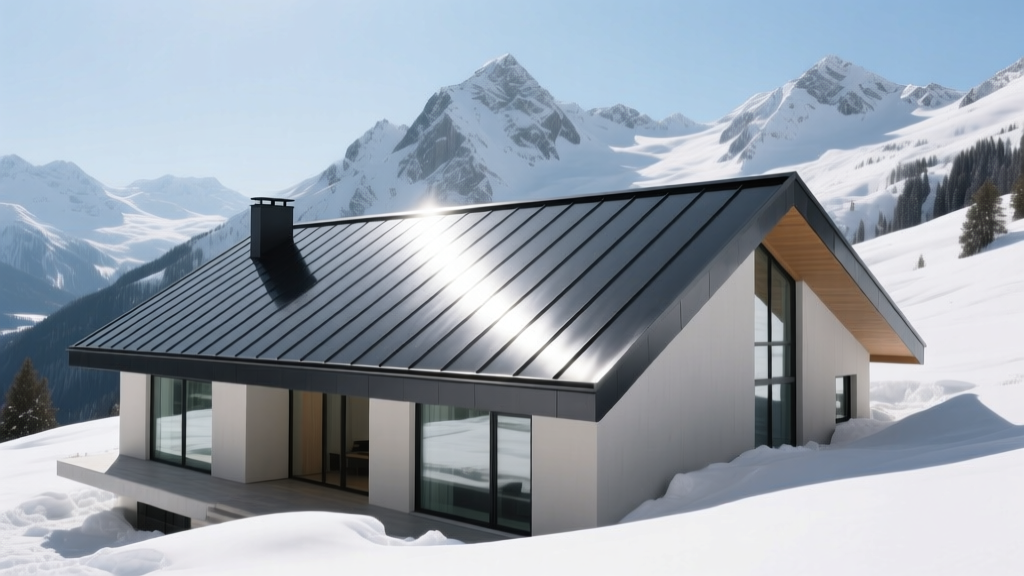
Mountainous and northern climates impose severe static loads from snow accumulation, alongside dynamic stresses from freeze-thaw cycles and ice damming. Steel is the superior standing seam metal roof material here due to its higher yield strength (typically 80 ksi for Grade 80 Galvalume compared to 30-40 ksi for aluminum).
Structural vs. Architectural Panels
For roof pitches below 3:12, or in regions where snow loads exceed 50 pounds per square foot (PSF), you must specify a structural standing seam panel. Unlike architectural panels that rely on a solid continuous deck for support, structural panels feature taller seams (2.5 to 3 inches) and can span open purlins up to 5 feet apart without deflection.
Thermal Movement Engineering: In alpine climates where ambient temperatures can swing 100°F between winter nights and summer days, a 50-foot steel panel will expand and contract by approximately 0.75 inches. Install floating clip systems that allow the panel to slide laterally over the fasteners, preventing seam tearing and fastener back-out.
Desert & High-UV Exposure
The primary enemy in arid, high-sunlight climates is not moisture, but ultraviolet (UV) radiation and extreme thermal shock. The U.S. Department of Energy emphasizes the importance of high Solar Reflectance Index (SRI) values in hot climates to reduce cooling loads and mitigate the urban heat island effect.
Coating Chemistry: PVDF vs. SMP
The longevity of your standing seam metal roof material in the desert is entirely dependent on the paint chemistry. You will encounter two primary resin systems:
- Silicone Modified Polyester (SMP): A budget-friendly coating with excellent hardness and scratch resistance. However, SMP resins break down under intense UV exposure, leading to severe chalking and color fading (often 5-10 Delta Hunter units) within 7 to 10 years in desert climates.
- Polyvinylidene Fluoride (PVDF): Marketed under trade names like Kynar 500® or Hylar 5000®, PVDF contains a 70% fluoropolymer resin. The carbon-fluorine bond is one of the strongest in organic chemistry, rendering it virtually impervious to UV degradation. PVDF coatings maintain color stability (Delta E < 5) and chalk resistance for 30 to 40 years, making it the mandatory choice for the American Southwest.
2026 Installed Cost Breakdown by Material
Pricing for standing seam systems fluctuates based on global steel and aluminum commodities, regional labor rates, and roof complexity. The following ranges reflect 2026 fully installed costs (including tear-off of one existing layer, synthetic underlayment, panels, trim, and labor) for a standard 2,000 sq. ft. residential roof with a 6:12 pitch.
National Average Installed Costs (Per Square Foot)
- 24-Gauge AZ55 Galvalume (Snap-Lock): $13.50 – $17.00 / sq. ft.
- 22-Gauge AZ55 Galvalume (Mechanical Lock): $16.00 – $21.00 / sq. ft.
- 0.032" Aluminum 5052-H32 (Coastal Spec): $18.50 – $24.00 / sq. ft.
- Upgrades (Ice & Water Shield / Snow Guards): Add $2.50 – $4.50 / sq. ft.
Final Specification Checklist
Before finalizing your material order, verify these critical specifications with your supplier and installing contractor:
- Substrate Certification: Demand mill certificates proving the Galvalume coating is AZ55 (minimum 0.55 oz/sq ft) or the aluminum is 5052-H32 marine grade.
- Coating Warranty: Ensure the PVDF coating warranty explicitly covers chalking (max 5 Hunter units), fading (max 5 Delta E), and chipping for a minimum of 30 years, and verify that the warranty is transferable to a subsequent homeowner.
- Accessory Compatibility: Confirm that all flashings, Z-channels, and ridge caps are fabricated from the exact same substrate and alloy as the primary field panels to prevent localized galvanic corrosion.
For further technical detailing and installation standards, refer to the Metal Construction Association (MCA) technical bulletins, which provide exhaustive guidelines on clip spacing, sealant application, and thermal movement calculations specific to your chosen standing seam metal roof material.
Written by
Elena RodriguezElena Rodriguez is a civil engineer and technical writer specializing in concrete technology, masonry systems, and ASTM/ACI compliance. She earned her B.S. in Civil Engineering from Texas A&M University and spent a decade at a materials testing laboratory, performing over 2,000 concrete compressive strength tests and masonry prism evaluations. Elena is an ACI-certified Field Testing Technician (Grade I) and a member of ASTM Committee C12 on Natural Building Stone. She currently consults on forensic engineering cases involving concrete failures and moisture intrusion. Based in San Antonio, TX, Elena is a proud member of the Society of Women Engineers (SWE) and coaches her daughter's FIRST Robotics team.
More from Elena Rodriguez
View all
Walls & Panels
Cost Analysis: Light Gauge Steel Framing Advantages and Disadvantages
Evaluate light gauge steel framing advantages and disadvantages through a strict cost analysis lens, comparing material, labor, and lifecycle expenses.
Aug 4, 2026

Walls & Panels
Gypsum Board Types: Exact Specifications, Thickness & Dimensions
Compare standard, Type X, and moisture-resistant gypsum board types. Get exact specifications, thicknesses, dimensions, and ASTM standards for your project.
Aug 4, 2026

Fire Resistance
Best Fire-Resistant Outdoor Decking Materials: 2026 Buyer Guide
Discover the best fire-resistant outdoor decking materials for 2026. Compare Class A PVC, aluminum, and hardwood options for WUI compliance and safety.
Aug 4, 2026