Top Steel Grades for Environmentally Safe Building Materials
Discover how specific structural steel grades like ASTM A992 and A588 qualify as environmentally safe building materials for LEED-certified projects.

The Metallurgy of Sustainable Steel
When evaluating environmentally safe building materials, structural steel consistently ranks at the top due to its infinite recyclability and high scrap utilization. However, treating all steel as equally 'green' is a critical procurement error. The environmental footprint of a steel member is dictated by its metallurgical grade, the furnace type used for smelting, and the required surface treatments. According to the World Steel Association, the global steel industry accounts for roughly 7% of global CO2 emissions, making the precise specification of low-carbon, high-recycled grades a mandatory practice for sustainable construction in 2026.
The primary differentiator in steel's environmental impact is the production route. Electric Arc Furnace (EAF) production, which melts scrap metal using high-voltage electric arcs, typically yields steel with 90% to 98% recycled content. Conversely, Basic Oxygen Furnace (BOF) production relies on virgin iron ore and coke, utilizing only 25% to 30% scrap. Specifying the correct ASTM grade inherently guides the mill toward the most environmentally safe production method.
Decoding Steel Grades for Eco-Conscious Construction
Not all ASTM grades are produced equally. Understanding the metallurgical requirements of specific grades allows structural engineers and architects to select environmentally safe building materials without compromising structural integrity.
ASTM A992 (W-Shapes and Structural Beams)
ASTM A992 is the undisputed workhorse for wide-flange beams and structural shapes in North America. Because it is almost exclusively produced via the EAF route, A992 boasts an industry-average recycled content of 93%. Furthermore, A992 requires a specific yield strength (50 ksi) and tensile strength (65 ksi) that is easily achieved using recycled scrap without the addition of energy-intensive virgin alloys. When sourcing W-shapes, A992 is the default environmentally safe choice for framed structures.
ASTM A588 (Weathering Steel)
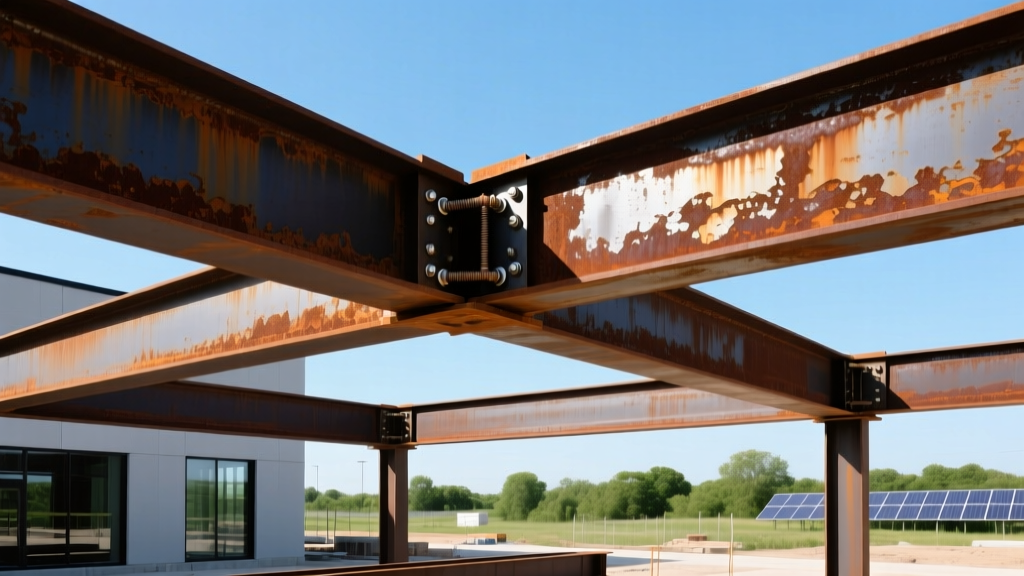
Often referred to by the trademarked name COR-TEN, ASTM A588 is a high-strength, low-alloy steel designed to form a dense, protective oxide layer (patina) when exposed to the atmosphere. This grade is alloyed with small amounts of copper, chromium, and nickel. From an environmental perspective, A588 eliminates the need for initial and recurring applications of VOC-heavy industrial paint systems. By removing the painting cycle, projects avoid the emissions associated with manufacturing, transporting, and applying chemical coatings every 15 to 20 years.
ASTM A500 (Hollow Structural Sections)
Cold-formed Hollow Structural Sections (HSS) are governed by ASTM A500. While highly efficient structurally—allowing for lighter overall building frames and reduced foundation concrete—the recycled content of A500 can fluctuate between 70% and 90% depending on whether the tube mill sources its hot-rolled coil from an EAF or BOF facility. To ensure A500 qualifies as an environmentally safe building material, procurement teams must explicitly require EAF-sourced coil in the contract documents.
LEED v4.1 Material & Resources Optimization
Under LEED v4.1, structural steel contributes heavily to the Environmental Product Declarations (EPD) and Sourcing of Raw Materials credits. To maximize points, specify that all structural steel must be accompanied by an industry-wide or product-specific EPD conforming to ISO 14025. The American Institute of Steel Construction (AISC) provides a standardized EPD for fabricated structural steel that covers the cradle-to-gate impacts of EAF-produced grades, streamlining the documentation process for sustainability consultants.
Comparative Matrix: Steel Types vs. Environmental Impact
The following matrix breaks down the environmental characteristics of the most common structural steel grades, providing a quick-reference framework for material selection.
| ASTM Grade | Primary Application | Avg. Recycled Content | VOC / Coating Impact | Best Eco-Application |
|---|---|---|---|---|
| A992 | W-Shapes, Beams | 93% (EAF) | Requires intumescent or epoxy coatings for fire/corrosion | Concealed structural frames, commercial high-rises |
| A588 | Exposed Beams, Bridges | 85% - 90% | Zero (Self-protecting patina) | Architecturally exposed structures, outdoor pavilions |
| A500 Gr. C | HSS Tubes, Columns | 70% - 90% | Requires paint or galvanizing | Space frames, trusses (specify EAF coil) |
| 304 Stainless | Facades, Fasteners | 60% - 75% | Zero (No coatings required) | Coastal environments, high-humidity interiors |
Coatings, Treatments, and Hidden Carbon
The environmental safety of a steel building extends beyond the mill. Surface treatments applied to prevent corrosion or provide fire resistance carry their own ecological burdens.
- Hot-Dip Galvanizing (Zinc): While zinc is a naturally occurring element and highly recyclable, the galvanizing process requires heating baths to 840°F (450°C), consuming significant natural gas. However, it provides a 50+ year maintenance-free lifespan, offsetting the initial embodied carbon.
- Intumescent Fireproofing: Traditional cementitious fireproofing is heavy and requires thick applications. Modern intumescent paints expand when exposed to heat, providing fire ratings with a fraction of the material volume. Specify water-based intumescent coatings to eliminate off-gassing of volatile organic compounds (VOCs) during application.
- Weathering Steel (Uncoated): As noted with A588, allowing the steel to oxidize naturally is the most environmentally benign corrosion strategy, provided the structural detail prevents water pooling, which can lead to accelerated, unchecked corrosion.
Troubleshooting Greenwashing in Steel Procurement
Material suppliers frequently use vague terminology that obscures the actual environmental impact of their products. Use this decision framework to verify claims:
Claim: '100% Recyclable'
The Reality: All steel is 100% recyclable at the end of its life. This claim provides zero information about the material's current footprint.
The Fix: Demand the Recycled Content Percentage documented on the Mill Test Report (MTR). Look specifically for the 'Scrap Charge' percentage.
Claim: 'Low-Carbon Steel'
The Reality: In metallurgy, 'low-carbon' (or mild steel) refers to the carbon content of the alloy (typically <0.25%), not the greenhouse gas emissions required to produce it.
The Fix: Request an Environmental Product Declaration (EPD) that explicitly lists the Global Warming Potential (GWP) in kg CO2e per ton of fabricated steel.
Claim: 'Sourced Locally'
The Reality: While local fabrication reduces transportation emissions, the raw steel coil or billet may have been smelted overseas using coal-heavy BOF methods.
The Fix: Trace the supply chain. Require the fabricator to disclose the origin of the raw steel mill, not just the location of the fabrication shop.
2026 Specification Framework for Architects and Engineers
To ensure your project utilizes genuinely environmentally safe building materials, integrate the following specifications into your structural drawings and contract documents:
- Mandate EAF Production: Include a note in the General Structural Notes requiring all ASTM A992 and A500 materials to be produced via the Electric Arc Furnace (EAF) route, guaranteeing a minimum of 90% post-consumer recycled content.
- Require ISO-Compliant EPDs: Specify that the steel fabricator must submit a cradle-to-gate EPD conforming to ISO 14025 and ISO 21930 for all structural steel packages prior to final payment.
- Optimize Section Sizes: Utilize Grade 50 steel (A992) rather than Grade 36 (A36). The higher yield strength allows for smaller, lighter cross-sections, reducing the total tonnage of steel required and lowering the overall embodied carbon of the structure.
- Design for Deconstruction (DfD): Specify bolted connections over field-welded connections where architecturally feasible. Bolted connections allow the steel frame to be disassembled and reused in future projects, rather than being cut apart and downcycled.
By moving beyond generic 'recycled steel' assumptions and specifying exact ASTM grades, furnace types, and coating systems, construction professionals can accurately quantify and minimize the environmental impact of their structural frameworks.
Written by
Elena RodriguezElena Rodriguez is a civil engineer and technical writer specializing in concrete technology, masonry systems, and ASTM/ACI compliance. She earned her B.S. in Civil Engineering from Texas A&M University and spent a decade at a materials testing laboratory, performing over 2,000 concrete compressive strength tests and masonry prism evaluations. Elena is an ACI-certified Field Testing Technician (Grade I) and a member of ASTM Committee C12 on Natural Building Stone. She currently consults on forensic engineering cases involving concrete failures and moisture intrusion. Based in San Antonio, TX, Elena is a proud member of the Society of Women Engineers (SWE) and coaches her daughter's FIRST Robotics team.
More from Elena Rodriguez
View all
Walls & Panels
Cost Analysis: Light Gauge Steel Framing Advantages and Disadvantages
Evaluate light gauge steel framing advantages and disadvantages through a strict cost analysis lens, comparing material, labor, and lifecycle expenses.
Aug 4, 2026

Walls & Panels
Gypsum Board Types: Exact Specifications, Thickness & Dimensions
Compare standard, Type X, and moisture-resistant gypsum board types. Get exact specifications, thicknesses, dimensions, and ASTM standards for your project.
Aug 4, 2026

Fire Resistance
Best Fire-Resistant Outdoor Decking Materials: 2026 Buyer Guide
Discover the best fire-resistant outdoor decking materials for 2026. Compare Class A PVC, aluminum, and hardwood options for WUI compliance and safety.
Aug 4, 2026