How Many Types of Wood Is There? A Builder's Cost & Value Guide
Discover how many types of wood there are in construction. We break down the cost, value, and ROI of softwoods, hardwoods, and engineered lumber.
The Taxonomy of Construction Wood: Answering the Numbers Game
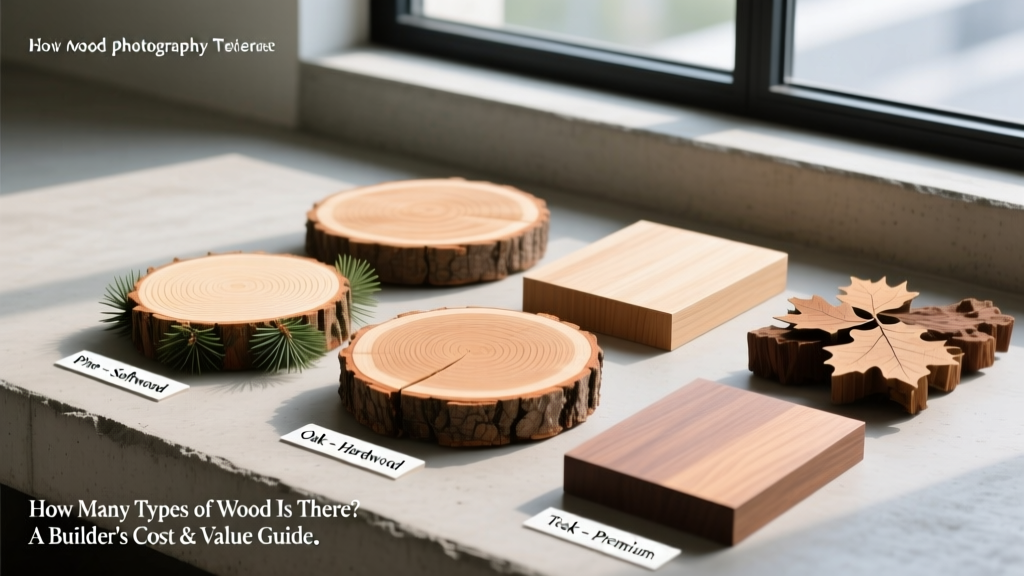
When contractors and architects ask, "how many types of wood is there?" the answer depends entirely on the lens being used. Botanically, there are over 60,000 identified tree species on Earth. However, from a commercial construction and cost-analysis perspective, the global timber trade relies on a highly consolidated list. According to The Wood Database, fewer than 40 primary species dominate the structural and finish building materials market.
These commercially viable woods are strictly categorized into three pillars: Softwoods (gymnosperms used for structural framing), Hardwoods (angiosperms used for finish carpentry and flooring), and Engineered Composites (manufactured structural elements). Understanding the exact cost per board foot (BF), linear foot (LF), or square foot (SF) across these categories is critical for maximizing project ROI and preventing budget overruns.
Quick Market Stats
- Total Tree Species: ~60,000+
- Commercially Harvested Species: ~150
- Dominant Construction Species: ~35 (e.g., SPF, Douglas Fir, Southern Yellow Pine, Red Oak)
- Engineered Categories: 4 primary (LVL, PSL, LSL, Glulam) plus CLT
Cost & Value Matrix: Commercial Wood Types Compared
The following matrix outlines the 2026 baseline pricing for the most heavily specified wood types in North American construction, alongside their primary value propositions.
| Wood Type / Grade | Category | Avg Cost (2026) | Primary Construction Use | Value / ROI Profile |
|---|---|---|---|---|
| SPF (Spruce-Pine-Fir) #2 | Softwood | $4.50 - $6.00 / BF | Interior wall framing, joists | High volume, lowest cost baseline |
| Southern Yellow Pine (SYP) #2 | Softwood | $5.50 - $7.50 / BF | Pressure-treated sill plates, decking | Superior preservative retention |
| Douglas Fir Select Structural | Softwood | $8.50 - $12.00 / BF | Heavy timber beams, exposed rafters | High strength-to-weight, aesthetic premium |
| Red Oak (Select & Better) | Hardwood | $6.50 - $9.50 / BF | Interior flooring, stair treads | 75-80% ROI at residential resale |
| Hard Maple (1st & 2nds) | Hardwood | $7.00 - $10.50 / BF | Cabinetry, high-traffic flooring | Extreme durability, modern aesthetic |
| Black Walnut (FAS Grade) | Hardwood | $16.00 - $24.00 / BF | Custom millwork, luxury accents | High upfront cost, luxury appraisal bump |
| LVL (Laminated Veneer Lumber) | Engineered | $3.50 - $5.50 / LF | Ridge beams, long-span headers | Eliminates twisting/shrinking callbacks |
| CLT (Cross-Laminated Timber) | Engineered | $14.00 - $19.00 / SF | Mid-rise commercial floors/walls | 20% faster erection vs. steel/concrete |
Softwoods: The Structural Workhorses
Softwoods account for roughly 80% of all lumber consumed in the United States. When evaluating softwoods, cost is heavily dictated by the grade stamp issued under the American Lumber Standard Committee (ALSC) guidelines.
SPF vs. SYP vs. Douglas Fir
Spruce-Pine-Fir (SPF): Sold as a mixed species group, SPF #2 is the default for standard 2x4 and 2x6 wall framing. It is cost-effective but has lower natural decay resistance and lower nail-holding capacity compared to SYP.
Southern Yellow Pine (SYP): SYP is significantly denser than SPF. This density makes it the undisputed champion for pressure-treated applications. According to the USDA Forest Products Laboratory Wood Handbook, SYP's cellular structure allows for deeper and more uniform penetration of preservatives like Alkaline Copper Quaternary (ACQ) and Copper Azole (CA-C). If you are framing a ground-contact deck or a below-grade sill plate, SYP provides vastly superior long-term value by preventing premature rot, despite a 15-20% upfront cost premium over SPF.
Douglas Fir: When structural loads require longer clear spans without intermediate support, or when the timber will be left exposed to the interior living space, Douglas Fir Select Structural or Free of Heart Center (FOHC) is specified. It resists checking and twisting far better than standard pine, protecting the investment in exposed architectural designs.
Hardwoods: Calculating Finish ROI
Hardwoods are priced using the National Hardwood Lumber Association (NHLA) grading system (FAS, Select, #1 Common). In construction, their value is measured not by structural load-bearing capacity, but by the Janka hardness scale and resale ROI.
"Specifying prefinished Hard Maple (1,450 lbf Janka) over site-finished Red Oak (1,290 lbf) adds roughly $1.50 to $2.00 per square foot in material costs, but eliminates $3.50 per square foot in on-site sanding and finishing labor, resulting in a net savings while upgrading the wear layer."
The Luxury Tier: Walnut and White Oak
White Oak (1,360 lbf) has seen a massive surge in specification for both flooring and exterior cladding (using thermally modified variants). Its closed-cell structure makes it naturally rot-resistant, allowing it to be used in exterior applications where traditional hardwoods would fail. Black Walnut remains the pinnacle of interior millwork. While FAS grade Walnut commands upwards of $18.00/BF, utilizing it strictly for high-visibility accents (e.g., kitchen island waterfalls, custom range hoods) rather than full-room applications maximizes the luxury appraisal value without destroying the finish budget.
Engineered Wood: The Modern Value Multiplier
Engineered wood products (EWPs) solve the inherent weaknesses of solid sawn lumber: dimensional instability, checking, and length limitations. APA - The Engineered Wood Association outlines four primary structural composite lumbers that every builder must price into modern framing budgets.
EWP Selection Guide
- LVL (Laminated Veneer Lumber): Best for long-span headers and ridge beams. Manufactured by peeling logs into thin veneers and laminating them with parallel grains. Cost Advantage: Predictable sizing eliminates the need to cull through solid timber yards for straight beams.
- PSL (Parallel Strand Lumber): Best for heavily loaded point columns and long beams. Made from long, thin wood strands. Cost Advantage: Highest bending strength of the composites, allowing for smaller cross-sections that save interior headroom.
- LSL (Laminated Strand Lumber): Best for rim boards and tall wall studs. Made from shorter, flaked strands. Cost Advantage: Highly stable, virtually eliminating rim-board shrinkage that causes drywall cracks and floor squeaks.
- Glulam (Glued-Laminated Timber): Best for curved beams, arches, and heavy exposed timber framing. Cost Advantage: Can be manufactured in massive, custom profiles that solid timber cannot physically yield.
Hidden Costs: Grading, Moisture, and Treatment
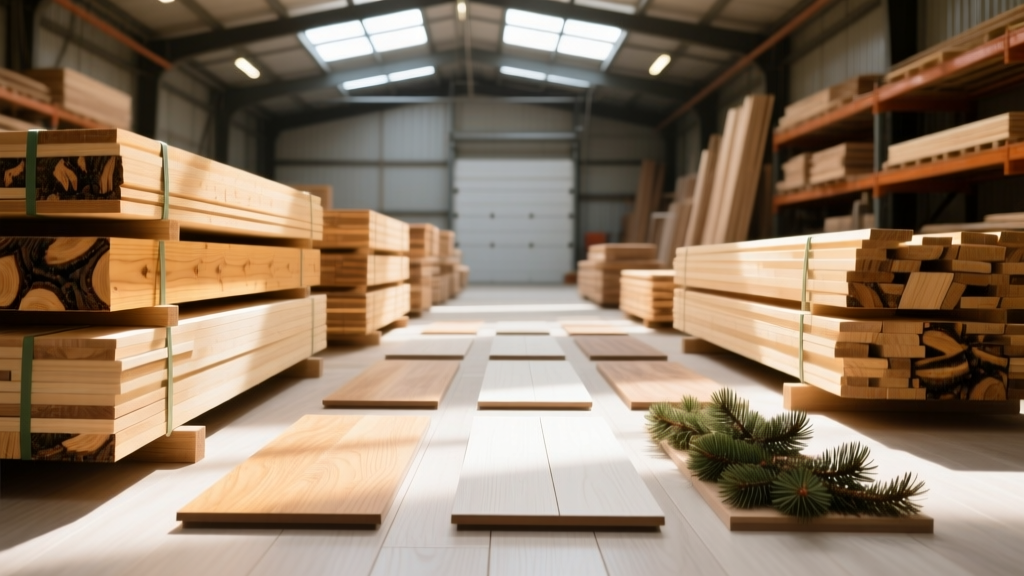
The base price per board foot is rarely the final cost. Builders frequently lose margin to three hidden lumber variables:
- Moisture Content (MC): Standard Kiln-Dried (KD) lumber is dried to a maximum of 19% MC. If you are framing a climate-controlled interior, specifying KD15 (dried to 15% MC) costs roughly 8% more upfront but prevents the wood from shrinking as it acclimates to the home's 35-45% interior relative humidity. This prevents costly drywall nail-pops and trim separation callbacks.
- Wane and Skip Limits: Lower-grade studs (#3 or Stud grade) have higher allowances for wane (bark edge) and skip (unplaned rough spots). While cheaper by $0.50 to $0.80 per linear foot, the labor cost for carpenters to sort, flip, and cull warped or heavily waned studs easily wipes out the material savings.
- Preservative Tagging: For exterior applications, Ensure the AWPA (American Wood Protection Association) tag specifies the correct retention level. Above-ground (UC3B) requires lower chemical retention and costs less than Ground Contact (UC4A) or Marine (UC5). Mis-specifying UC3B for a ground-contact deck joist will result in structural failure within 5 to 7 years.
Decision Framework: Maximizing ROI on Your Lumber Spend
Use this if/then framework to allocate your lumber budget effectively:
IF you are framing standard, non-load-bearing interior partition walls...
THEN specify SPF Stud grade. The structural demands are minimal, and the cost savings are significant.
IF you are building an exterior deck substructure or a ground-level sill plate...
THEN specify #2 SYP treated to UC4A (Ground Contact) standards. Do not substitute SPF or above-ground treatments.
IF you need a 20-foot clear-span header over a garage door...
THEN specify a 3-ply or 5-ply LVL. Attempting to build this up from solid 2x12 Douglas Fir will result in a heavier, more expensive, and highly prone-to-shrinking assembly.
IF you are installing hardwood flooring in a high-moisture area (kitchen/powder room)...
THEN specify Engineered Hardwood with a thick (4mm+) wear layer rather than solid hardwood. The cross-ply core prevents the cupping and crowning that solid planks experience under fluctuating moisture conditions.
Frequently Asked Questions
Is engineered wood cheaper than solid lumber?
On a pure per-linear-foot basis, engineered wood (like LVL) is often more expensive than solid sawn timber. However, when factoring in the labor savings of not having to crown, cull, and nail together multiple plies of solid lumber—as well as the elimination of future drywall callbacks caused by timber shrinkage—engineered wood provides a higher net value on complex structural spans.
How many types of pressure-treated wood are there?
While the base species is usually Southern Yellow Pine, the "types" of treated wood are defined by their chemical retention levels (UC1 through UC5) and the specific preservative used (ACQ, CA-C, MCQ, or Borate). For residential construction, you will primarily encounter UC3B (Above Ground), UC4A (Ground Contact), and UC4C (Ground Contact Heavy Duty).
Written by
Sarah WhitfieldSarah Whitfield is a chartered quantity surveyor (MRICS) and construction cost analyst with 15 years of experience in material pricing, procurement strategy, and project budgeting. She earned her degree in Construction Management from the University of Reading (UK) and has worked on projects ranging from $2M custom homes to $180M mixed-use developments across North America and Europe. Sarah currently leads cost estimating for BuildMat Insight, maintaining a proprietary database of 4,000+ material price points updated quarterly. She is a frequent contributor to RSMeans cost data panels and has presented at the International Cost Engineering Council (ICEC) congress. Based in Denver, CO, Sarah is an avid trail runner and volunteer mentor for Women in Construction.
More from Sarah Whitfield
View all
Wood & Lumber
What Are the Different Types of Wood? A Builder's Guide
Compare structural softwoods, finish hardwoods, and engineered lumber. Analyze Janka ratings, MOE values, and 2026 pricing for construction.
Aug 4, 2026

Walls & Panels
Steel Framing vs Wood Framing: Corrosion and Moisture Defense
Compare steel framing vs wood framing for moisture resistance. Learn about galvanized coatings, condensation risks, and corrosion protection strategies.
Jul 21, 2026

Stone & Masonry
How to Cut Stone Veneer: Wet Saw vs Grinder Comparison
Compare the best tools for cutting stone veneer. We review wet saws, angle grinders, and chop saws to help you achieve clean, chip-free cuts.
Jul 21, 2026