Types of Flooring Wood: 2026 Cost, Lifespan, and ROI Analysis
Compare the lifecycle costs, installation labor, and resale ROI of different types of flooring wood. Data-driven guide for 2026 home renovations.

The True Cost of Wood Flooring: Beyond the Showroom Tag
When evaluating the types of flooring wood available for residential and commercial construction, focusing solely on the per-square-foot material cost is a critical financial error. In 2026, with skilled flooring labor rates averaging $65 to $95 per hour and moisture-mitigation materials seeing a 14% price increase over the last three years, the Total Cost of Ownership (TCO) must account for subfloor preparation, installation methodology, acclimatization time, and long-term maintenance. Wood flooring remains one of the few building materials that can yield a 100%+ return on investment at resale, but only if the correct species and structural format are matched to the building's specific environmental conditions.
Total Cost of Ownership (TCO) Matrix: Solid vs. Engineered vs. Reclaimed
The structural format of the wood dictates its installation limitations, lifespan, and refinishing potential. Below is a 30-year TCO analysis based on 1,000 square feet of living space, assuming standard residential wear and a single mid-lifecycle refinish for applicable materials.
| Material Type | Material Cost (per sq.ft.) | Labor & Prep (per sq.ft.) | Lifespan | Max Refinishes | Est. 30-Year TCO |
|---|---|---|---|---|---|
| Solid Hardwood (3/4") | $6.00 - $14.00 | $5.50 - $8.00 | 75-100+ Years | 5 to 7 | $18,500 - $28,000 |
| Engineered Hardwood (5/8" w/ 4mm wear layer) | $8.00 - $16.00 | $4.50 - $9.50 | 50-75 Years | 2 to 3 | $19,000 - $32,000 |
| Reclaimed Solid Wood (Antique Oak/Pine) | $12.00 - $25.00 | $9.00 - $14.00 | 100+ Years | 3 to 5 | $28,000 - $45,000 |
Species-Specific Value and Performance Breakdown
Not all hardwoods perform equally under load, moisture fluctuation, or UV exposure. The Janka hardness scale measures the force required to embed a 0.444-inch steel ball into the wood, serving as the primary metric for dent resistance. However, higher Janka ratings often correlate with higher milling waste and increased labor costs during installation.
White Oak (Quercus alba): The 2026 Market Standard
- Janka Rating: 1,360 lbf
- Material Cost: $6.50 - $11.00 / sq.ft.
- Value Proposition: White oak features a closed-cell grain structure (due to tyloses in the pores), making it highly resistant to water penetration compared to red oak. Its neutral, low-variance grain pattern aligns with current architectural trends, ensuring broad buyer appeal and maximum resale ROI.
Hickory (Carya): High Durability, High Labor
- Janka Rating: 1,820 lbf
- Material Cost: $7.50 - $13.00 / sq.ft.
- Value Proposition: Exceptional impact resistance makes it ideal for high-traffic zones or homes with large pets. However, hickory's extreme density and interlocking grain cause high blade wear during milling and installation. Expect a 10-15% higher waste factor during cutting and increased labor time for pneumatic nailing, as the wood can split if not properly pre-drilled or if incorrect cleat pressures are used.
Hard Maple (Acer saccharum): The Light-Tone Specialist
- Janka Rating: 1,450 lbf
- Material Cost: $5.50 - $9.50 / sq.ft.
- Value Proposition: While harder than white oak, maple has a very tight, closed pore structure that makes it notoriously difficult to stain evenly without professional-grade water-popping techniques. If you desire a natural, light-toned floor with a subtle grain, maple offers excellent value. If you plan to use dark pigmented stains, the risk of blotching increases project risk and potential rework costs.
The Engineered Wood Wear Layer: Where Value is Won or Lost
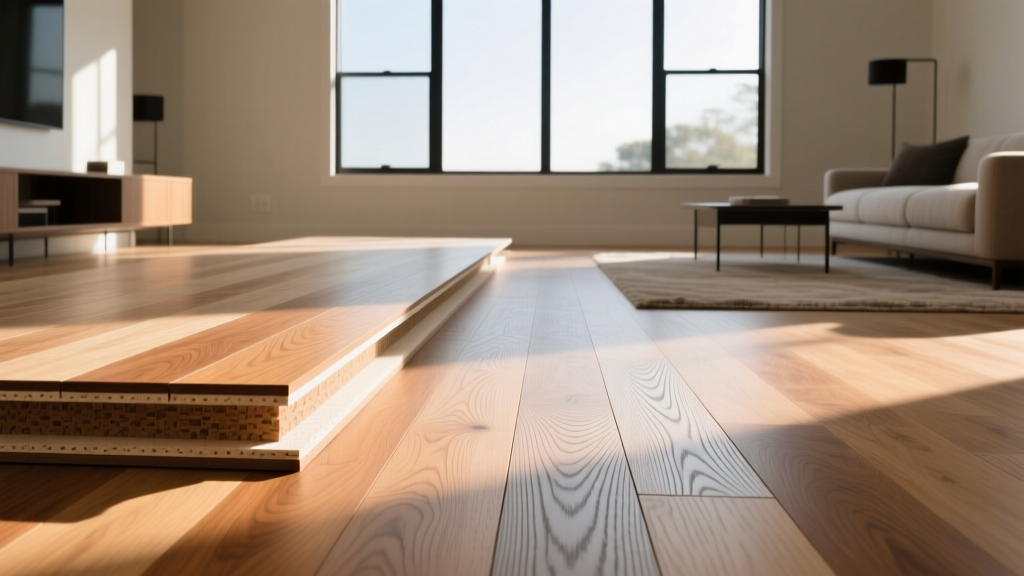
Engineered wood is frequently dismissed by purists, but it is the only viable type of flooring wood for below-grade installations (basements) or over concrete slabs due to its cross-ply dimensional stability. The financial value of engineered wood is entirely dependent on the thickness of the top veneer (wear layer).
Many big-box retailers stock engineered wood with a 1.5mm to 2mm wear layer priced attractively at $4.00/sq.ft. This material cannot be sanded and refinished. Once the urethane finish wears through (typically in 7-10 years in high-traffic zones), the entire floor must be replaced. Always specify a minimum 4mm wear layer (preferably 6mm) for engineered products, which allows for 2 to 3 full sandings, effectively matching the lifecycle of solid hardwood and justifying the premium upfront cost.
Installation Economics and Failure Modes
The chosen installation method drastically alters the labor budget and long-term performance. According to the National Wood Flooring Association (NWFA), improper installation accounts for over 75% of all wood flooring failures.
Nail-Down / Staple-Down
Used exclusively for solid 3/4" wood over plywood subfloors. It is the most cost-effective labor method ($4.50 - $6.00/sq.ft.). Failure Mode: If the plywood subfloor has a moisture content variance of more than 2-4% compared to the hardwood, the floor will experience severe cupping or gapping within the first seasonal HVAC cycle.
Glue-Down
Required for engineered wood over concrete slabs. Modern silane-modified polymer (SMP) adhesives (such as Bostik GreenForce or Sika Bond) provide moisture vapor barriers and acoustic dampening. Cost Impact: Premium adhesives add $1.50 to $2.50 per square foot to the material budget, and trowel-down labor is 20% slower than pneumatic nailing.
Resale ROI: What the Housing Market Rewards
Wood flooring consistently ranks at the top of home improvement ROI metrics. Data from the National Association of Realtors (NAR) Remodeling Impact Report indicates that installing new hardwood flooring recovers an average of 118% of its project cost at the time of sale. Furthermore, 20% of real estate agents report that wood floors directly helped close a home sale faster.
However, the ROI is heavily dependent on species and finish selection. Highly stylized, wide-plank (7" to 10") white oak with a matte, water-based polyurethane finish yields the highest buyer premium in 2026. Conversely, high-gloss finishes, extreme rustic distressing, or exotic species with volatile color shifts (like Brazilian Cherry, which darkens significantly under UV light) can alienate conservative buyers and appraisers, effectively capping the resale premium.
Strategic Decision Framework
Use this matrix to select the optimal type of flooring wood based on your specific structural and financial parameters:
- If installing over a concrete slab or radiant heat system: You must use Engineered Hardwood (minimum 5/8" thick, 4mm wear layer) with a full-spread SMP adhesive or a floating click-lock system. Solid wood will inevitably warp due to moisture transmission and thermal expansion.
- If maximizing resale value on a standard wood subfloor: Choose 3/4" Solid White Oak, 4" to 5" wide planks, finished on-site with a commercial-grade water-based 2-part polyurethane (e.g., Bona Traffic HD). This offers the highest recognized value by appraisers.
- If building in a high-humidity coastal or tropical climate: Prioritize quarter-sawn wood species or highly stable exotics like Teak or Ipe. Quarter-sawing alters the grain orientation, reducing tangential shrinkage and swelling by up to 50% compared to plain-sawn boards, mitigating seasonal gapping.
- If operating on a strict budget but demanding authenticity: Avoid laminate or LVP. Instead, source 3/4" solid red oak (often 15-20% cheaper than white oak) and apply a light, neutralizing stain to mimic the white oak aesthetic, pairing it with a high-quality matte topcoat to hide micro-scratches.
For comprehensive technical guidelines on grading, moisture tolerances, and fastener schedules, always consult the industry cost databases and manufacturer specifications prior to finalizing your material procurement. Proper specification at the design phase is the single most effective way to control lifecycle costs in wood flooring.
Written by
Sarah WhitfieldSarah Whitfield is a chartered quantity surveyor (MRICS) and construction cost analyst with 15 years of experience in material pricing, procurement strategy, and project budgeting. She earned her degree in Construction Management from the University of Reading (UK) and has worked on projects ranging from $2M custom homes to $180M mixed-use developments across North America and Europe. Sarah currently leads cost estimating for BuildMat Insight, maintaining a proprietary database of 4,000+ material price points updated quarterly. She is a frequent contributor to RSMeans cost data panels and has presented at the International Cost Engineering Council (ICEC) congress. Based in Denver, CO, Sarah is an avid trail runner and volunteer mentor for Women in Construction.
More from Sarah Whitfield
View all
Wood & Lumber
What Are the Different Types of Wood? A Builder's Guide
Compare structural softwoods, finish hardwoods, and engineered lumber. Analyze Janka ratings, MOE values, and 2026 pricing for construction.
Aug 4, 2026

Walls & Panels
Steel Framing vs Wood Framing: Corrosion and Moisture Defense
Compare steel framing vs wood framing for moisture resistance. Learn about galvanized coatings, condensation risks, and corrosion protection strategies.
Jul 21, 2026

Stone & Masonry
How to Cut Stone Veneer: Wet Saw vs Grinder Comparison
Compare the best tools for cutting stone veneer. We review wet saws, angle grinders, and chop saws to help you achieve clean, chip-free cuts.
Jul 21, 2026