Different Types of Wood Joints: A Structural Strength Comparison
Compare different types of wood joints for structural framing. Analyze shear strength, load-bearing capacity, and modern building code requirements.

The Mechanics of Wood Joinery in Structural Framing
Selecting the correct joinery method dictates the structural longevity, load distribution, and seismic resilience of a timber frame. While modern construction often relies on galvanized steel joist hangers and structural screws, traditional and hybrid wood joints remain critical in heavy timber construction, architectural millwork, and specialized load-bearing assemblies. Understanding the mechanical interlock and glue-line shear capacity of different types of wood joints is essential for structural engineers and advanced framers.
According to the USDA Forest Products Laboratory Wood Handbook, the strength of a wood joint is rarely limited by the wood fibers themselves, but rather by the geometry of the cut, the end-grain exposure, and the adhesive or mechanical fastener used. This comparison reviews five primary structural joints, evaluating their tensile and shear capacities against modern building requirements.
• Heavy Vertical Loads: Mortise and Tenon (with drawbore pinning)
• High Tensile/Uplift Forces: Dovetail or Sliding Dovetail
• Rapid Framing/Splicing: Half-Lap Joint (with structural epoxy)
• End-Grain to Long-Grain: Bridle Joint or modern steel tie plates
Detailed Breakdown: Core Structural Wood Joints
1. Mortise and Tenon (The Heavyweight)
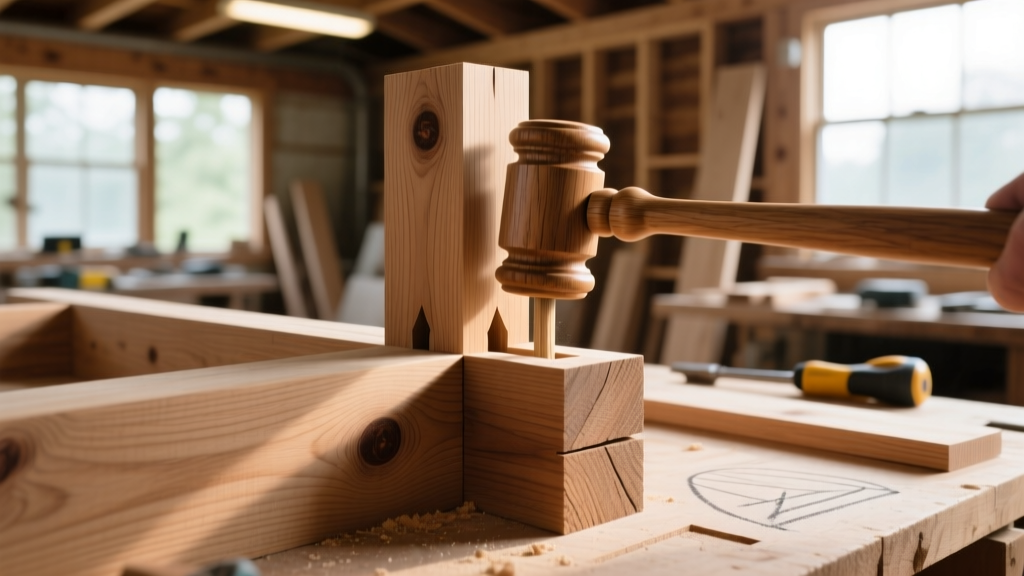
The mortise and tenon joint is the foundational connection in timber framing, designed primarily to resist compressive and shear forces. The tenon (the projecting piece) fits into the mortise (the cavity). For structural timber, the one-third rule applies: the tenon should be exactly one-third the thickness of the stock to prevent splitting the mortise walls while maintaining tenon shear strength.
Pro-Tip for Maximum Strength: Utilize drawbore pinning. By offsetting the peg hole in the tenon by 1/16 inch toward the shoulder compared to the mortise hole, driving a hardwood peg pulls the joint impossibly tight, eliminating the need for structural adhesives in exterior timber frames where moisture fluctuations would cause Type I PVA glues to fail.
2. Dovetail (The Tensile Champion)
While commonly associated with fine drawer construction, the structural dovetail (often a sliding or housed dovetail) is vital in timber trusses and purlin-to-plate connections where wind uplift creates severe tensile stress. The mechanical flaring of the joint makes it physically impossible to pull apart along the axis of the wood grain without destroying the fibers.
When cutting structural dovetails in softwoods (like Douglas Fir or Southern Yellow Pine), use a 1:6 angle ratio. For dense hardwoods (like White Oak), a 1:8 ratio prevents the short-grain corners from shearing off under load.
3. Half-Lap Joint (The Quick Framer)
The half-lap removes half the thickness of each intersecting board, creating a flush surface with a massive long-grain-to-long-grain gluing area. While it lacks the mechanical interlock of a dovetail, its sheer adhesive surface area makes it incredibly strong when paired with modern resorcinol formaldehyde or Type I polyurethane adhesives.
Code Limitation: The American Wood Council’s National Design Specification (NDS) generally requires mechanical fastening (such as structural screws or through-bolts) for lap joints in primary load-bearing roof and floor diaphragms, as adhesive-only joints are not rated for dynamic seismic or high-wind uplift loads in standard residential framing.
4. Bridle Joint (End-Grain Maximizer)
Essentially an open mortise and tenon, the bridle joint is used at the corners of timber frames and the apex of pitched roof trusses. It maximizes the gluing surface by wrapping the joint around the end grain. However, because wood shrinks and swells primarily across the grain (radially and tangentially), bridle joints are highly susceptible to checking and splitting if the timber is not kiln-dried to an exact 12-15% moisture content before assembly.
5. Biscuit and Dowel Joints (Modern Alignment)
While rarely used for primary structural framing, compressed beech biscuits and fluted hardwood dowels are standard in architectural millwork, structural insulated panels (SIPs), and mass timber (CLT) edge-joining. They provide immense shear resistance against racking but offer negligible tensile strength. In mass timber construction, 3/4-inch hardwood dowels are often used in conjunction with self-tapping structural screws to align heavy panels before final mechanical fastening.
Load-Bearing Comparison Matrix
| Joint Type | Primary Strength Axis | Best Structural Application | Fabrication Method |
|---|---|---|---|
| Mortise & Tenon | Compression / Shear | Post-to-beam, heavy timber frames | CNC Router / Hollow Chisel Mortiser |
| Dovetail | Tension / Uplift | Truss webs, purlin locks | 5-axis CNC / Hand saw & chisel |
| Half-Lap | Shear (Adhesive dependent) | Splicing beams, diagonal bracing | Table saw / Router |
| Bridle | Compression / Bending | Truss apexes, corner framing | Band saw / Tenoner |
| Dowel/Biscuit | Shear (Racking) | CLT panel alignment, millwork | Plate joiner / CNC boring head |
Fastener vs. Traditional Joinery: The Building Code Perspective
A common misconception in modern timber framing is that traditional joinery exempts a builder from using metal fasteners. Under the International Building Code (IBC) and International Residential Code (IRC), structural connections must resist specific uplift and lateral loads. Even a perfectly fitted, pegged mortise and tenon joint often requires supplemental steel tie plates or structural screws (such as the Simpson Strong-Tie SDWS series) to meet modern seismic and hurricane engineering requirements.
Engineering Reality Check: Wood is an anisotropic material. A joint that holds 5,000 lbs in compression may fail at 500 lbs in tension perpendicular to the grain. Always specify mechanical fasteners for any joint subject to wind uplift or seismic racking, regardless of the traditional joinery used.
Common Failure Modes and Troubleshooting
- Glue Starvation in End-Grain Joints: End-grain acts like a bundle of straws, wicking adhesive away from the glue line. Fix: Always apply a 'sizing coat' of glue (thinned with 10% water), let it tack up for 10 minutes, and then apply the full glue coat before clamping.
- Creep and Deflection: Under constant heavy loads, wood fibers slowly compress over years (creep). Fix: Design mortise and tenon shoulders to bear directly on the supporting post, transferring the load to the vertical grain rather than relying on the tenon's shear strength.
- Moisture-Induced Checking: If a green timber tenon is inserted into a dry mortise, the tenon will shrink and loosen. Fix: Ensure both mating pieces are equilibrated to the same moisture content (within 2%), or use slotted peg holes to allow for seasonal movement.
Final Verdict: Selecting the Right Joint
There is no universally 'strongest' wood joint; strength is entirely dependent on the directional forces applied to the assembly. For vertical load-bearing columns and beams, the mortise and tenon remains unmatched in compressive bearing when properly pegged. For resisting tensile forces and uplift in truss systems, the dovetail provides superior mechanical locking. However, for modern code-compliant residential and commercial framing, traditional joints should be viewed as precise alignment and load-distribution mechanisms, always supplemented by engineered steel connectors and structural screws to meet ASTM and local building code standards for dynamic loading.
Written by
Elena RodriguezElena Rodriguez is a civil engineer and technical writer specializing in concrete technology, masonry systems, and ASTM/ACI compliance. She earned her B.S. in Civil Engineering from Texas A&M University and spent a decade at a materials testing laboratory, performing over 2,000 concrete compressive strength tests and masonry prism evaluations. Elena is an ACI-certified Field Testing Technician (Grade I) and a member of ASTM Committee C12 on Natural Building Stone. She currently consults on forensic engineering cases involving concrete failures and moisture intrusion. Based in San Antonio, TX, Elena is a proud member of the Society of Women Engineers (SWE) and coaches her daughter's FIRST Robotics team.
More from Elena Rodriguez
View all
Walls & Panels
Cost Analysis: Light Gauge Steel Framing Advantages and Disadvantages
Evaluate light gauge steel framing advantages and disadvantages through a strict cost analysis lens, comparing material, labor, and lifecycle expenses.
Aug 4, 2026

Walls & Panels
Gypsum Board Types: Exact Specifications, Thickness & Dimensions
Compare standard, Type X, and moisture-resistant gypsum board types. Get exact specifications, thicknesses, dimensions, and ASTM standards for your project.
Aug 4, 2026

Fire Resistance
Best Fire-Resistant Outdoor Decking Materials: 2026 Buyer Guide
Discover the best fire-resistant outdoor decking materials for 2026. Compare Class A PVC, aluminum, and hardwood options for WUI compliance and safety.
Aug 4, 2026