Top Wood Types of Fences: 2026 Cost & Lifespan Analysis
Compare the top wood types of fences for 2026. Analyze material costs per linear foot, lifespan, rot resistance, and long-term ROI for your property.

The 2026 Fence Wood Cost & Value Matrix
Calculating the true return on investment for a perimeter fence requires looking beyond the initial lumber receipt. Material costs fluctuate based on regional supply chains, treatment processes, and grading standards. When evaluating the best wood types of fences, the most accurate metric is the annualized cost of ownership, which factors in material pricing, installation complexity, maintenance cycles, and ultimate lifespan.
The following matrix breaks down the 2026 market averages for the four primary fencing lumbers, providing a baseline for your budget and long-term value analysis.
| Wood Species | Material Cost (Per LF) | Installed Cost (Per LF) | Expected Lifespan | Maintenance Cycle | Value Rating |
|---|---|---|---|---|---|
| Pressure-Treated Pine | $3.50 - $6.00 | $18.00 - $28.00 | 15 - 20 Years | Every 1-2 Years | High (Short-Term) |
| Western Red Cedar | $9.00 - $15.00 | $30.00 - $48.00 | 20 - 30 Years | Every 3-5 Years | Excellent |
| Redwood | $14.00 - $22.00 | $40.00 - $65.00 | 25 - 35 Years | Every 3-5 Years | Good (Regional) |
| Tropical Hardwood (Ipe) | $22.00 - $38.00 | $60.00 - $95.00 | 40 - 60+ Years | Optional (UV only) | Superior (Legacy) |
Species Breakdown: Material Grades and Hidden Costs
Selecting a species is only the first step. The specific grade and treatment level you purchase dictate the structural integrity and aesthetic longevity of the fence. Buying the wrong grade can lead to severe warping, checking, and premature rot.
Pressure-Treated Southern Yellow Pine (SYP)
SYP remains the most economical choice for residential perimeter fencing, but its value hinges entirely on the chemical retention levels and the grade of the board. According to the American Wood Protection Association (AWPA), wood in direct contact with the ground requires a higher chemical retention level than above-ground framing.
- Posts (Ground Contact): Must be stamped for UC4A or UC4B (Ground Contact) with a minimum retention level of 0.40 pcf (pounds per cubic foot) for ACQ or Copper Azole treatments. Using above-ground (0.25 pcf) lumber for posts will result in subterranean rot within 5 to 7 years.
- Pickets and Rails (Above Ground): UC3B (Above Ground) rated lumber at 0.25 pcf is sufficient and costs roughly 15% less than ground-contact stock.
- Grade Selection: Avoid 'Standard and Better' (#2) grades for pickets if you want to minimize cupping. Opt for 'Select Structural' or 'Premium' grades, which have tighter growth rings and fewer knots, reducing the tension that causes SYP to twist as it dries in the sun.
Western Red Cedar
Cedar is the benchmark for natural rot resistance and dimensional stability. Its natural extractives (thujaplicins) act as built-in fungicides. When sourcing cedar, the Western Red Cedar Lumber Association (WRCLA) grading system is your primary guide for balancing cost and aesthetics.
- Select Tight Knot (STK): The optimal value tier for fencing. STK allows for small, tight, sound knots that will not fall out. It provides the classic rustic cedar look at a fraction of the cost of clear grades.
- Architect Clear / Clear Heart: Free of visible knots. While visually striking for modern horizontal slat fences, clear cedar can cost 60% to 100% more than STK and offers no additional structural or rot-resistant benefits.
- Sapwood vs. Heartwood: Ensure your cedar order specifies 'Heartwood' or a high heartwood percentage. The outer sapwood of a cedar log lacks the natural decay-resistant extractives and is highly susceptible to insect damage and rot.
Redwood
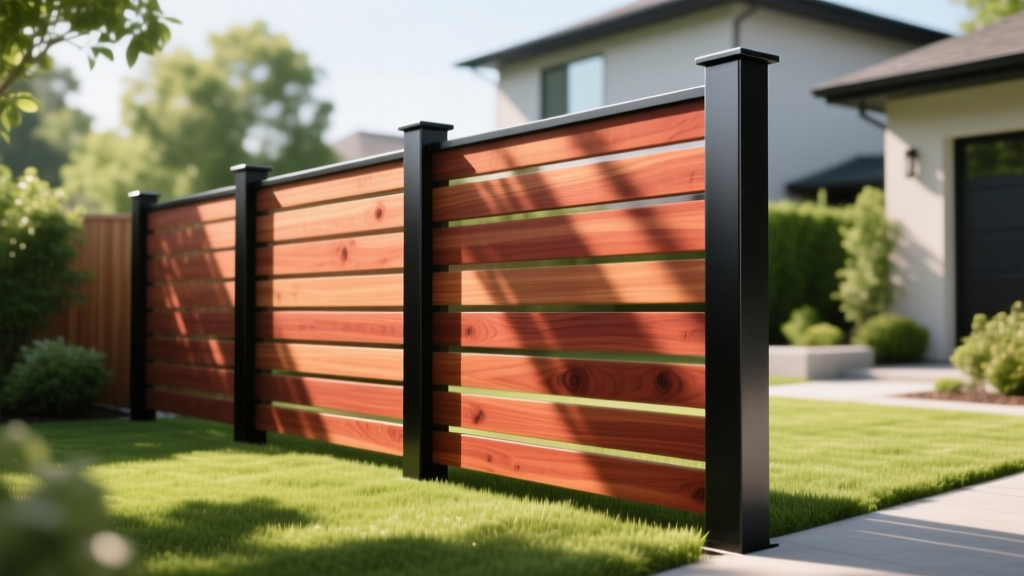
Redwood offers superior dimensional stability and a rich, deep color that weathers to a distinguished silver-gray if left untreated. However, its value proposition is heavily dependent on your geographic location; shipping costs from California mills make redwood prohibitively expensive in the Midwest and Eastern Seaboard.
For fencing, specify Construction Heart grade. This grade allows for knots but guarantees the wood is from the decay-resistant heartwood. Avoid 'Construction Common', which includes sapwood and will compromise the fence's lifespan in damp climates. Redwood also boasts a Class B fire rating, making it a high-value choice for properties in wildfire-prone zones (WUI areas).
Tropical Hardwoods (Ipe and Cumaru)
Tropical hardwoods represent the ultimate legacy investment. Ipe (Brazilian Walnut) registers an astonishing 3,680 on the Janka hardness scale—making it virtually impervious to scratches, dents, and wood-boring insects. The USDA Forest Products Laboratory classifies untreated Ipe as having the highest possible durability rating, routinely lasting 50+ years in ground contact without chemical preservatives.
The hidden costs of tropical hardwoods lie in the installation labor. The extreme density requires pre-drilling every single hole and the use of specialized carbide-tipped saw blades, which dull rapidly. Furthermore, Ipe cannot be face-nailed; it requires hidden stainless steel clip systems or screw-and-plug methods, increasing installation time by up to 40%.
Critical Failure Modes and Mitigation Strategies
Even the most expensive lumber will fail prematurely if installed without accounting for environmental stressors. Address these common failure modes during the design phase to protect your investment.
- End-Grain Wicking and Checking: Wood absorbs moisture up to 15 times faster through the end grain than the face grain. When cutting pressure-treated or cedar posts, immediately seal the cut ends with a copper naphthenate brush-on treatment or a specialized wax emulsion like Anchorseal. Failure to do so results in deep vertical checking (splitting) that compromises post-mount hardware.
- Frost Heave on Post Footings: In climates with deep freeze-thaw cycles, setting wooden posts directly in concrete bellies at the frost line will cause the concrete to act as a piston, heaving the post upward. The high-value installation method involves setting a sonotube below the frost line, backfilling the bottom 6 inches with gravel for drainage, and using a galvanized post base anchored to the concrete, keeping the wood entirely above grade.
- Picket Cupping and Bark-Edge Inclusion: When installing flat-sawn pickets, always install them with the bark-side (the side with the wider, more pronounced growth rings) facing outward. This forces the edges to cup slightly toward the fence framing, allowing water to shed off the face rather than pooling in the cupped center.
Climate-Specific Purchasing Framework
To maximize your ROI, align your lumber selection with your local microclimate rather than defaulting to national trends.
Sourcing and Inspecting Your Lumber Load
Do not accept a lumber delivery blind. Fencing projects require high volumes of linear material, and a single bad bundle can ruin the visual continuity of a 200-foot run. When the flatbed arrives, inspect for the following:
- Moisture Content (MC): Bring a pin-type moisture meter. Pressure-treated pine straight from the yard often has an MC of 30% to 45%. If you install it immediately with tight butt joints, the boards will shrink by up to 1/4 inch as they acclimate, leaving massive gaps. For cedar and redwood, target an MC of 12% to 15%.
- The Crown Test: Sight down the edge of every 4x4 post and 2x4 rail. Reject any board with a 'crown' (bow) that exceeds 1/2 inch over an 8-foot span. While slight bowing can be forced straight during rail installation, severely crowned posts will warp the entire fence line as they dry and release internal tension.
- Bundle Storage: If you are not installing the lumber immediately, it must be stored flat, supported by uniform stickers (spacers) every 24 inches, and covered with a breathable tarp. Storing lumber directly on the ground or wrapping it tightly in non-breathable plastic will induce rapid fungal growth and warping.
Written by
Sarah WhitfieldSarah Whitfield is a chartered quantity surveyor (MRICS) and construction cost analyst with 15 years of experience in material pricing, procurement strategy, and project budgeting. She earned her degree in Construction Management from the University of Reading (UK) and has worked on projects ranging from $2M custom homes to $180M mixed-use developments across North America and Europe. Sarah currently leads cost estimating for BuildMat Insight, maintaining a proprietary database of 4,000+ material price points updated quarterly. She is a frequent contributor to RSMeans cost data panels and has presented at the International Cost Engineering Council (ICEC) congress. Based in Denver, CO, Sarah is an avid trail runner and volunteer mentor for Women in Construction.
More from Sarah Whitfield
View all
Wood & Lumber
What Are the Different Types of Wood? A Builder's Guide
Compare structural softwoods, finish hardwoods, and engineered lumber. Analyze Janka ratings, MOE values, and 2026 pricing for construction.
Aug 4, 2026

Walls & Panels
Steel Framing vs Wood Framing: Corrosion and Moisture Defense
Compare steel framing vs wood framing for moisture resistance. Learn about galvanized coatings, condensation risks, and corrosion protection strategies.
Jul 21, 2026

Stone & Masonry
How to Cut Stone Veneer: Wet Saw vs Grinder Comparison
Compare the best tools for cutting stone veneer. We review wet saws, angle grinders, and chop saws to help you achieve clean, chip-free cuts.
Jul 21, 2026